
Which one of the following statements about glass is not correct?
- (a)Glass is often said to be a super-cooled liquid.
- (b)Glass has no definite melting point.
- (c)Soda glass is harder than pyrex glass.
- (d)Boron is present in pyrex glass.
Answer
Why
Correct — C. This statement is not correct: borosilicate (Pyrex) glass is actually harder and far more heat- and chemical-resistant than ordinary soda(-lime) glass — the reverse of what the option claims. The other three statements are true: glass is an amorphous solid often described as a super-cooled liquid, it softens over a range and so has no sharp melting point, and Pyrex is a borosilicate glass containing boron.
Why the others are wrong
- (a)Glass is often said to be a super-cooled liquid. — This is true — being amorphous, glass is commonly described as a super-cooled liquid, so it is not the incorrect statement sought.
- (b)Glass has no definite melting point. — True — an amorphous solid softens gradually over a temperature range instead of melting at one sharp point.
- (d)Boron is present in pyrex glass. — True — Pyrex is borosilicate glass, so boron (as B₂O₃) is present in it.
Concept
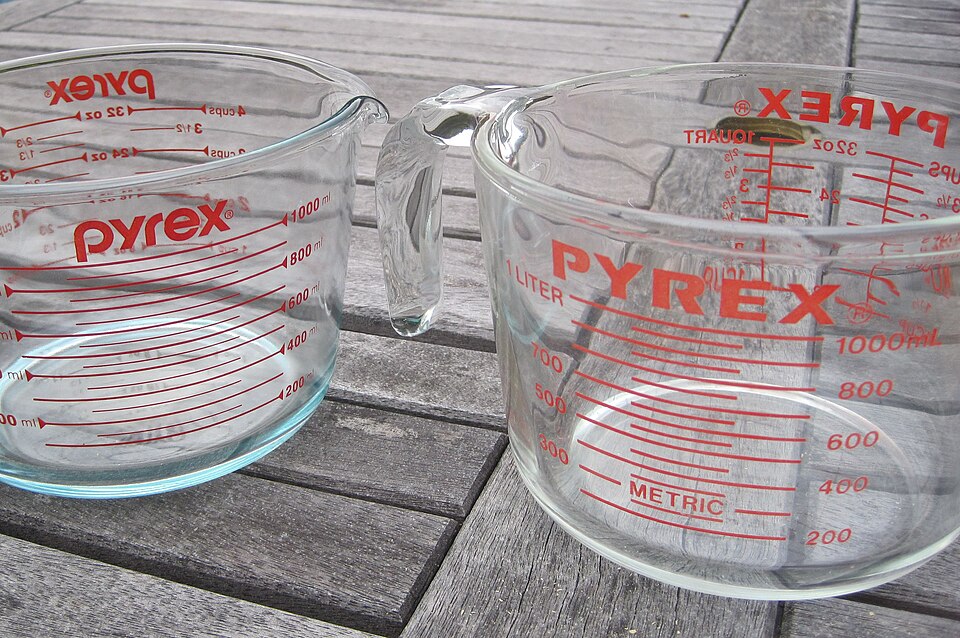
Glass is an amorphous solid with no long-range crystalline order, so it softens over a range rather than melting sharply. Its composition sets its properties: ordinary glass is soda-lime, while Pyrex is borosilicate, whose boron content makes it harder and much more resistant to heat and thermal shock.
The false option inverts a real fact — borosilicate glass outperforms soda-lime glass on hardness and heat resistance, not the other way round. The other three are standard descriptions of glass as an amorphous, boron-containing (for Pyrex) material.
Key facts
- Glass is amorphous, so it has no definite melting point and softens over a range.
- Soda-lime glass is the ordinary, inexpensive glass used for windows and bottles.
- Borosilicate (Pyrex) glass contains boron (B₂O₃) and resists heat and thermal shock.
- Borosilicate glass is harder and more durable than soda-lime glass.
Study next
Common traps
- Assuming ordinary soda glass is the toughest — borosilicate (Pyrex) is harder and more heat-resistant.
- Thinking an amorphous solid melts at one fixed temperature.
Asked as 'which statement about glass is not correct' — the false option usually mis-ranks soda-lime against borosilicate glass.
Related PYQs
Consider the following statements: I. Glass can be etched or scratched by diamond. II. Glass can be etched or scratched by hydrofluoric acid. III. Glass can be etched or scratched by aqua regia. IV. Glass can be etched or scratched by concentrated sulphuric acid. Which of these statements are correct?
- (a) I and IV
- (b) II and III
- (c) I and II
- (d) II and IV
Answer(c) I and II
Same subject — the properties of glass. UPSC tests what can scratch or etch glass (diamond mechanically, hydrofluoric acid chemically); this NDA item tests glass being amorphous and how borosilicate compares with soda-lime glass.
Practice
- practice — not a real PYQ
Which additive makes Pyrex glass resistant to heat and thermal shock?
- (a)Lead oxide
- (b)Boron (as B₂O₃)
- (c)Sodium carbonate
- (d)Iron oxide
Answer(b) Boron (as B₂O₃) — borosilicate glass owes its heat resistance to boron. - practice — not a real PYQ
Glass is best described as
- (a)a crystalline solid
- (b)an amorphous solid
- (c)a true liquid
- (d)a gas
Answer(b) an amorphous solid — it lacks long-range order and has no fixed melting point.