
Stalactite, stalagmite and pillars are the depositional landforms of
- (a)running water.
- (b)wind.
- (c)glacier.
- (d)underground water.
Answer
Why
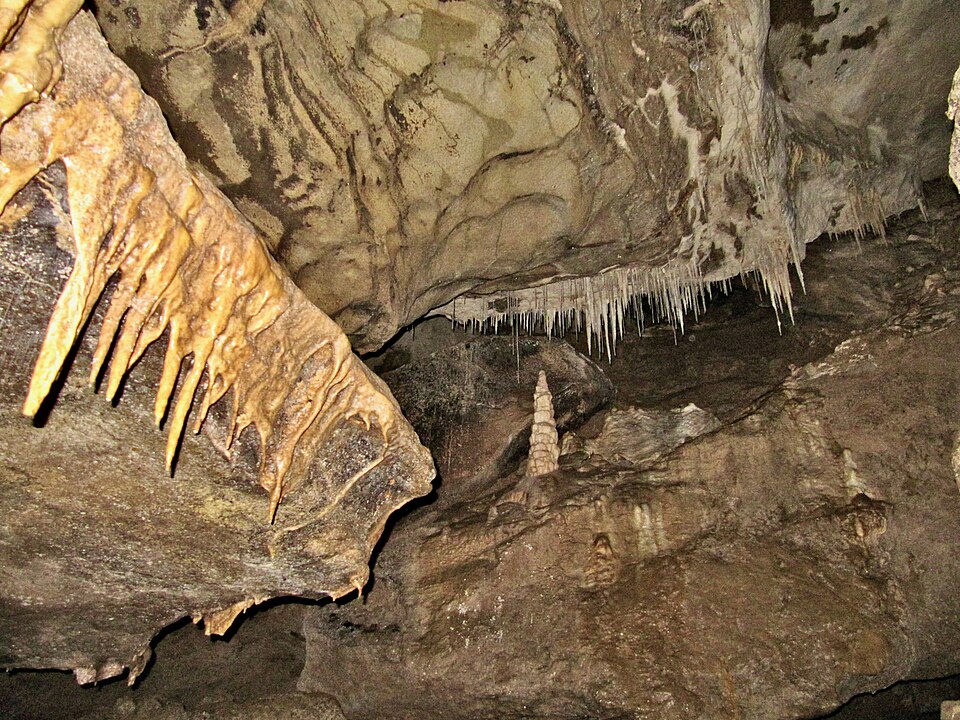
Correct — D, underground water. Stalactites, stalagmites and pillars are karst cave deposits. Groundwater charged with carbon dioxide dissolves limestone as it seeps down; when the drip reaches an air-filled cavern it loses CO2 and precipitates calcium carbonate. Deposition from the cave roof grows a stalactite hanging down, drip onto the floor builds a stalagmite rising up, and when the two meet they fuse into a pillar (column). All three are therefore depositional work of underground (ground) water.
Why the others are wrong
- (a)running water. — Rivers deposit floodplains, natural levees, alluvial fans and deltas — not cave dripstones.
- (b)wind. — Wind (aeolian) deposition builds sand dunes and loess, not calcium-carbonate cave formations.
- (c)glacier. — Glacial deposition produces moraines, drumlins, eskers and outwash plains, not stalactites or stalagmites.
Concept
In limestone (karst) regions, slightly acidic groundwater dissolves calcium carbonate as it percolates, then re-deposits it inside caves as calcite. These dripstone features — stalactites from the ceiling, stalagmites from the floor, and pillars where they join — are the classic depositional landforms of underground water.
Each agent (river, wind, ice, groundwater) leaves its own depositional signature. Dripstones inside caves are the giveaway of groundwater; picture drops of mineral-laden water hardening drop by drop over centuries.
Key facts
- Stalactites hang from the cave roof; stalagmites build up from the cave floor.
- A pillar or column forms when a stalactite and stalagmite grow together.
- They are made of calcium carbonate (calcite) precipitated from dripping groundwater.
- Such features are typical of limestone/karst caves, e.g. the Borra Caves (Andhra Pradesh).
Study next
Common traps
- Mixing up stalactite (ceiling, 'holds tight to the top') and stalagmite (ground, 'might reach the top').
- Treating dripstones as erosional features — they are depositional.
Asked as 'which agent forms these landforms' or by matching landforms (dune, moraine, stalactite) to their agents.
Related PYQs
No directly related past PYQ was found.
Practice
- practice — not a real PYQ
A stalagmite differs from a stalactite in that a stalagmite
- (a)hangs down from the cave roof
- (b)rises up from the cave floor
- (c)is formed by wind action
- (d)is an erosional feature
Answer(b) rises up from the cave floor — built by mineral-laden drips falling onto the floor. - practice — not a real PYQ
Karst landforms such as sinkholes and caverns develop mainly in regions underlain by
- (a)granite
- (b)basalt
- (c)limestone
- (d)sandstone
Answer(c) limestone — soluble carbonate rock that groundwater readily dissolves and re-deposits.