
A deep valley characterized by steep step-like slope is known as
- (a)U-shaped valley.
- (b)Blind valley.
- (c)Gorge.
- (d)Canyon.
Answer
Why
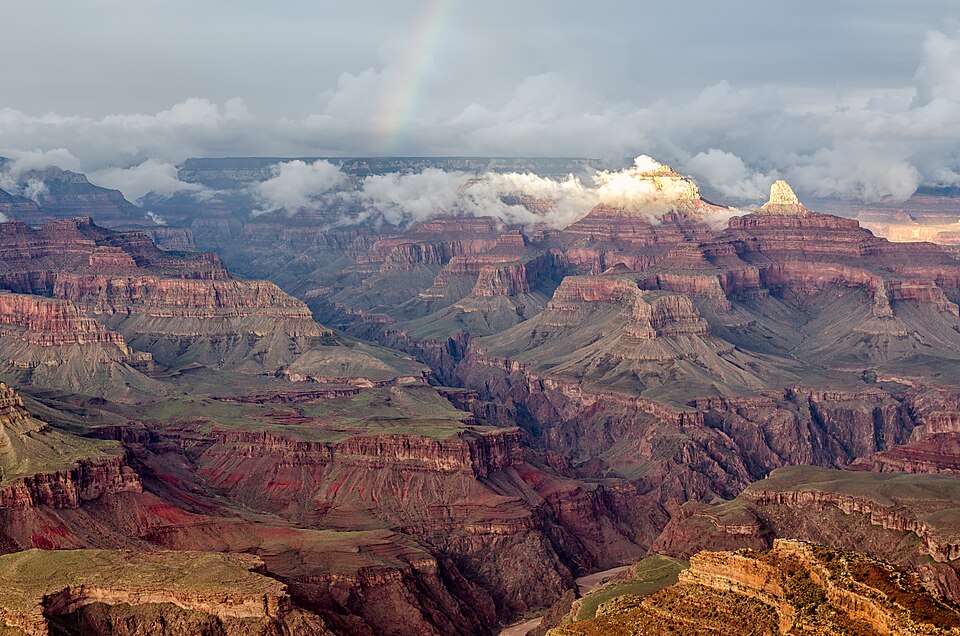
Correct — D, Canyon. A canyon is a deep river valley whose sides descend in a series of steps or terraces rather than a single sheer drop. This step-like profile develops where a river cuts down through horizontal layers of hard and soft sedimentary rock in an arid climate: the hard bands stand out as ledges while the soft bands wear back, giving the characteristic stepped walls of the Grand Canyon. The steep step-like slope is the specific clue that separates a canyon from a plain gorge.
Why the others are wrong
- (a)U-shaped valley. — A U-shaped valley (glacial trough) has a wide flat floor and steep smooth sides carved by a glacier — not deep stepped slopes cut by a river.
- (b)Blind valley. — A blind valley is a karst feature that ends abruptly where the stream sinks underground; it is not defined by deep step-like walls.
- (c)Gorge. — A gorge is deep and very narrow with near-vertical walls, typical of humid regions; the defining 'step-like' terracing points to a canyon rather than a gorge.
Concept
A canyon is a deep, steep-sided river valley whose walls rise in a stepped or terraced fashion. It is the arid-region relative of the gorge: both are cut by vertical (downward) river erosion, but the canyon's alternating resistant and weak horizontal strata produce a benched, step-like slope, while a gorge is narrow with sheer walls.
Read the qualifier carefully. 'Deep' fits both gorge and canyon, but 'steep step-like slope' is the discriminator — terraced walls come from horizontal strata eroding differentially in a dry climate, the hallmark of a canyon.
Key facts
- A canyon is a deep valley with steep, step-like (terraced) sides cut by a river.
- The stepped profile reflects alternating hard and soft horizontal rock layers in an arid setting.
- A gorge is deeper-than-wide with near-vertical walls, typical of humid regions.
- The Grand Canyon (Colorado River, USA) is the classic example of a canyon.
Study next
Common traps
- Choosing 'gorge' for any deep valley — the step-like terraced walls specifically indicate a canyon.
- Confusing a glacial U-shaped valley with a river-cut canyon.
Definition-matching — a landform is described (deep, narrow, stepped, U-shaped) and you name it, or landforms are matched to their eroding agent.
Related PYQs
Gandikota canyon of South India was created by which one of the following rivers?
- (a) Cauvery
- (b) Manjira
- (c) Pennar
- (d) Tungabhadra
Answer(c) Pennar
Same landform — a canyon. UPSC asks which river carved the Gandikota canyon (the Pennar), reinforcing that a canyon is a deep river-cut valley, exactly the feature defined here.
Practice
- practice — not a real PYQ
A very deep and narrow valley with near-vertical walls, common in humid regions, is called a
- (a)canyon
- (b)gorge
- (c)U-shaped valley
- (d)rift valley
Answer(b) gorge — deeper than it is wide, with steep near-vertical sides. - practice — not a real PYQ
A U-shaped valley is typically produced by the erosional action of
- (a)a river
- (b)wind
- (c)a glacier
- (d)underground water
Answer(c) a glacier — glacial scouring widens and deepens the valley into a U-shaped trough.