
Which one of the following is a Rabi crop in the Northern States of India?
- (a)Rice
- (b)Bajra
- (c)Barley
- (d)Ragi
Answer
Why
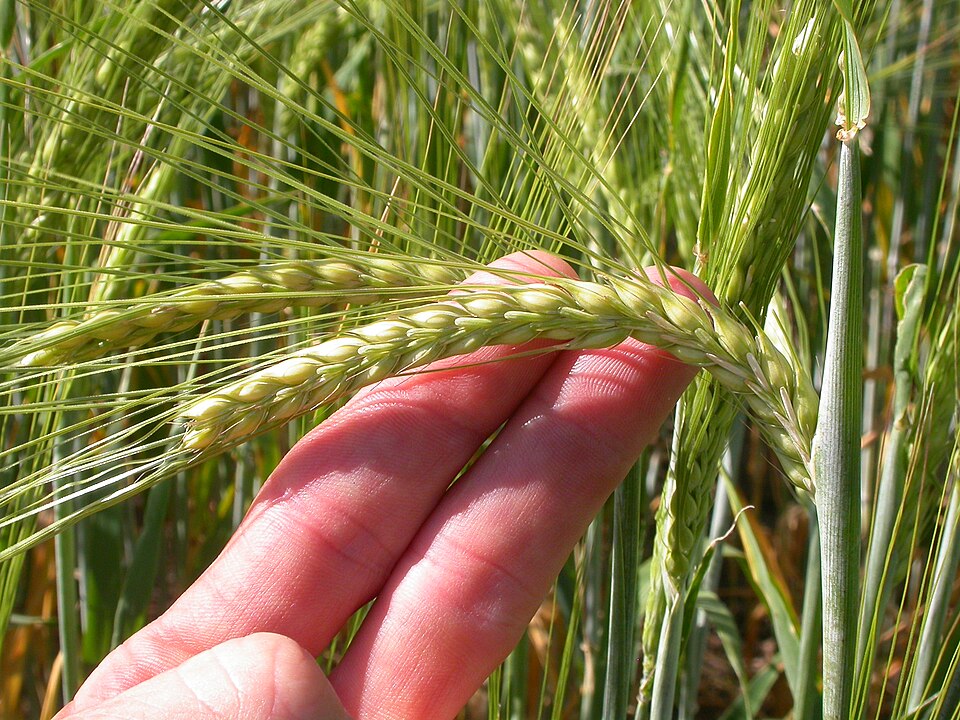
Correct — C, barley. Barley is a Rabi (winter) crop in the northern States of India — sown in October–November and harvested in March–April, growing through the cool, dry winter. Rice, bajra (pearl millet) and ragi (finger millet) are Kharif crops, sown with the south-west monsoon in June–July and harvested in autumn.
Why the others are wrong
- (a)Rice — Rice is the leading Kharif crop, sown at the onset of the south-west monsoon and needing warm, wet conditions — not the winter Rabi season.
- (b)Bajra — Bajra (pearl millet) is a hardy Kharif millet grown in the monsoon months, not a winter Rabi crop.
- (d)Ragi — Ragi (finger millet) is likewise a Kharif crop of the monsoon season, not sown in winter.
Concept
Indian farming follows two main cropping seasons. Kharif crops are sown with the south-west monsoon (June–July) and harvested in September–October — rice, bajra, ragi, maize and cotton. Rabi crops are sown in the cooler post-monsoon months (October–November) and harvested in spring — wheat, barley, gram, mustard and peas.
Sort each crop by its sowing season. Rice, bajra and ragi all depend on monsoon warmth and rain, marking them Kharif; barley alone is a winter-sown Rabi grain. The trap is grouping all cereals together — season, not the crop family, decides the answer.
Key facts
- Rabi crops are sown in October–November and harvested in March–April.
- Barley, wheat, gram and mustard are major Rabi crops of northern India.
- Rice, bajra and ragi are Kharif crops grown in the monsoon season.
- The two seasons are set by the timing of the south-west monsoon.
Study next
Common traps
- Assuming every cereal grows in the same season — season depends on sowing and monsoon timing, not on the crop family.
- Confusing millets like bajra and ragi (Kharif) with winter Rabi grains.
One crop must be picked out by season — recall that barley, wheat, gram and mustard are Rabi while rice and the millets are Kharif.
Related PYQs
Consider the following crops: 1. Cotton 2. Groundnut 3. Rice 4. Wheat. Which of these are Kharif crops?
- (a) 1 and 4
- (b) 2 and 3 only
- (c) 1, 2 and 3
- (d) 2, 3 and 4
Answer(c) 1, 2 and 3
Same Kharif/Rabi distinction — UPSC asks which crops are Kharif (wheat being the Rabi exception); this NDA item asks which listed crop is the Rabi one (barley).
Which of the following statements with reference to crops cultivated in India is/are correct? 1. Bajra grows well in sandy and shallow black soils, whereas red and shallow black soil is suited for Ragi 2. Bajra is predominantly grown in states like Rajasthan, Uttar Pradesh and Maharashtra, while Ragi is mainly cultivated in Karnataka, Tamil Nadu and Himachal Pradesh Select the answer using the code given below:
- (a) 1 only
- (b) 2 only
- (c) Both 1 and 2
- (d) Neither 1 nor 2
Answer(c) Both 1 and 2
Same concept — the soils, regions and seasons of Indian food crops. That NDA item tests where bajra and ragi (both Kharif millets) are grown; this one asks which listed crop belongs to the Rabi season.
Practice
- practice — not a real PYQ
Which one of the following is a Rabi crop?
- (a)Rice
- (b)Maize
- (c)Mustard
- (d)Cotton
Answer(c) Mustard — a winter-sown Rabi oilseed; the others are Kharif crops. - practice — not a real PYQ
Kharif crops are generally sown
- (a)in October–November
- (b)with the onset of the south-west monsoon
- (c)in the summer Zaid season
- (d)after the winter harvest
Answer(b) with the onset of the south-west monsoon — the defining feature of Kharif crops.