
Which one of the following is a non-metallic mineral?
- (a)Iron
- (b)Mica
- (c)Copper
- (d)Bauxite
Answer
Why
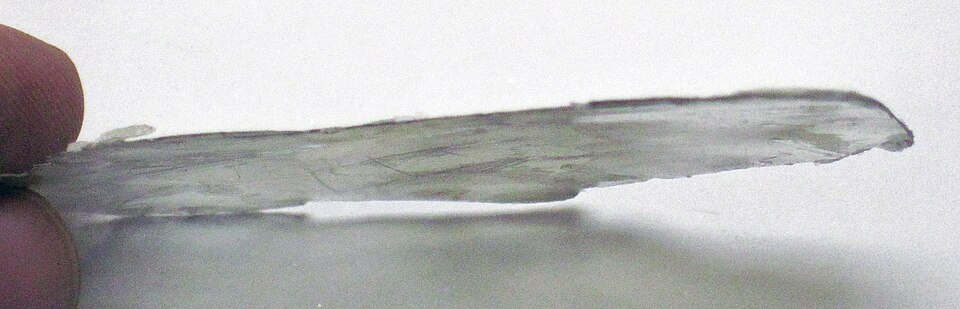
Correct — B, mica. Mica is a non-metallic mineral — a silicate valued for its perfect cleavage and its use as an electrical and thermal insulator, not as a source of metal. Iron, copper and bauxite are all metallic minerals, mined specifically to extract the metal they contain.
Why the others are wrong
- (a)Iron — Iron is a metallic mineral — its ores (haematite, magnetite) are mined and smelted to obtain iron metal, so it is not non-metallic.
- (c)Copper — Copper is a metallic mineral; ores such as chalcopyrite are worked to recover copper metal.
- (d)Bauxite — Bauxite is the chief metallic ore of aluminium, so it is classed with the metallic minerals, not the non-metallic ones.
Concept
Minerals are broadly grouped as metallic (worked to extract a metal) and non-metallic (used for the mineral itself, not a metal). Non-metallic minerals such as mica, limestone, gypsum and dolomite lack metallic lustre and malleability, and are prized for physical or chemical properties rather than for a recoverable metal.
Scan each option for whether it is mined to obtain a metal. Iron, copper and bauxite all yield metals, leaving mica — an insulating silicate — as the only non-metallic mineral. The trap is treating any hard, shiny mineral as 'metallic'; mica is shiny but is an insulator, not a metal ore.
Key facts
- Mica is a non-metallic mineral valued as an electrical and heat insulator.
- India's mica belt runs through Jharkhand, Bihar, Andhra Pradesh and Rajasthan.
- Iron, copper and bauxite are metallic minerals mined to extract their metals.
- Bauxite is the principal ore of aluminium.
Study next
Common traps
- Assuming any shiny or hard mineral is metallic — mica is lustrous but is an insulator, not a metal ore.
- Confusing bauxite (a metallic ore of aluminium) with a non-metallic mineral.
One mineral must be sorted from a list as non-metallic — recall which are worked for a metal (iron, copper, bauxite) and which are used for the mineral itself (mica).
Related PYQs
Match List I with List II and select the answer using the code given below the Lists: List I (City) A. Bewar B. Balaghat C. Bilaspur D. Ballary List II (Mineral) 1. Manganese 2. Mica 3. Iron-ore 4. Bauxite Code:
- (a) A-3, B-1, C-4, D-2
- (b) A-3, B-4, C-1, D-2
- (c) A-2, B-1, C-4, D-3
- (d) A-2, B-4, C-1, D-3
Answer(c) A-2, B-1, C-4, D-3
Same concept — identifying Indian minerals (mica, iron-ore, bauxite, manganese) and their producing districts. This item asks which of a list is non-metallic; that NDA item pairs the same minerals with their source regions.
Practice
- practice — not a real PYQ
Which one of the following is the chief ore of aluminium?
- (a)Haematite
- (b)Bauxite
- (c)Mica
- (d)Limestone
Answer(b) Bauxite — the principal metallic ore from which aluminium is extracted. - practice — not a real PYQ
Which one of the following is a non-metallic mineral used mainly as an electrical insulator?
- (a)Manganese
- (b)Bauxite
- (c)Mica
- (d)Copper
Answer(c) Mica — a non-metallic silicate widely used for electrical insulation.