
 View answer copy →
Ranga ManjuRank 24CSE 2024
Answered this exact question
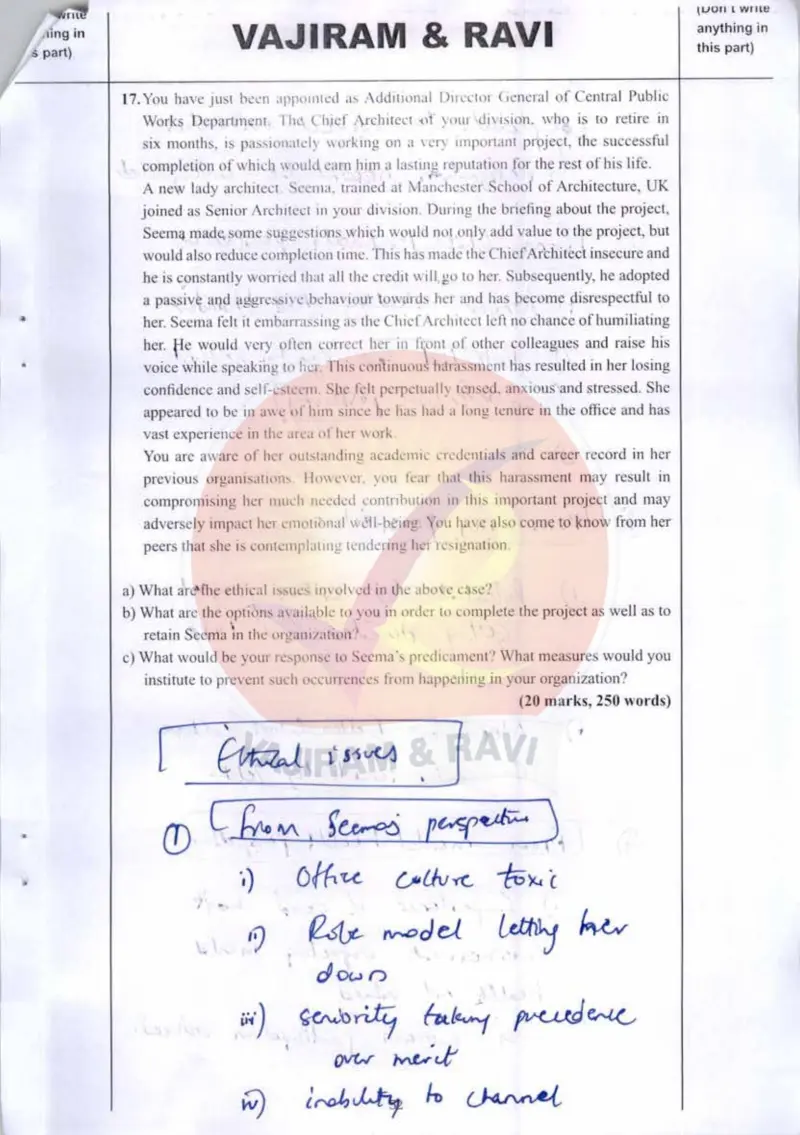
This mock case study reuses the real 2023 CPWD/Seema workplace-harassment case almost verbatim, so the topper's full worked answer (ethical issues, options to retain Seema, preventive measures) directly answers this PYQ.
Key learnings from their answer
- ›In Q4 ("character revealed in private life") Ranga Manju stacked matched real cases on both sides, positives like IAS Sagayam, Lal Bahadur Shastri (wealth under Rs 500 at death), and the AC-shifted-to-the-maternity-ward officer, against negatives Asaram, Ram Rahim, and KPS Gill (citing the actual case Rupan Deol Bajaj v. KPS Gill) -> stock an Ethics answer with named, verifiable people and cite the case law by name; balanced positive-and-negative examples prove a claim far better than abstract assertion.
- ›Every answer ran a consistent template: a quotation/proverb hook opening (e.g., "Integrity is to do the right thing when no one is watching" for Q1, "Family is the first school" for Q2) into a framing line, then underlined sub-headers, closing on a one-line takeaway -> a repeatable intro-body-conclusion skeleton lets you write fast and uniformly under time pressure across 19 attempts without reinventing structure each time.
- ›It was a complete full-length attempt: all 13 Section-A items and all 6 Section-B case studies (Kerala landslides, AI task force, GoodLife Pharma/Revivol, CPWD harassment, etc.) attempted in order, within page limits -> finishing the whole paper within limits is itself a scoring strength; partial papers cap your ceiling regardless of per-answer quality.
What they cited: KPS Gill — war hero in public, molester in private; SC case Rupan Deol Bajaj v. KPS Gill (Q4)