
 View answer copy →
Jagrati AwasthiAIR 2CSE 2020
Answered a very similar question
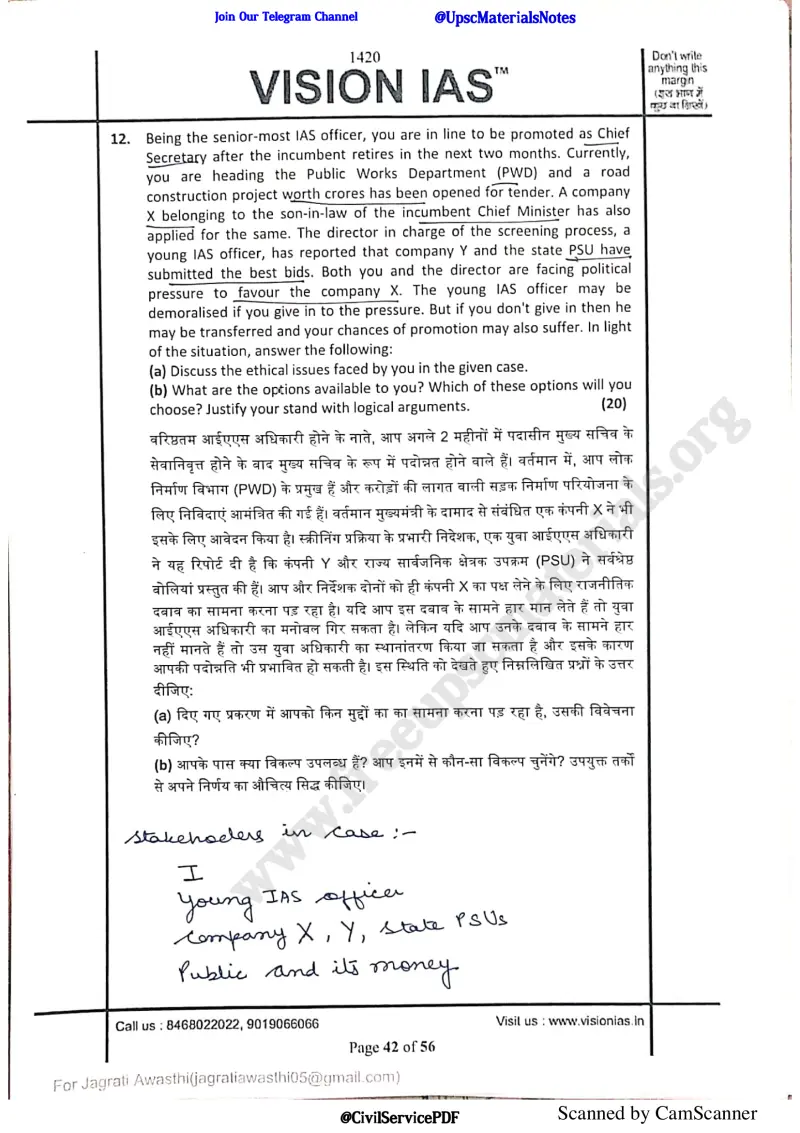
Their question: “Case study — IAS officer facing CM pressure to favour Company X in a PWD tender, with own promotion at stake (conflict of interest, fair tendering)”
The 2025 Subash/PWD PYQ has the same core (a senior officer pressured by a powerful minister to favour a chosen company in a road/PWD project, with career stakes); the topper's choice to stand up and uphold fair tendering while naming the personal cost is a direct model.
Key learnings from their answer
- ›Across all six case studies (Q9-Q13) she runs one disciplined template: identify stakeholders -> list the ethical issues/dilemmas -> enumerate options with pros AND cons for each -> state the chosen option -> spell out the course of action -> close with a value-based conclusion. -> For any ethics case study, fix this exact skeleton in advance so under time pressure you never skip the options-with-pros/cons step, which is where most marks are won.
- ›On the conflict-of-interest tender case (Q12) she explicitly chooses to stand up to the Chief Minister and uphold fair tendering despite her own promotion being at stake. -> In pressure-versus-promotion case studies, take a clear principled stand and name the personal cost you accept, fence-sitting reads as evasion; owning the trade-off reads as integrity.