 View answer copy →
Shruti SharmaAIR 1CSE 2021scored 5/10
Answered a very similar question
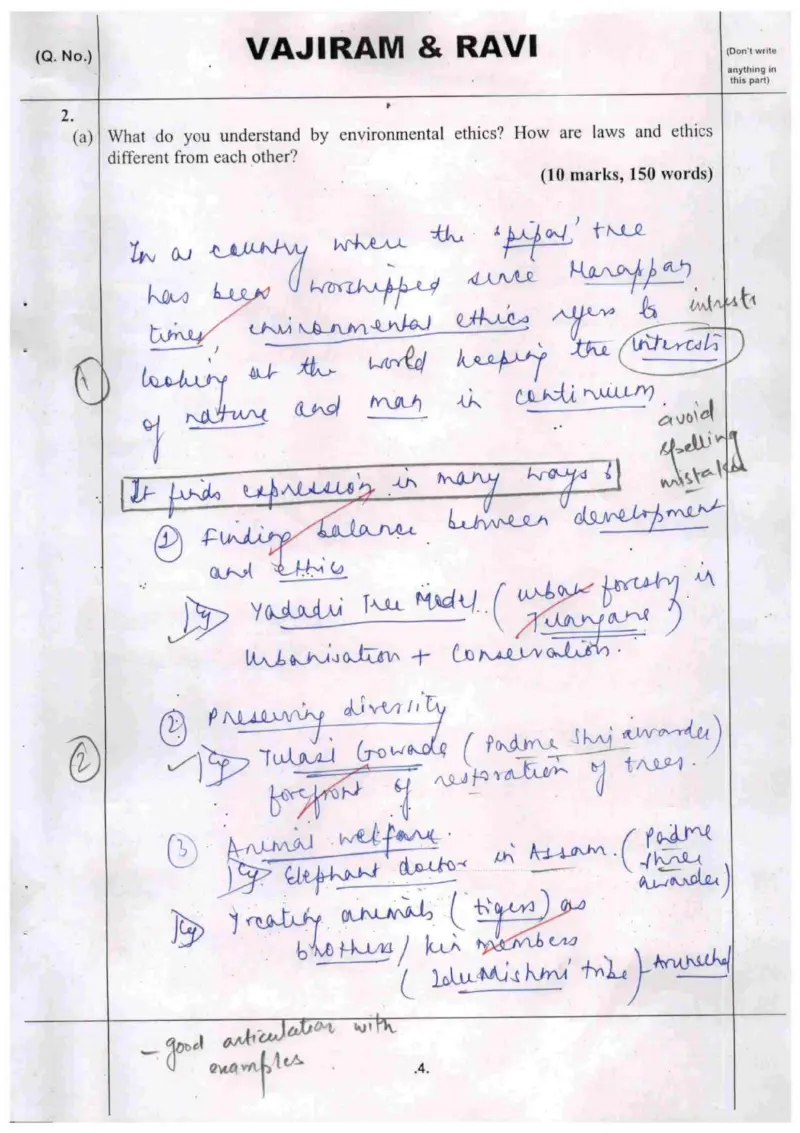
Their question: “Environmental ethics; how laws and ethics differ”
Her answer covers both environmental ethics (dense named cases) and a Laws-vs-Ethics table, mapping onto both sub-parts of 2015 Q1 (environmental ethics + differentiate Law and Ethics).
Key learnings from their answer
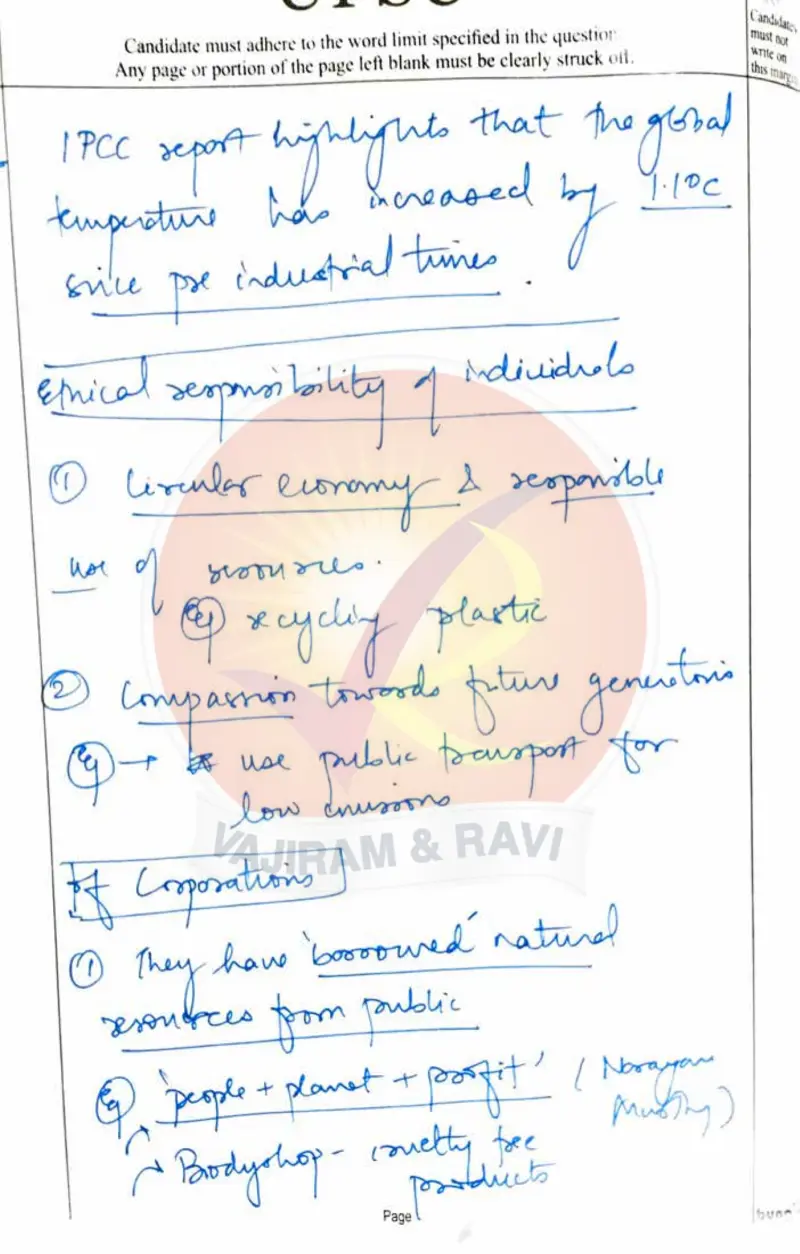
- ›For environmental ethics Q2(a) she did not stop at one example, she stacked grassroots, named, verifiable cases: the 'pipal' tree worshipped since Harappan times, Telangana's Yadadri Tree Model, Padma Shri Tulasi Gowda, the Assam 'elephant doctor', and the Idu Mishmi tribe treating tigers as kin; the evaluator's note 'good articulation with examples' is the payoff. Lesson: in Ethics, convert every abstract value into a cluster of specific named real-world instances (people, schemes, tribes) rather than generic statements, that density is what drew the 'Very Good' on Conceptual Clarity & Content.
- ›She compresses arguments into labelled visuals, a boxed triangle of Principles + Values + Emotions converging on 'ethical dilemma' (Q1), a two-column LAWS vs ETHICS table (Q2a), and a flow diagram from 'academic development affected' to girl-child dropout/child labour (Q3b). Lesson: use diagrams to carry the structure of definitions and comparisons; note the examiner's 'enclose diagram in a box', always frame diagrams cleanly so they read as deliberate, not scribbled.
What they cited: Q2(a): the 'pipal' tree worshipped since Harappan times; Yadadri Tree Model of urban forestry (Telangana); Tulasi Gowda (Padma Shri); the 'elephant doctor' of Assam (Padma Shri); Idu Mishmi tribe of Arunachal treating tigers as kin; abortion laws (context-dependence); the Holocaust in Germany (legal but unethical); affirmative-action laws