
 View answer copy →
Kumud MishraRank 69CSE 2024
Answered a very similar question
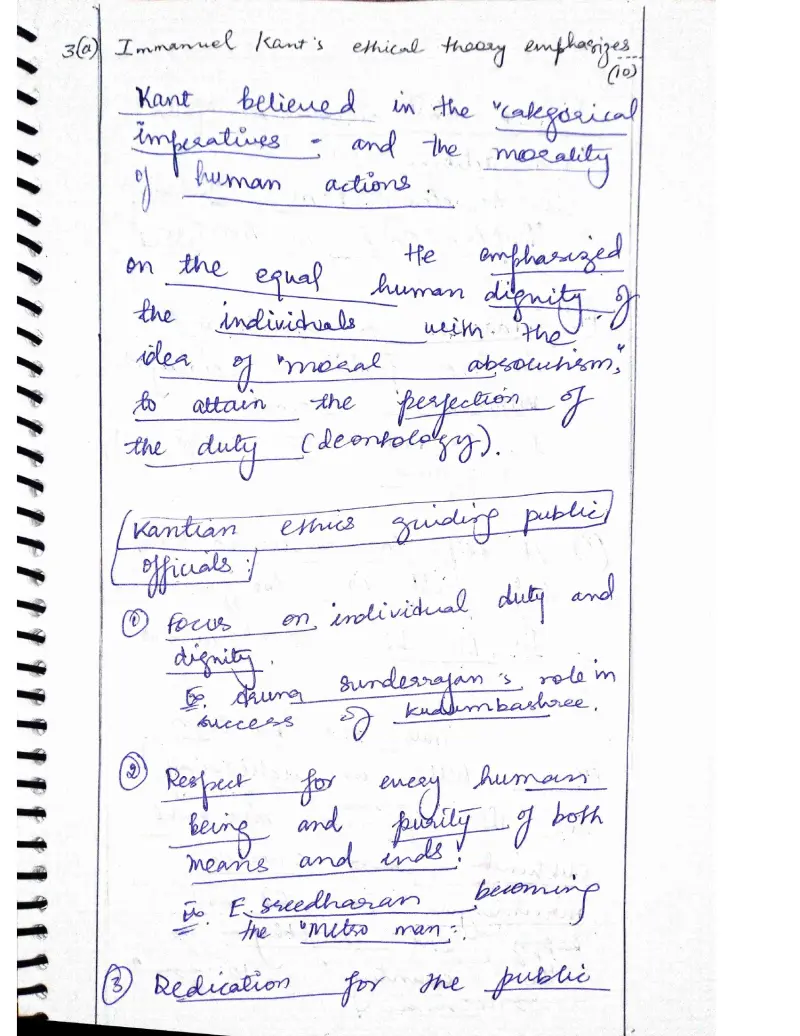
Their question: “Kant's ethical theory — categorical imperative, deontology, human dignity (means and ends)”
2014 Q6 is the Kantian 'treat humans as ends, never merely as means' statement; the topper's worked Kant answer supplies its exact core argument.
Key learnings from their answer
- ›Theory answers are anchored to the correct named thinker AND their signature idea, not vague paraphrase, Rawls' 'veil of ignorance', Kant's categorical imperative and means-vs-ends dignity, and Bentham vs Mill via the actual lines 'Two sovereign masters, pain and pleasure' (Bentham) answered by Mill's 'Poetry is better than pushpin' -> learn one precise phrase or device per philosopher so you can deploy the thinker accurately under time pressure instead of generic 'as per utilitarianism'.
- ›Every theory point is followed by a concrete real-Indian example tagged 'Ex.', E. Sreedharan as the 'Metro Man', Armstrong Pame's 'People's Road' in Manipur, Vinoba Bhave's Bhoodan revolution, Sindhutai Sapkal's work for orphans, Dr. Rajendra Prasad quitting law for peasants -> in Ethics, never let an abstract value float free: pin each point to a named administrator or reformer so the examiner sees you can operationalise the concept, not just define it.