
With reference to lichens, which of the following statements is/are correct ? 1. Lichens are very good indicators of pollution. 2. Lichens grow well in polluted areas. Select the correct answer from the code given below : Code :
- (a)Only 2
- (b)Both 1 and 2
- (c)Neither 1 nor 2
- (d)Only 1
Correct — D, Only 1. Statement 1 is the standard textbook fact: lichens are the classic bioindicator of air pollution, and sulphur dioxide in particular. Statement 2 states the exact opposite of the truth and is what makes statement 1 work. A lichen is a symbiosis of a fungus with an alga or a cyanobacterium; it has no roots, no waxy cuticle and no stomata, so it absorbs water and dissolved minerals directly from rain and the atmosphere over its entire surface — and it has no way of excluding or excreting what it takes in. Dissolved sulphur dioxide attacks the chlorophyll of the photosynthetic partner, the partnership breaks down, and lichen cover simply disappears. That is why industrial and heavily built-up areas show 'lichen deserts' where the bark of trees and the surface of stone are bare. So lichens do not grow well in polluted areas; their retreat from an area is the signal that the air there has deteriorated.
- (a)Only 2 — It keeps the false statement and drops the true one. Lichens are conspicuously absent from polluted air, not flourishing in it, while their value as an indicator of air quality is settled and is the reason they are surveyed at all.
- (b)Both 1 and 2 — The two statements cannot both be true — accepting statement 2 destroys statement 1. If lichens grew equally well in clean and polluted air, their presence would carry no information about air quality and they could not be indicators. A candidate who reads 'indicator of pollution' loosely as 'found where there is pollution' walks straight into this option.
- (c)Neither 1 nor 2 — Statement 1 is correct and is one of the most frequently examined facts in Indian environment papers — lichens are the standard bioindicator of air pollution, especially of sulphur dioxide. Rejecting it leaves the option untenable.
A lichen is not a single organism but a stable mutualistic association: a fungus (the mycobiont) forms the body, and an alga or cyanobacterium (the photobiont) housed inside it does the photosynthesis. Because the fungal body has no roots, no cuticle and no stomata, everything the lichen needs — and everything the air contains — enters directly across its whole surface, with no regulation and no route of excretion. That physiology makes lichens both extraordinarily hardy in clean but harsh habitats (bare rock, bark, Arctic tundra) and extraordinarily fragile in polluted ones. Sensitivity varies by growth form: the shrubby, hanging fruticose lichens go first, foliose (leafy) lichens next, and the tightly crust-like crustose lichens last.
The examiner is testing whether you understand what 'indicator' means. An indicator species is one whose presence, absence or abundance reports a condition of the environment. Lichens indicate air pollution by vanishing, not by thriving — so statement 2 is not merely an extra fact, it contradicts statement 1. Once you see that the two statements are mutually inconsistent, the answer must be 'Only 1' or 'Only 2', and statement 1 is the one that is true. One honest nuance worth carrying: the picture is not perfectly binary — a few tolerant crustose species survive moderate pollution, and nitrogen-loving lichens can even spread where ammonia deposition is high. The rule the exam wants is the sulphur dioxide rule: as SO2 rises, lichen diversity and cover collapse.
- A lichen is a mutualistic association between a fungus (mycobiont) and an alga or cyanobacterium (photobiont)
- Lichens have no roots, cuticle or stomata, so they absorb water, minerals and airborne pollutants directly across the whole thallus and cannot excrete them
- Sulphur dioxide is the pollutant they are most sensitive to; it destroys the photobiont's chlorophyll, producing bare 'lichen deserts' around industrial and urban centres
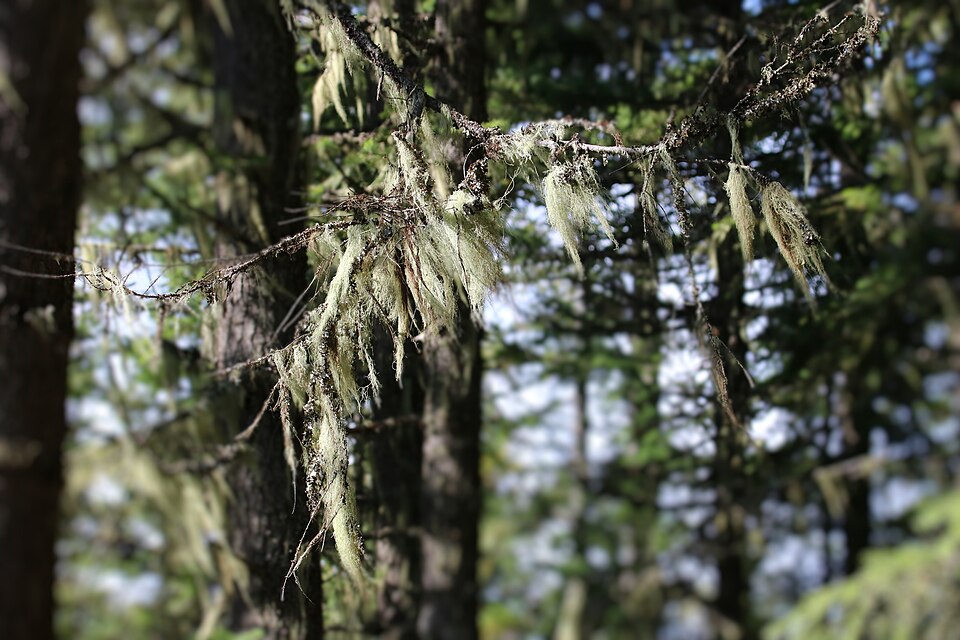
- Sensitivity by growth form runs fruticose (shrubby, e.g. Usnea) > foliose (leafy) > crustose (crust-forming), so the mix of forms present grades the pollution level
- Lichens are pioneer species in primary succession on bare rock, secreting acids that weather the rock and begin soil formation
- The acid-base indicator dye litmus is extracted from lichens of the genus Roccella
- Reading 'indicator of pollution' as 'grows where there is pollution' — lichens indicate by disappearing
- Treating lichen and moss as the same thing; moss is a bryophyte, a single plant, while a lichen is a fungus-plus-photobiont partnership
- Assuming that because lichens survive on bare rock they must be tough enough to survive polluted city air — the very physiology that lets them live without soil is what makes them defenceless against airborne pollutants
UPPSC has returned to lichens repeatedly as a one-line recall item — 'which is the indicator of air pollution' — and here dressed it as a two-statement test of whether you know the direction of the relationship; UPSC prefers the biology, asking what a lichen is made of or which organisms can survive on a surface without soil.
Lichens, which are capable of initiating ecological succession even on a bare rock, are actually a symbiotic association of
- (a) algae and bacteria
- (b) algae and fungi
- (c) bacteria and fungi
- (d) fungi and mosses
Answer(b) algae and fungi
The composition that explains the indicator property. Because the fungal body has no roots or cuticle and the algal partner must photosynthesise inside it, pollutants absorbed straight from the air reach the chlorophyll — which is why the partnership fails in dirty air.
In the nature, which of the following is/are most likely to be found surviving on a surface without soil? 1. Fern 2. Lichen 3. Moss 4. Mushroom Select the correct answer using the code given below.
- (a) 1 and 4 only
- (b) 2 only
- (c) 2 and 3
- (d) 1, 3 and 4
Answer(c) 2 and 3
Same physiology, opposite consequence — a lichen can live on bare rock precisely because it draws water and nutrients from the atmosphere, and that same unfiltered uptake is what makes it collapse under airborne sulphur dioxide.
Which one of the following is the well known example of bioindicator of air pollution ?
- (a) Lichens
- (b) Methyl mercury
- (c) Rose plant
- (d) Sunflower
Answer(a) Lichens
The direct ancestor of this question — the same fact asked as a one-line recall item. UPPSC has now converted it into a two-statement test of whether the candidate also knows the direction of the relationship.
Which of the following is indicator of air pollution ?
- (a) Puffballs
- (b) Algae
- (c) Lichen
- (d) Moss
Answer(c) Lichen
The same fact again two years later, this time with moss and algae as the near-miss options — evidence that this is a guaranteed-return item in UPPSC Paper-I rather than a one-off.
- practice — not a real PYQ
The disappearance of lichens from the trees of an industrial town is most directly attributed to a high atmospheric concentration of:
- (a)Carbon dioxide
- (b)Sulphur dioxide
- (c)Methane
- (d)Argon
Answer(b) Sulphur dioxide — dissolved SO2 destroys the chlorophyll of the lichen's photosynthetic partner, which is why 'lichen deserts' form around industrial centres.
- practice — not a real PYQ
Which of the following pairs of organisms live together in a lichen?
- (a)A fungus and an alga or cyanobacterium
- (b)A bacterium and a moss
- (c)A fungus and a fern
- (d)An alga and a bacterium only
Answer(a) A fungus and an alga or cyanobacterium — the fungus (mycobiont) forms the body and the photobiont supplies food by photosynthesis.