
Which one of the following is the well known example of bioindicator of air pollution ?
- (a)Lichens
- (b)Methyl mercury
- (c)Rose plant
- (d)Sunflower
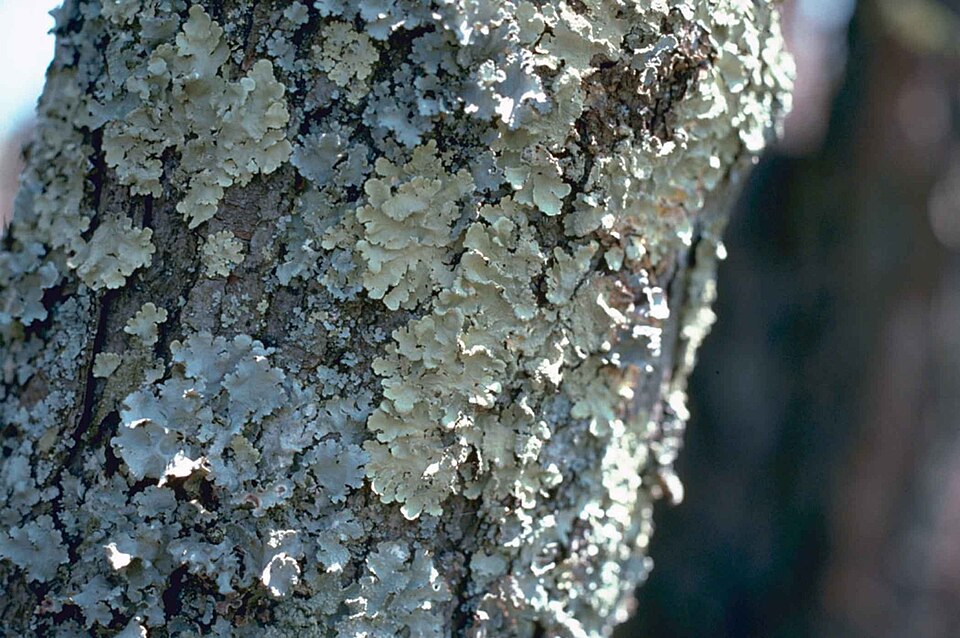
Correct — A, Lichens. A lichen is a symbiotic association of a fungus with an alga or a cyanobacterium. It has no roots, no protective cuticle and no stomata, so it absorbs water, minerals — and whatever pollutants are dissolved in them — directly from rain and air over its entire surface, and it has no way of excreting what it takes up. That makes lichens extraordinarily sensitive to sulphur dioxide (SO2) and other gaseous pollutants, which destroy the chlorophyll of the algal partner. Lichens flourish on tree bark, walls and rock wherever the air is clean and disappear wherever it is polluted, leaving the bare 'lichen desert' typical of industrial and heavily built-up areas. Their presence, absence and species composition are therefore the classic biological indicator (bioindicator) of air quality.
- (b)Methyl mercury — Wrong — methyl mercury is not an organism at all but an organic compound of mercury. It is itself a pollutant, notorious for biomagnifying up aquatic food chains (the agent of Minamata disease). A bioindicator, by definition, has to be a living organism.
- (c)Rose plant — Wrong — the rose is a cultivated ornamental shrub with no standing as an air-pollution indicator. It has neither the fully exposed absorbing surface nor the documented sensitivity to SO2 that makes the lichen the textbook choice.
- (d)Sunflower — Wrong — the sunflower is associated with phytoremediation, where it is grown to draw heavy metals and radionuclides out of contaminated soil and water. That is the clean-up of soil and water pollution, not the indication of air pollution.
A bioindicator is a living organism whose presence, absence, abundance or condition reveals the state of the environment around it. Lichens are the standard bioindicator for air. The fungal partner (mycobiont) supplies structure and absorption while the algal or cyanobacterial partner (photobiont) photosynthesises, so the whole thallus lives directly off the atmosphere — no roots drawing on soil, no waxy cuticle keeping pollutants out. Sulphur dioxide destroys the photobiont's chlorophyll, which is why lichens are among the first organisms to vanish as SO2 levels climb. Sensitivity varies with growth form: the bushy fruticose lichens die back first, the leafy foliose next, and the crust-like crustose lichens hold on longest — so the lichen community itself grades the air quality of a place.
Three of the four options are simply not indicator organisms, and one of them is not even alive. The reasoning shortcut is two-step: a bioindicator must be an organism (which rules out methyl mercury), and it must take up pollutants directly from the medium being tested (which rules out ordinary rooted plants such as the rose and the sunflower). Only the lichen satisfies both. The pairing 'lichen = SO2-sensitive indicator of air pollution' is worth memorising outright, because lichens also recur in ecological-succession questions as the pioneer species on bare rock.
- Lichen = a mutualistic symbiosis of a fungus (mycobiont) with an alga or cyanobacterium (photobiont).
- No roots and no cuticle — it absorbs water, minerals and pollutants straight from air and rainwater, and accumulates them.
- Extremely sensitive to sulphur dioxide (SO2); the absence of lichens from bark in cities is the classic 'lichen desert' of polluted air.
- Sensitivity order by growth form: fruticose (most sensitive) → foliose → crustose (most tolerant).
- Lichens are also the classic pioneer species in primary succession on bare rock (the lichen stage of a xerosere).
- Choosing a chemical such as methyl mercury — a bioindicator has to be a living organism, not a pollutant.
- Confusing bioindication (an organism signalling pollution) with phytoremediation (a plant removing pollution) and with biomagnification (a toxin concentrating up a food chain).
- Mixing up water-quality indicators (algae and algal blooms) with the air-quality indicator (lichen).
Asked directly as 'which is the bioindicator of air pollution', as 'lichens are most sensitive to which gas' (SO2), or embedded in ecological-succession questions where lichens are the pioneers on bare rock. UPPSC repeats it — the 2021 paper carried virtually the same question.
No directly related past PYQ was found.
- practice — not a real PYQ
Lichens are used as bioindicators of air pollution primarily because they are highly sensitive to:
- (a)Carbon dioxide
- (b)Sulphur dioxide
- (c)Nitrogen gas
- (d)Water vapour
Answer(b) Sulphur dioxide — SO2 destroys the chlorophyll of the algal partner, so lichens die back wherever the air is polluted.
- practice — not a real PYQ
The use of plants such as the sunflower to draw heavy metals and radionuclides out of contaminated soil and water is called:
- (a)Bioindication
- (b)Biomagnification
- (c)Phytoremediation
- (d)Eutrophication
Answer(c) Phytoremediation — using plants to extract, stabilise or degrade pollutants from soil and water.