
Which of the following pair is/are NOT correctly matched ? (Dam) – (River) 1. Baglihar Dam – Chenab 2. Pandoh Dam – Ravi 3. Srisailam Dam – Tungabhadra Select the correct answer from the code given below : Code :
- (a)1 and 2
- (b)2 and 3
- (c)Only 3
- (d)Only 1
Answer
Why
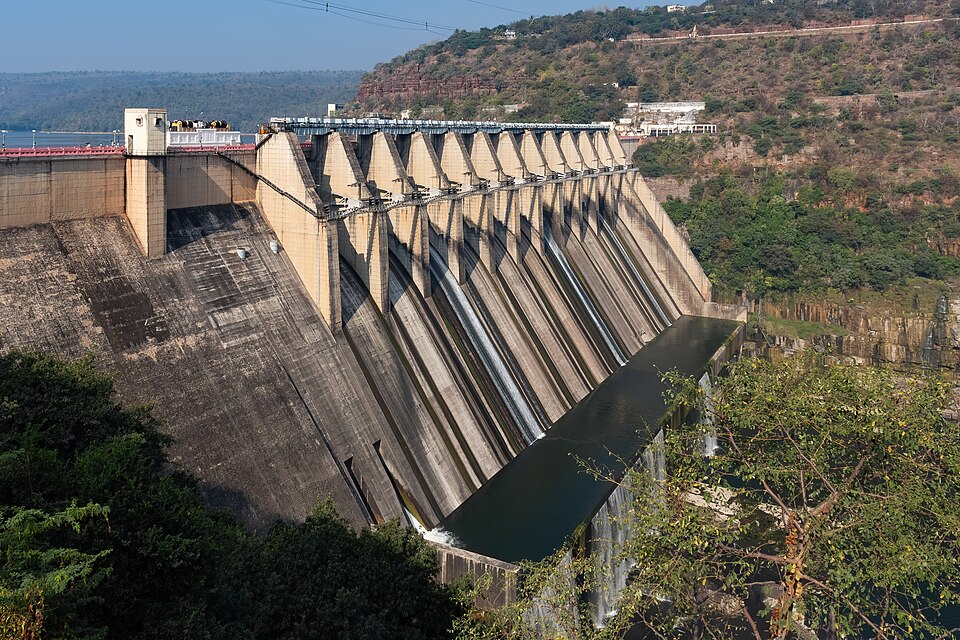
Correct — B, 2 and 3. The stem asks for the pairs that are NOT correctly matched, so you are collecting errors, and there are two of them. Pair 1 is sound: the Baglihar Dam is on the Chenab in Ramban district of Jammu and Kashmir, and it is well known precisely as a Chenab project — it was the subject of Pakistan's objection under the Indus Waters Treaty, and a neutral expert ruled in 2007 that the design was broadly within the treaty's parameters. Pair 2 is wrong. The Pandoh Dam is on the BEAS, not the Ravi. It stands in Mandi district of Himachal Pradesh, was completed in 1977, and is a diversion dam rather than a storage dam: it turns the Beas south-west through some 38 kilometres of tunnels and channels, generates power at the 990 MW Dehar power house and then discharges the water into the Sutlej. That is the Beas–Sutlej Link, and notice that the Ravi has no part in it at all. Pair 3 is wrong too. The Srisailam Dam is on the KRISHNA, not the Tungabhadra. It is a masonry gravity dam in the Nallamala Hills between Nandyal district in Andhra Pradesh and Nagarkurnool district in Telangana, with an installed capacity of about 1,670 MW across its two power houses, and the Krishna River carries it in every standard list of that river's dams alongside Almatti, Jurala, Nagarjuna Sagar and Prakasam Barrage. The Tungabhadra is a major tributary of the Krishna and its own dam is the Tungabhadra Dam at Hospet in Karnataka — a different structure on a different river. Two wrong pairs, 2 and 3, which is option (b).
Why the others are wrong
- (a)1 and 2 — This catches the genuine Pandoh error but wrongly convicts Baglihar. Baglihar really is on the Chenab, and the pairing is one of the better-documented dam facts in Indian general studies because of the Indus Waters Treaty dispute: the Chenab is one of the three western rivers allotted to Pakistan under the treaty, on which India retains only limited run-of-the-river rights, which is exactly why a dam on it drew an international objection. The option also lets the Srisailam error through, so it misses one of the two answers the stem is asking for.
- (c)Only 3 — Right about Srisailam, but it clears the Pandoh pair, and Pandoh is on the Beas. Candidates often accept 'Pandoh – Ravi' because all four names in play — Ravi, Beas, Sutlej, Chenab — are Himachal and Punjab rivers of the Indus system, so any pairing among them looks equally plausible. The way to keep them apart is by what each dam does: Pandoh belongs to the Beas Project, whose whole purpose is to move Beas water into the Sutlej for power at Dehar, while the Ravi's signature structures are the Thein (Ranjit Sagar) Dam and the Chamera scheme.
- (d)Only 1 — This is the worst reading available, because it convicts the one pair that is correct and acquits both that are wrong. It is what a candidate marks who has heard of the Baglihar controversy, remembers that the dam was contested, and translates 'contested' into 'wrongly matched'. The dispute was never about which river Baglihar stands on — everyone agreed it was the Chenab — but about whether its gated spillway and pondage complied with the Indus Waters Treaty's design criteria for the western rivers.
Concept
Dam-and-river matching is a fixed item in Indian geography because a dam is defined by its river: the river decides the basin, the states that quarrel over the water, the treaty regime if any, and the purpose the structure serves. Three regimes meet in this question. The Chenab belongs to the western rivers of the Indus system, governed by the Indus Waters Treaty of 1960, on which India may build only run-of-the-river works — hence Baglihar and the neutral expert. The Beas belongs to the eastern rivers allotted to India, where the Beas Project moves water across basins into the Sutlej for hydro power. The Krishna belongs to peninsular India, where Srisailam and Nagarjuna Sagar are the great gorge dams of the lower valley and the water is shared between Karnataka, Telangana and Andhra Pradesh.
Work a not-matched pairs question by verifying each pair independently before touching the options, and be suspicious of any pair whose named river is a close relative of the true one. Both falsifiers here are exactly that. The Ravi is a sister river of the Beas in the same Indus sub-system and the same hill state, so 'Pandoh – Ravi' reads smoothly. The Tungabhadra is the Krishna's own tributary, and the Srisailam reservoir's backwaters actually extend up towards the Krishna–Tungabhadra confluence, so 'Srisailam – Tungabhadra' reads smoothly too. Neither is a random substitution; both are the nearest wrong answer available, which is the standard design of this format.
Key facts
- Baglihar Dam is on the Chenab in Ramban district, Jammu and Kashmir; a neutral expert under the Indus Waters Treaty ruled in 2007 that the project was broadly within the treaty's technical parameters
- Pandoh Dam is on the BEAS in Mandi district, Himachal Pradesh, completed in 1977 — a diversion dam that sends Beas water 'to the southwest through a 38 km long system of tunnels and channels' to the 990 MW Dehar power house and then into the Sutlej, the Beas–Sutlej Link
- Srisailam Dam is on the KRISHNA in the Nallamala Hills, between Nandyal district (Andhra Pradesh) and Nagarkurnool district (Telangana), with an installed capacity of about 1,670 MW
- The Tungabhadra is a major tributary of the Krishna with a catchment of about 71,400 square kilometres; its own reservoir is behind the Tungabhadra Dam at Hospet in Karnataka, and it is the Bhima — not the Tungabhadra — that is the Krishna's longest tributary
- Other well-known dams on the Krishna include Almatti, Narayanpur, Jurala, Nagarjuna Sagar, Pulichintala and the Prakasam Barrage; the Ravi's signature structures are the Thein (Ranjit Sagar) Dam and the Chamera scheme
- Under the Indus Waters Treaty, 1960, the eastern rivers Ravi, Beas and Sutlej are allotted to India and the western rivers Indus, Jhelum and Chenab to Pakistan, with India retaining limited run-of-the-river use on the latter
Study next
Common traps
- Answering the opposite question. The stem asks which pairs are NOT correctly matched, so option (d), 'Only 1', is the trap for anyone who identified the one correct pair and stopped there
- Assuming Srisailam is a Tungabhadra project because the Tungabhadra is the Krishna's tributary and the reservoir's backwaters reach up towards their confluence. The dam itself impounds the Krishna
- Treating Ravi, Beas and Sutlej as interchangeable because they are neighbours in the same system. Anchor each dam by its purpose — Pandoh diverts Beas water to the Sutlej, Thein impounds the Ravi, Bhakra impounds the Sutlej
UPPSC returns to the 'which pairs are NOT correctly matched' format year after year across dam–river, tributary–river, port–country and institute–location, and it usually mixes one securely known pair with two near-miss substitutions from the same basin or region. UPSC asks the same content either as a single not-matched pair or as a statement question about a named project's treaty status or funding, which is why the Baglihar–Indus Waters Treaty link is worth carrying into both examinations.
Related PYQs
Which one of the following pairs is not correctly matched? Dam/Lake — River
- (a) Govind Sagar : Satluj
- (b) Kolleru Lake : Krishna
- (c) Ukai Reservoir : Tapi
- (d) Wular Lake : Jhelum
Answer(b) Kolleru Lake : Krishna
The same format, the same subject and the same species of falsifier — a dam or lake attached to a river from its own neighbourhood. There the error is Kolleru Lake with the Krishna, when Kolleru actually sits in the depression between the Krishna and Godavari deltas and is fed by local streams; here the errors are Pandoh with the Ravi and Srisailam with the Tungabhadra. In each case the wrong river is the nearest available one, so recognition of the name is not enough.
Consider the following statements : 1. The Baglihar Power Project had been constructed within the parameters of the Indus Water Treaty. 2. The project was completely built by the Union Government with loans from Japan and the World Bank. Which of the statements given above is/are correct ?
- (a) 1 only
- (b) 2 only
- (c) Both 1 and 2
- (d) Neither 1 nor 2
Answer(a) 1 only
Names the same dam that anchors pair 1 and explains why it is worth knowing. Baglihar is not merely on the Chenab; it is famous for being on the Chenab, because the Chenab is a western river under the Indus Waters Treaty and the project's design was referred to a neutral expert. A candidate who carries that story cannot be talked out of the Baglihar–Chenab pairing, which is exactly what options (a) and (d) try to do.
Which of the following rivers is a Trans-Himalayan river ?
- (a) Jhelum
- (b) Sutlej
- (c) Ganga
- (d) Ravi
Answer(b) Sutlej
Drills the river identities that pair 2 depends on. Jhelum, Sutlej and Ravi are set against one another there, and the answer turns on where each rises relative to the Great Himalaya. Holding the Indus-system rivers apart in that way — rather than as one undifferentiated cluster of Himachal and Punjab names — is what stops a candidate accepting 'Pandoh – Ravi' when Pandoh belongs to the Beas and its whole purpose is to feed the Sutlej.
Which hydropower plant in Bhutan was inaugurated recently by Indian Prime Minister Narendra Modi
- (a) Chhukha Power Plant
- (b) Dagachhu Power Plant
- (c) Kurichha Power Plant
- (d) Mangdechhu Power Plant
Answer(d) Mangdechhu Power Plant
Shows the other face of the same topic: UPPSC also asks hydroelectric projects by name, and expects the candidate to attach each to its river and its host region. Mangdechhu sits on the Mangdechhu in central Bhutan just as Baglihar sits on the Chenab and Srisailam on the Krishna — the project name is only useful if the river travels with it, which is precisely what this 2025 question tests by breaking the link.
Practice
- practice — not a real PYQ
The Pandoh Dam, which diverts water through a system of tunnels to the Dehar power house and thence into the Sutlej, is built on which river?
- (a)Ravi
- (b)Beas
- (c)Chenab
- (d)Yamuna
Answer(b) Beas — Pandoh is a diversion dam in Mandi district, Himachal Pradesh, completed in 1977, and forms the head of the Beas–Sutlej Link. - practice — not a real PYQ
Under the Indus Waters Treaty of 1960, which of the following groups of rivers was allotted to India?
- (a)Indus, Jhelum and Chenab
- (b)Ravi, Beas and Sutlej
- (c)Jhelum, Chenab and Ravi
- (d)Indus, Sutlej and Beas
Answer(b) Ravi, Beas and Sutlej — the eastern rivers went to India, the western rivers Indus, Jhelum and Chenab to Pakistan, with India keeping limited run-of-the-river rights on the western group, which is why Baglihar on the Chenab was contested.