
With reference to “PraVaHa” software developed by ISRO, which of the following statements is/are correct ? 1. It is a path-breaking feat by Vikram Sarabhai Space Centre. 2. Initial aerodynamic design of space vehicles requires evaluation of large number of configurations. Select the correct answer from the codes given below :
- (a)Only 2
- (b)Neither 1 nor 2
- (c)Only 1
- (d)Both 1 and 2
Correct — D, Both 1 and 2. PraVaHa — the name expands to 'Parallel RANS Solver for Aerospace Vehicle Aero-thermo-dynamic Analysis' — is a computational fluid dynamics solver that ISRO announced in 2024, and ISRO's own description places it squarely at the Vikram Sarabhai Space Centre, the agency's launch-vehicle centre at Thiruvananthapuram. That settles statement 1: it is a VSSC product, and describing an indigenous, parallelised aerodynamic and aero-thermodynamic solver of this class as a significant achievement is fair. Statement 2 is not a vague generality either; it is close to ISRO's own sentence, 'Initial aerodynamic design studies for launch vehicles demand evaluation of a large number of configurations.' The reason is practical. At the concept stage a launch vehicle exists as dozens or hundreds of candidate shapes — different nose cones, fairings, strap-on arrangements, fin sizes — and each has to be assessed across a wide band of Mach numbers and angles of attack. Running every one of those cases in a wind tunnel would be prohibitively slow and expensive, so a parallel solver running on a cluster becomes the screening tool, with the tunnel reserved for validation. PraVaHa simulates external and internal flows on launch vehicles and on winged and non-winged re-entry vehicles, and has been used extensively in the Gaganyaan programme for the human-rated HLVM3, the Crew Escape System and the Crew Module. It presently handles perfect-gas and real-gas conditions, with work under way to validate the simulation of chemical reactions from air dissociation during earth re-entry and combustion as in scramjet vehicles. Both statements stand, and the key marks (d). Read as of the December 2024 exam; the software has continued in development since.
- (a)Only 2 — Accepts the rationale but rejects the attribution, and the attribution is the one thing ISRO states explicitly: PraVaHa was developed at the Vikram Sarabhai Space Centre. VSSC is ISRO's launch-vehicle centre, so an aerodynamic and aero-thermodynamic solver for launch vehicles and re-entry bodies is exactly the kind of tool that would come from there.
- (b)Neither 1 nor 2 — Rejects both, but neither is in doubt. VSSC is the stated developer, and the sentence about needing to evaluate a large number of configurations during initial aerodynamic design is taken almost word for word from ISRO's own account of why the software was built.
- (c)Only 1 — Discards statement 2, most often because it reads like a textbook truism rather than a fact about PraVaHa. That instinct is wrong here on both counts. It is a fact — early aerodynamic design really does require screening a large number of configurations, which is why a fast parallel solver matters — and UPPSC routinely lifts such explanatory sentences verbatim from the press release, so a generic-sounding statement in a UPPSC pair is frequently the true one.
Computational fluid dynamics solves the equations of fluid motion numerically over a mesh drawn around a vehicle, and it is how modern aerospace design has largely replaced the early stages of wind-tunnel work. The 'RANS' in PraVaHa's name stands for Reynolds-Averaged Navier-Stokes: the full Navier-Stokes equations are averaged over turbulent fluctuations so the problem becomes tractable on a computer, which is the standard engineering compromise between accuracy and cost. 'Parallel' means the mesh is split across many processors so a single case runs in hours rather than weeks. The 'aero-thermo-dynamic' part matters for re-entry, where a body descending at hypersonic speed does not merely feel drag but heats the air around it enough to dissociate its molecules, and predicting that heating decides the thermal protection system. A ground tunnel cannot easily reproduce those conditions, which is why a validated solver is not a convenience but a necessity for a human spaceflight programme.
This is a straight press-release question, and it rewards the candidate who read the ISRO announcement rather than one who reasons from first principles. UPPSC's pattern in such items is to take two sentences from the release, keep one as the identifying fact — here the developing centre — and keep the other as the rationale sentence. Because the rationale sentence sounds like something anyone could have written, many candidates strike it out and choose 'Only 1'. Resist that. The useful habit for space and defence current affairs is to store four things about every named item: what kind of thing it is, which organisation or centre made it, what problem it solves, and which flagship mission it is attached to. For PraVaHa that is: a CFD solver; VSSC; screening many aerodynamic configurations quickly and predicting re-entry heating; Gaganyaan. With those four in hand, a two-statement pair on it takes seconds. It also helps to know ISRO's division of labour, because UPPSC likes to swap centres — VSSC at Thiruvananthapuram for launch vehicles, URSC at Bengaluru for satellites, LPSC for propulsion, SAC at Ahmedabad for payloads, and SDSC-SHAR at Sriharikota for launches.
- PraVaHa stands for 'Parallel RANS Solver for Aerospace Vehicle Aero-thermo-dynamic Analysis' and was developed at the Vikram Sarabhai Space Centre (VSSC), Thiruvananthapuram.
- ISRO's stated rationale is that 'Initial aerodynamic design studies for launch vehicles demand evaluation of a large number of configurations' — which is statement 2 of this question almost verbatim.
- It simulates external and internal flows on launch vehicles and on winged and non-winged re-entry vehicles, and has been used in the Gaganyaan programme for the human-rated HLVM3, the Crew Escape System and the Crew Module.
- It currently handles perfect-gas and real-gas conditions; validation work is under way for chemical reactions arising from air dissociation during earth re-entry and for combustion as in scramjet vehicles.
- VSSC, Thiruvananthapuram, is ISRO's launch-vehicle development centre — the lineage of SLV-3, ASLV, PSLV, GSLV and LVM3 runs through it.
- Assuming any ISRO software must come from a Bengaluru centre. Launch-vehicle aerodynamics belongs to VSSC at Thiruvananthapuram.
- Striking out a statement because it reads like a general truth. UPPSC lifts explanatory sentences straight from press releases, and they are usually correct as written.
- Confusing PraVaHa, a CFD solver, with a launch vehicle, a satellite or a mission name — the trap in any 'recently in the news' item is misplacing the category.
UPPSC takes a PIB or ISRO release and splits it into two statements, one naming the centre or agency and one restating the rationale, then asks which are correct. UPSC prefers 'what is X, recently seen in the news?' or a three-statement set on the capability of a mission — so remember the category, the centre and the flagship mission it serves.
With reference to India's satellite launch vehicles, consider the following statements: 1. PSLVs launch the satellites useful for Earth resources monitoring whereas GSLVs are designed mainly to launch communication satellites. 2. Satellites launched by PSLV appear to remain permanently fixed in the same position in the sky, as viewed from a particular location on Earth. 3. GSLV Mk III is a four-stage launch vehicle with the first and third stages using solid rocket motors; and the second and fourth stages using liquid rocket engines. Which of the statements given above is/are correct?
- (a) 1 only
- (b) 2 and 3
- (c) 1 and 2
- (d) 3 only
Answer(a) 1 only
The design-side knowledge PraVaHa exists to serve — what distinguishes a PSLV from a GSLV, and how a launch vehicle's stages and configuration are put together. The aerodynamic screening described in statement 2 is precisely how such configurations are arrived at.
Which Geosynchronous Satellite Launch Vehicle was used by ISRO to launch Chandrayaan-2 space craft ?
- (a) GSLV – MK III – M1
- (b) GSLV – MK II – M2
- (c) GSLV – MK IV – M8
- (d) GSLV – MK V – M4
Answer(a) GSLV – MK III – M1
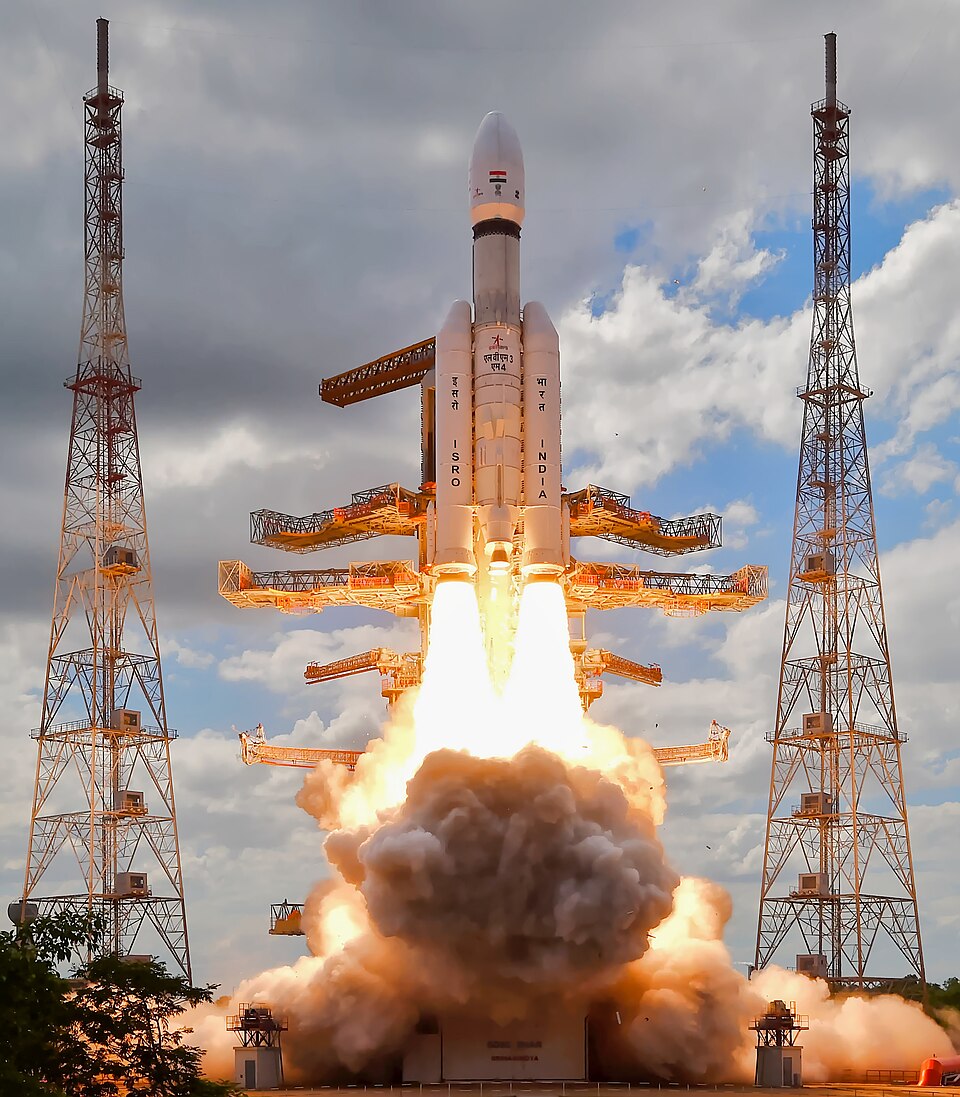
The vehicle at the other end of this question — GSLV Mk III, now called LVM3, whose human-rated version HLVM3 is one of the configurations PraVaHa was used to analyse for Gaganyaan. UPPSC has tracked this launcher family for years.
The "NISAR satellite" is jointly developed by which of the following organizations?
- (a) ISRO and NASA
- (b) ESA and NASA
- (c) ESA and ISRO
- (d) ROSCOSMOS and CNSA
Answer(a) ISRO and NASA
The same examiner habit as statement 1 — take a named space product and ask which organisation is behind it. Whether the answer is 'ISRO and NASA' for NISAR or 'VSSC' for PraVaHa, the examinable unit is the attribution.
- practice — not a real PYQ
'PraVaHa', developed by ISRO and seen in the news in 2024, is
- (a)a satellite navigation constellation
- (b)a computational fluid dynamics software for aerodynamic analysis of space vehicles
- (c)a new solid rocket booster for the LVM3
- (d)a launch-pad automation and countdown system
Answer(b) a computational fluid dynamics software for aerodynamic analysis of space vehicles — its full form is 'Parallel RANS Solver for Aerospace Vehicle Aero-thermo-dynamic Analysis', and it simulates flows over launch vehicles and re-entry bodies.
- practice — not a real PYQ
PraVaHa was developed by which ISRO centre, and was used extensively in the aerodynamic analysis of which programme?
- (a)U R Rao Satellite Centre, Bengaluru — Chandrayaan-3
- (b)Vikram Sarabhai Space Centre, Thiruvananthapuram — Gaganyaan
- (c)Space Applications Centre, Ahmedabad — NavIC
- (d)Liquid Propulsion Systems Centre, Valiamala — Aditya-L1
Answer(b) Vikram Sarabhai Space Centre, Thiruvananthapuram — Gaganyaan; it was applied to the human-rated HLVM3, the Crew Escape System and the Crew Module.