
The "NISAR satellite" is jointly developed by which of the following organizations?
- (a)ISRO and NASA
- (b)ESA and NASA
- (c)ESA and ISRO
- (d)ROSCOSMOS and CNSA
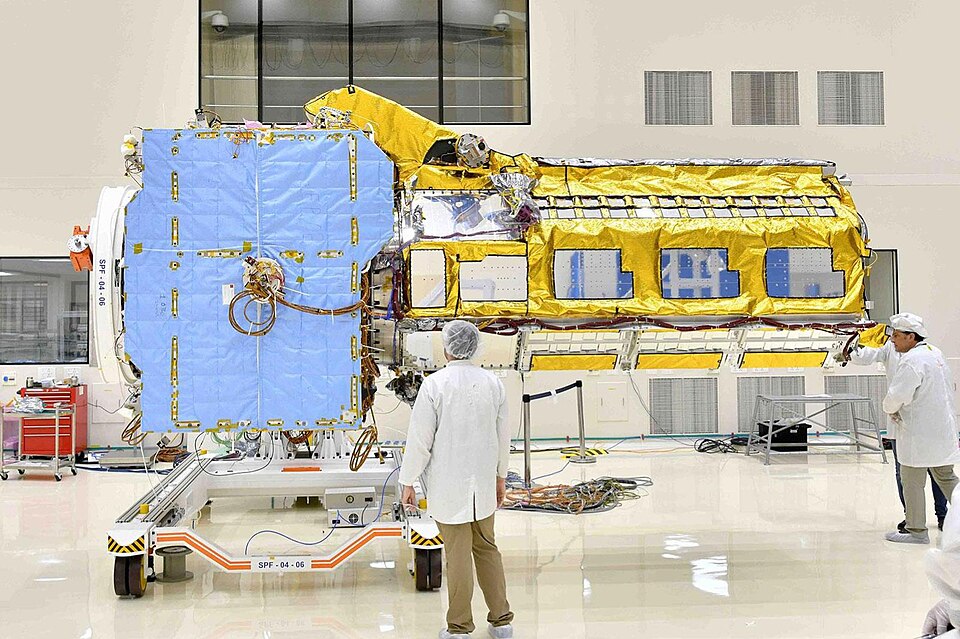
Correct — A, ISRO and NASA. NISAR stands for NASA-ISRO Synthetic Aperture Radar — the name itself encodes the two partners. It is a joint Earth-observation mission of the Indian Space Research Organisation (ISRO) and the US National Aeronautics and Space Administration (NASA), carrying a dual-frequency radar (NASA's L-band and ISRO's S-band) to map land and ice-surface changes.
- (b)ESA and NASA — The European Space Agency (ESA) is not a NISAR partner. NISAR is specifically a NASA-ISRO collaboration.
- (c)ESA and ISRO — ISRO is a partner, but the other party is NASA, not ESA — the mission's name (NASA-ISRO SAR) makes the pairing explicit.
- (d)ROSCOSMOS and CNSA — Russia's ROSCOSMOS and China's CNSA have no role in NISAR; neither appears in the mission's name or design.
NISAR (NASA-ISRO Synthetic Aperture Radar) is a joint Earth-observation satellite developed by ISRO and NASA. It is the first satellite to carry a dual-frequency Synthetic Aperture Radar — NASA's L-band and ISRO's S-band — letting it image the Earth's surface in fine detail, day or night and through cloud cover, to track deformation of land, ice sheets and vegetation.
This is a name-decoding question: the acronym NISAR literally begins 'NASA-ISRO', so a candidate who expands it correctly reaches the answer. The distractors swap in other major space agencies (ESA, ROSCOSMOS, CNSA) to tempt those who recognise NISAR only vaguely as an international mission.
- NISAR = NASA-ISRO Synthetic Aperture Radar — a joint ISRO-NASA Earth-observation mission.
- It carries a dual-frequency SAR: NASA supplies the L-band radar, ISRO the S-band radar.
- SAR imaging works day and night and can see through clouds, tracking land, ice and biomass change.
- ISRO provides the S-band radar, spacecraft bus and launch (GSLV from Satish Dhawan Space Centre, Sriharikota).
- Guessing ESA or ROSCOSMOS as a partner without decoding the acronym 'NASA-ISRO'
- Confusing NISAR (radar Earth observation) with other ISRO missions like Aditya-L1 or Chandrayaan
UPPSC/UPSC test recent space missions by asking for the partner agencies, the payload type (SAR), or the objective of the mission.
- practice — not a real PYQ
The primary payload of the NISAR satellite is a:
- (a)Optical high-resolution camera
- (b)Dual-frequency Synthetic Aperture Radar (SAR)
- (c)Hyperspectral imager
- (d)Microwave sounder for weather
Answer(b) Dual-frequency Synthetic Aperture Radar — NASA's L-band and ISRO's S-band. - practice — not a real PYQ
Which of the following is an advantage of Synthetic Aperture Radar (SAR) used in NISAR over optical imaging?
- (a)It works only in bright daylight
- (b)It can image day or night and see through clouds
- (c)It measures atmospheric ozone
- (d)It requires no satellite platform
Answer(b) It can image day or night and penetrate cloud cover.