
Given below are two statements, one is labelled as Assertion (A) and the other as Reason (R). Assertion (A) : In April 2024, India delivered the BrahMos Supersonic Cruise Missile to Philippines. Reason (R) : The Missile has a range of 490 kilometres. Select the correct answer from the codes given below :
- (a)Both (A) and (R) are true, but (R) is not the correct explanation of (A).
- (b)(A) is false, but (R) is true.
- (c)Both (A) and (R) are true and (R) is the correct explanation of (A).
- (d)(A) is true, but (R) is false.
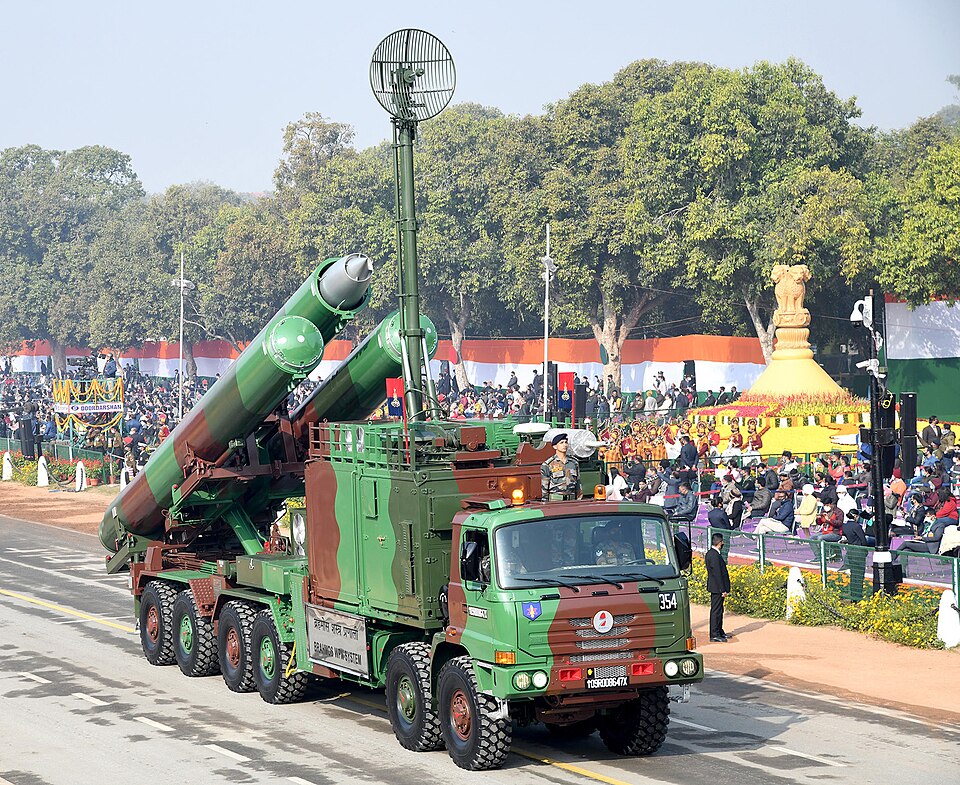
Correct — D, (A) is true, but (R) is false. The Assertion is a fact of April 2024: on 19 April 2024 an Indian Air Force heavy-lift transport flew the first battery of the BrahMos shore-based anti-ship missile system to the Philippines, handing it to the Philippine Marine Corps. That delivery closed the contract signed on 28 January 2022 — about US $375 million for three batteries — and it was India's first export of the missile to a foreign navy, which is exactly why it was in every current-affairs compilation of 2024. The Reason fails on a number. The BrahMos supplied for export flies to 290 km, not 490 km. That 290 km figure is not an accident of design: it is the ceiling India observed for a transferable system under the Missile Technology Control Regime, whose Category-I rule discourages export of systems able to carry a 500 kg payload beyond 300 km. Longer-legged variants exist — after India joined the MTCR in June 2016 the extended-range BrahMos was tested for Indian service — but the Philippine package is the 290 km version. So (A) stands and (R) falls, which is option (d). One more habit worth building here: even if the Reason had carried a correct range, a range figure could never *explain* a delivery. Assertion–Reason marking rewards checking each statement on its own truth first, and only then asking whether the second is the cause of the first.
- (a)Both (A) and (R) are true, but (R) is not the correct explanation of (A). — This needs both statements to be true, and the Reason is not. The export BrahMos has a range of 290 km; 490 km is not the figure for the system sold to the Philippines. Note that the rest of this option — that a range figure would not be the correct explanation of a delivery — is sound reasoning; it is the truth of (R) that sinks it.
- (b)(A) is false, but (R) is true. — Inverts the item completely. The Assertion is the well-documented half: the first BrahMos battery reached the Philippine Marine Corps on 19 April 2024, flown in by the Indian Air Force under the January 2022 contract. It is the Reason, not the Assertion, that carries the wrong number.
- (c)Both (A) and (R) are true and (R) is the correct explanation of (A). — Fails twice over. The Reason is false on the range (290 km, not 490 km), and even a true range would not be the reason India delivered the missile to Manila — that came from a government-to-government defence sale concluded in January 2022, not from any property of the missile's reach.
BrahMos is a supersonic cruise missile built by BrahMos Aerospace, the India–Russia joint venture set up in 1998 whose name fuses the Brahmaputra and the Moskva. Being a cruise missile, it is air-breathing and flies inside the atmosphere on a low, guided path: a solid-propellant booster gets it moving, then a liquid-fuelled ramjet sustains it at close to three times the speed of sound. That is a different animal from a ballistic missile, which is rocket-powered only in its boost phase and then coasts on a ballistic arc. BrahMos is also 'universal' — it has been fired from land launchers, warships, submarines and the Su-30MKI — which is why the same name turns up in naval, army and air-force news items.
Assertion–Reason items in UPPSC are usually decided by one checkable number, and here the number is the range. The trap is that 490 km is plausible-sounding: it sits between the original 290 km and the extended-range figures reported for Indian service, so a candidate who half-remembers 'BrahMos range has been increased' will accept it. The discipline that saves you is to ask which version the item is about. The Philippine contract is an export, and export ranges are shaped by the Missile Technology Control Regime, not by what the missile could do in Indian colours. Once (R) is fixed as false, only options (b) and (d) survive, and (b) would require you to believe the April 2024 delivery never happened — which was one of the most-reported defence stories of that year. So (d) is forced.
- The first BrahMos battery was delivered to the Philippine Marine Corps on 19 April 2024, airlifted by the Indian Air Force; the contract had been signed on 28 January 2022 for about US $375 million covering three batteries of the shore-based anti-ship missile system.
- The export version's range is 290 km — the figure India kept within under the Missile Technology Control Regime, which India joined in June 2016. Extended-range BrahMos variants have since been tested for Indian service; 490 km is not the Philippine figure.
- BrahMos Aerospace is an India–Russia joint venture formed in 1998; the missile is named after the Brahmaputra and the Moskva rivers and flies at roughly Mach 2.8–3.
- Cruise missile vs ballistic missile: a cruise missile is jet- or ramjet-propelled through most of its flight inside the atmosphere, while a ballistic missile is rocket-powered only in the boost phase and then follows a ballistic trajectory. BrahMos is a supersonic cruise missile; Agni-V is a long-range ballistic missile.
- Quoting an Indian-service range for an exported system. The Philippine BrahMos is the 290 km version; extended-range figures belong to variants developed after India joined the MTCR.
- Calling BrahMos a ballistic missile, or Agni a cruise missile — UPSC set exactly this swap in 2023 and it is still the most common single error in this topic.
- In Assertion–Reason items, checking the 'explanation' relationship before checking whether each statement is independently true. Truth first, causation second.
UPPSC likes one named defence platform from the year's news, wrapped either as Assertion–Reason with a planted number or as a straight 'which system was commissioned/delivered' recall. UPSC prefers the conceptual cut — classifying a weapon by propulsion or flight profile, or asking what a regime like the MTCR does.
Consider the following statements : 1. Ballistic missiles are jet-propelled at subsonic speeds throughout their flights, while cruise missiles are rocket-powered only in the initial phase of flight. 2. Agni-V is a medium-range supersonic cruise missile, while BrahMos is a solid-fuelled intercontinental ballistic missile. Which of the statements given above is/are correct?
- (a) 1 only
- (b) 2 only
- (c) Both 1 and 2
- (d) Neither 1 nor 2
Answer(d) Neither 1 nor 2
The same missile, tested conceptually rather than by news: UPSC swapped the propulsion of cruise and ballistic missiles and mislabelled BrahMos an intercontinental ballistic missile. Getting that classification right is what tells you which BrahMos range figure is even plausible.
Which one of the following pairs is not correctly matched?
- (a) Arjun : Indigenous produced Main Battle Tank (MBT)
- (b) Phalcon : Cruise missile supplied by Russia to India
- (c) Saras : Indigenously developed civilian passenger aircraft
- (d) Operation Seabird : New Indian Naval Base at Karwar
Answer(b) Phalcon : Cruise missile supplied by Russia to India
The classic trap of attaching the wrong class to a defence system — Phalcon is an airborne early-warning radar, not a cruise missile. Same skill as spotting that 490 km is not the export BrahMos figure: check what the platform actually is before accepting the attribute glued to it.
Which of the following Scorpene Class Submarines was commissioned into Indian Navy in January, 2023?
- (a) INS Karanj
- (b) INS Kalvari
- (c) INS Vagir
- (d) INS Vela
Answer(c) INS Vagir
The same UPPSC habit one year earlier — a single named Indian defence platform from the year's news (INS Vagir, commissioned January 2023) tested for exact recall. Note the classification discipline it rewards: Vagir is a Scorpene-design conventional submarine, just as BrahMos is a supersonic cruise missile, and UPPSC expects the platform, the date and the class together.
- practice — not a real PYQ
The BrahMos missile is best described as
- (a)a subsonic cruise missile developed jointly by India and France
- (b)a supersonic cruise missile developed jointly by India and Russia
- (c)an intermediate-range ballistic missile developed indigenously by DRDO
- (d)a hypersonic glide vehicle developed jointly by India and Israel
Answer(b) a supersonic cruise missile developed jointly by India and Russia — BrahMos Aerospace was set up in 1998 as an India–Russia joint venture; the missile is ramjet-powered and flies at about Mach 2.8–3. India's subsonic cruise missile is Nirbhay; Agni is the ballistic family.
- practice — not a real PYQ
The Missile Technology Control Regime (MTCR), which India joined in 2016, is best described as
- (a)a treaty under the United Nations that bans the possession of ballistic missiles
- (b)an informal, non-binding export-control arrangement among member countries on missiles and related technology
- (c)an organ of the International Atomic Energy Agency that inspects missile facilities
- (d)a defence-production consortium that jointly manufactures missiles for its members
Answer(b) an informal, non-binding export-control arrangement — the MTCR is a voluntary political understanding among member states restricting transfers of missiles and technology, especially systems carrying a 500 kg payload beyond 300 km. It is not a UN treaty, not an IAEA body and not a production consortium.