
Which Geosynchronous Satellite Launch Vehicle was used by ISRO to launch Chandrayaan-2 space craft?
- (a)GSLV – MK III – M1
- (b)GSLV – MK II – M2
- (c)GSLV – MK IV – M8
- (d)GSLV – MK V – M4
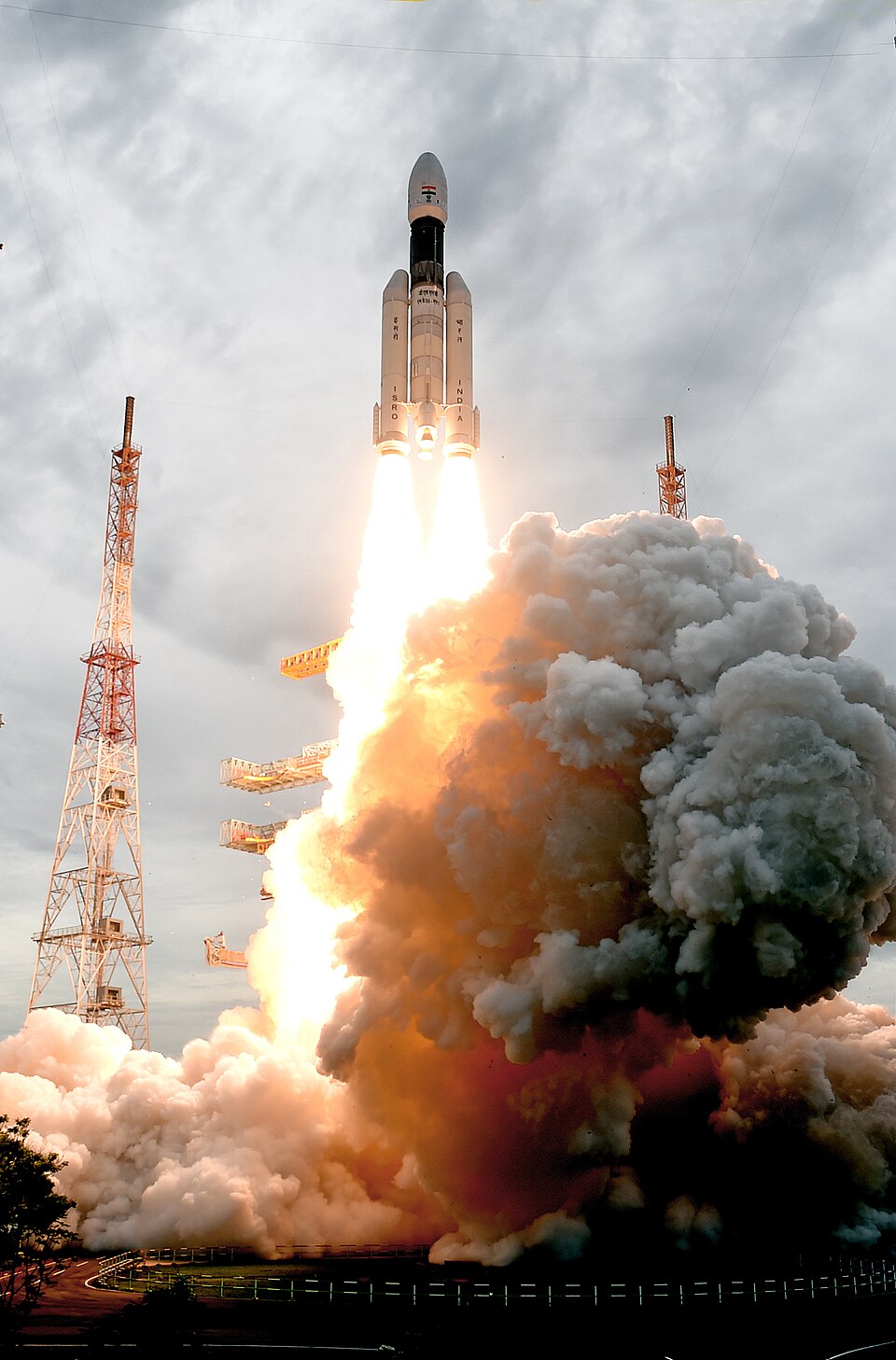
Correct — A, GSLV Mk III-M1. Chandrayaan-2 lifted off on 22 July 2019 at 14:43 IST from the Satish Dhawan Space Centre, Sriharikota, on the GSLV Mk III-M1 — the first operational flight of India's heaviest launcher, popularly nicknamed 'Bahubali' for the roughly 3,850 kg composite spacecraft it had to place in an Earth parking orbit. The mission needed Mk III precisely because the payload (orbiter + Vikram lander + Pragyan rover) was far beyond what the smaller GSLV Mk II or the PSLV could send moonward. The spacecraft entered lunar orbit on 20 August 2019; the Vikram lander deviated from its descent trajectory below about 2.1 km and was lost on 6-7 September 2019, but the orbiter continued to function. The launcher has since been redesignated LVM3, and it was the LVM3-M4 flight that carried Chandrayaan-3 in July 2023 to its successful soft landing.
- (b)GSLV – MK II – M2 — GSLV Mk II is a real vehicle, but it is the smaller three-stage launcher used for two-tonne-class communication satellites, and its flights are designated in the D/F series (GSLV-D5, F08, F11...), not 'M2'. It did not have the lift capability for Chandrayaan-2's composite stack.
- (c)GSLV – MK IV – M8 — There is no GSLV Mk IV. ISRO's GSLV family stops at Mk III (now LVM3); Mk IV is an invented designation meant to catch candidates who assume the numbering simply keeps climbing.
- (d)GSLV – MK V – M4 — There is no GSLV Mk V either. It is the same trap as Mk IV, one step further — an unused Roman numeral attached to a plausible-looking flight number.
ISRO operates a graded fleet of launchers matched to payload mass and orbit. PSLV mainly places remote-sensing satellites in sun-synchronous polar orbits; GSLV Mk II lifts about two tonnes of communication satellite to geostationary transfer orbit using an indigenous cryogenic upper stage; and GSLV Mk III / LVM3 — a three-stage vehicle with two S200 solid strap-ons, a liquid L110 core and a C25 cryogenic upper stage — is the heavy-lift workhorse for four-tonne-class GTO missions and for India's interplanetary and human-spaceflight ambitions. Chandrayaan-2 was the vehicle's first operational (as against developmental) flight.
The question can be cracked without remembering the flight designation: only one Indian launcher was capable of sending Chandrayaan-2's combined orbiter-lander-rover stack toward the Moon, and that is the heaviest one, Mk III. From there, eliminate Mk IV and Mk V because they do not exist, and eliminate Mk II because it is the lighter GTO vehicle. Note also that the flight number M1 marks it as the first mission-series flight of Mk III — a detail worth carrying, since UPPSC printed the full designation rather than just the vehicle name.
- Chandrayaan-2 was launched on GSLV Mk III-M1 on 22 July 2019 from Satish Dhawan Space Centre, Sriharikota.
- It was the first operational flight of GSLV Mk III, the heaviest Indian launcher; the vehicle has since been renamed LVM3.
- The spacecraft entered lunar orbit on 20 August 2019; the Vikram lander was lost during descent on 6-7 September 2019 while the orbiter remained operational.
- GSLV Mk IV and GSLV Mk V do not exist — the family runs PSLV, GSLV Mk II, GSLV Mk III/LVM3.
- Present-day update: Chandrayaan-3 flew on LVM3-M4 on 14 July 2023 and soft-landed near the lunar south pole on 23 August 2023.
- Assuming the GSLV family continues to Mk IV or Mk V — it does not.
- Confusing vehicle-series letters: Mk III flights are numbered M1, M2, M3..., whereas Mk II flights use D (developmental) and F (operational) numbers.
- Forgetting that GSLV Mk III was renamed LVM3, so the same rocket appears under two names in questions from before and after 2022.
UPPSC asks the flat 'which vehicle launched which mission' pairing; UPSC prefers statement-based questions on what each launcher is designed for, orbit types and stage configuration — so learn the vehicle-to-purpose mapping, not just the mission list.
With reference to India's satellite launch vehicles, consider the following statements: 1. PSLVs launch the satellites useful for Earth resources monitoring whereas GSLVs are designed mainly to launch communication satellites. 2. Satellites launched by PSLV appear to remain permanently fixed in the same position in the sky, as viewed from a particular location on Earth. 3. GSLV Mk III is a four-stage launch vehicle with the first and third stages using solid rocket motors; and the second and fourth stages using liquid rocket engines. Which of the statements given above is/are correct?
- (a) 1 only
- (b) 2 and 3
- (c) 1 and 2
- (d) 3 only
Answer(a) 1 only
Same concept from the conceptual side — what each Indian launcher is for and how GSLV Mk III is actually staged, which is exactly the knowledge that lets you pick Mk III for Chandrayaan-2.
With reference to Indian satellites and their launchers, consider the following statements: 1. All the INSAT-series of satellites were launched abroad 2. PSLVs were used to launch IRS-series of satellites 3. India used the indigenously built cryogenic engines for the first time for powering the third stage of GSLV 4. GSAT, launched in the year 2001, has payloads to demonstrate digital broadcasts and internet services Which of these statements are correct?
- (a) 1, 2, 3 and 4
- (b) 2, 3 and 4
- (c) 1, 2 and 4
- (d) 1 and 3
Answer(c) 1, 2 and 4
Same satellite-to-launcher mapping habit, seventeen years earlier, and it covers the GSLV cryogenic-stage story that explains why the Mk III line exists at all.
- practice — not a real PYQ
Chandrayaan-2 was launched from which of the following centres?
- (a)Vikram Sarabhai Space Centre, Thiruvananthapuram
- (b)Satish Dhawan Space Centre, Sriharikota
- (c)U R Rao Satellite Centre, Bengaluru
- (d)Space Applications Centre, Ahmedabad
Answer(b) Satish Dhawan Space Centre, Sriharikota — the launch took place there on 22 July 2019; the other centres design vehicles, build satellites and develop payloads but do not launch.
- practice — not a real PYQ
GSLV Mk III has been redesignated by ISRO as
- (a)LVM3
- (b)PSLV-XL
- (c)SSLV
- (d)GSLV Mk IV
Answer(a) LVM3 — the vehicle was renamed the Launch Vehicle Mark-3 because it is used for far more than geosynchronous missions; the same rocket carried Chandrayaan-2 in 2019 and Chandrayaan-3 in 2023.