
Who among the following had translated Chintamani Bhatt's Sanskrit text 'Suka Saptati' in Persian and gave it the title 'Tutinama' ?
- (a)Abdur Razzak
- (b)Amir Khusro
- (c)Khwaza Ziya-uddin Nakhshabi
- (d)Shihabuddin-al-Umari
Answer
Why
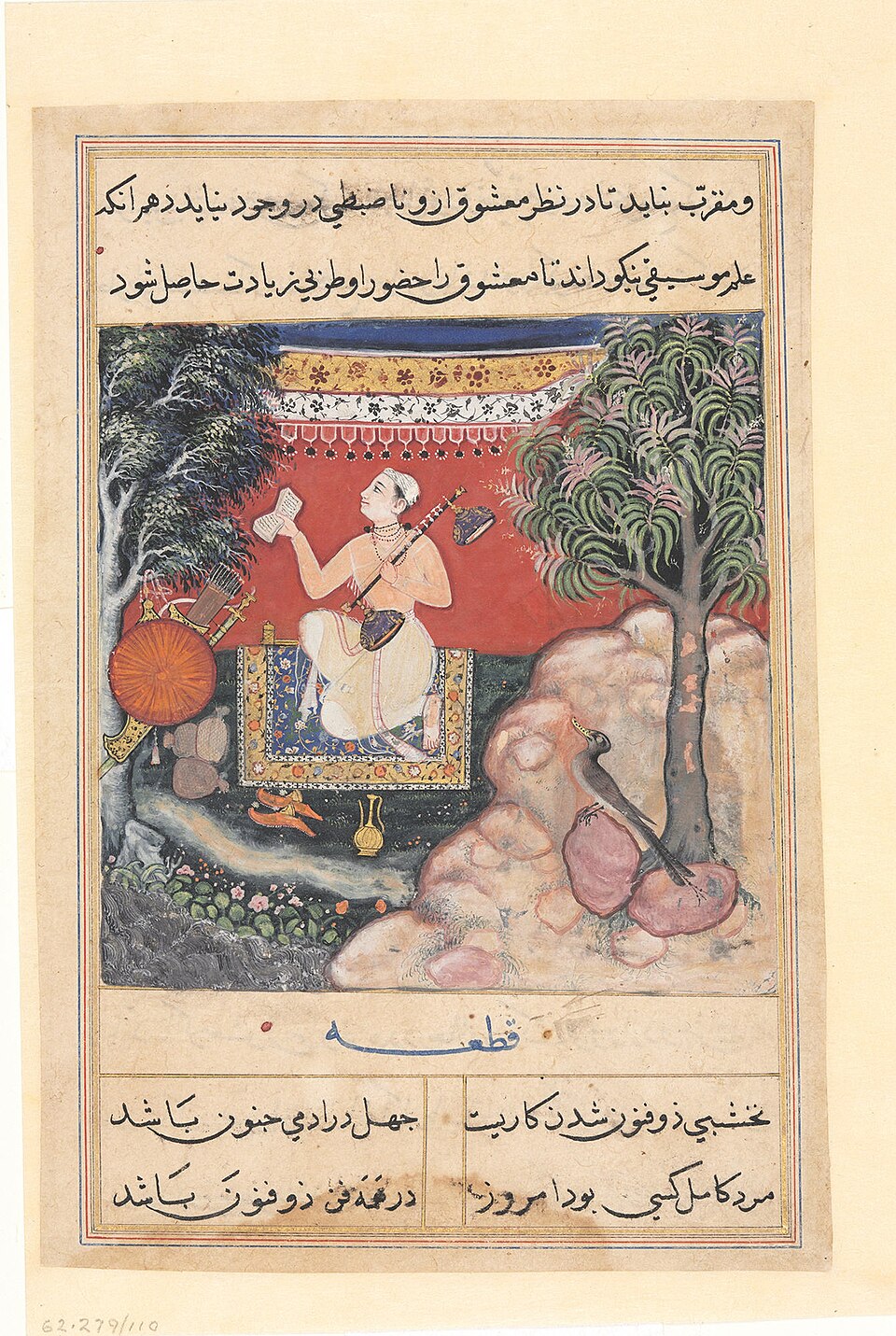
Correct — C, Khwaza Ziya-uddin Nakhshabi. Ziya-ud-din Nakhshabi — the name is also transliterated Khwaja Ziya'al-Din Nakhshabi — was a Persian-writing physician and Sufi who migrated to Badaun, in what is now Uttar Pradesh, in the fourteenth century. There, in about 1330-1335, he recast the Sanskrit Sukasaptati, the 'Seventy Tales of the Parrot', into Persian and gave the new work the title Tutinama, literally 'Book of the Parrot'. It is a frame narrative: a parrot holds a merchant's wife at home night after night by beginning a story and leaving it unfinished until dawn. Nakhshabi did not translate mechanically — he reworked and abridged the tales for a Persian readership, which is why the Tutinama is normally described as his version rather than a plain rendering. The work later became famous through the lavishly illustrated manuscript produced for Emperor Akbar in the 1560s, a large part of which is now in the Cleveland Museum of Art. One caution on the stem: the attribution of the Sukasaptati to Chintamani Bhatta comes from Indian textbook accounts and is the commission's framing; the authorship of that Sanskrit collection, which is dated to roughly the twelfth century, is not securely settled, and nothing in the answer depends on it.
Why the others are wrong
- (a)Abdur Razzak — Abdur Razzaq was a fifteenth-century Timurid envoy sent from Herat by Shah Rukh, who visited Calicut and the Vijayanagara court of Devaraya II in 1442-43. He is a source, not a translator — his account of what he saw survives in the Matla-us-Sadain wa Majma-ul-Bahrain. Wrong century and wrong kind of work.
- (b)Amir Khusro — The strongest distractor, because Amir Khusrau really was the great Persian literary figure of the Delhi Sultanate in exactly this period and really did write on Indian themes. But his works are his own compositions — the Khazain-ul-Futuh, the Tughlaq Nama, the Nuh Sipihr, the Persian masnavis — not a translation of the Sukasaptati. Fame in Persian letters is not the same as authorship of this particular text.
- (d)Shihabuddin-al-Umari — Shihabuddin al-Umari was an Arab administrator and encyclopaedist at Damascus and Cairo who wrote the Masalik-ul-Absar. His account of India is second-hand: he never came to India, and he wrote in Arabic, not Persian.
Concept
Translation from Sanskrit into Persian was one of the long continuities of medieval Indian court culture, running from the Sultanate into the Mughal period. Firoz Shah Tughlaq had Sanskrit manuscripts taken from Nagarkot rendered into Persian; Nakhshabi's Tutinama belongs to the same fourteenth-century current, though it was a private literary project rather than a royal commission. Under Akbar the practice was institutionalised in a translation bureau, which produced the Razmnama (the Mahabharata), a Persian Ramayana, and Nizamuddin Panipati's Jug-Bashisht from the Yogavasistha; Dara Shukoh's Sirr-i-Akbar, a Persian version of the Upanishads, is the seventeenth-century culmination. The Tutinama's own afterlife is part of this story — Akbar had it illustrated, and its miniatures are among the earliest surviving works of the Mughal atelier.
The elimination here is by role, not by fame. Three of the four names are famous for something other than translating a Sanskrit text: Abdur Razzaq is a foreign envoy whose travel account we read as a source on Vijayanagara, al-Umari is an Arabic encyclopaedist writing at a distance, and Amir Khusrau is an original poet. Only Nakhshabi is remembered specifically as the man who turned the Sukasaptati into the Tutinama, and his association with Badaun makes him a favourite with UPPSC because the place lies in Uttar Pradesh. When a question names both a source text and a derived title, fix the pair as a unit — Sukasaptati to Tutinama, Yogavasistha to Jug-Bashisht, Mahabharata to Razmnama, Upanishads to Sirr-i-Akbar.
Key facts
- Ziya-ud-din Nakhshabi, a Persian-writing physician and Sufi settled at Badaun in present-day Uttar Pradesh, produced the Tutinama in about 1330-1335 from the Sanskrit Sukasaptati.
- 'Tutinama' means 'Book of the Parrot'; the Sanskrit original, the Sukasaptati or 'Seventy Tales of the Parrot', is dated to roughly the twelfth century.
- The illustrated Tutinama made for Akbar in the 1560s is one of the earliest surviving Mughal manuscript projects; the largest part of it is held by the Cleveland Museum of Art.
- Abdur Razzaq wrote the Matla-us-Sadain after his 1442-43 embassy to Vijayanagara; Shihabuddin al-Umari wrote the Masalik-ul-Absar in Arabic without ever visiting India.
Study next
Common traps
- Marking Amir Khusrau because he is the best-known Persian writer of the period, when the question asks specifically for a translator of the Sukasaptati
- Confusing the Tutinama with the Hamzanama; both were illustrated for Akbar but the Hamzanama is the Persian romance of Amir Hamza, not a translation from Sanskrit
- Treating the stem's attribution of the Sukasaptati to Chintamani Bhatta as settled scholarship — it is a textbook attribution, and the answer does not turn on it
UPPSC asks medieval literature as a direct 'who wrote / who translated' recall or as a match list of authors and works, and it favours figures with an Uttar Pradesh connection such as Nakhshabi at Badaun. UPSC prefers to place the work in its court and reign — 'translated during the reign of whom' — so learn each text with its translator, its patron and its ruler.
Related PYQs
"YogaVasistha" was translated into Persian by Nizamuddin Panipati during the reign of:
- (a) Akbar
- (b) Humayun
- (c) Shahjahan
- (d) Aurangzeb
Answer(a) Akbar
The identical concept — a named Sanskrit work turned into Persian by a named translator — asked in the same examination year. UPSC asks for the reign; UPPSC asks for the translator. Learn the triplet text-translator-patron and both forms are covered.
Who among the following translated 300 volumes of Sanskrit books collected by Firoz Tuglaq during the campaign of Nagarkot?
- (a) Azizuddin Khan
- (b) Mulla Abdul Baqi
- (c) Mirza Muhammad Ali
- (d) Talib Amuli
Answer(a) Azizuddin Khan
The same Sultanate-period translation movement, one generation later and under royal patronage rather than private initiative. Firoz Shah Tughlaq's Nagarkot manuscripts and Nakhshabi's Tutinama are the two Sultanate anchors UPPSC keeps returning to.
Practice
- practice — not a real PYQ
The Persian work 'Tutinama' is a rendering of which Sanskrit text?
- (a)Kathasaritsagara
- (b)Sukasaptati
- (c)Panchatantra
- (d)Hitopadesha
Answer(b) Sukasaptati — the 'Seventy Tales of the Parrot', recast into Persian as the Tutinama by Ziya-ud-din Nakhshabi in the fourteenth century. - practice — not a real PYQ
Consider the following pairs of Persian translation and Sanskrit original: 1. Razmnama — Mahabharata 2. Sirr-i-Akbar — Upanishads 3. Jug-Bashisht — Yogavasistha Which of the pairs given above are correctly matched?
- (a)1 and 2 only
- (b)2 and 3 only
- (c)1 and 3 only
- (d)1, 2 and 3
Answer(d) 1, 2 and 3 — the Razmnama was Akbar's Mahabharata, Dara Shukoh's Sirr-i-Akbar rendered the Upanishads, and Nizamuddin Panipati's Jug-Bashisht rendered the Yogavasistha.