
Sinovac given for Covid-19 is a
- (a)Non-replicating viral vector
- (b)mRNA vaccine
- (c)Protein sub-unit
- (d)Whole virus vaccine
Answer
Why
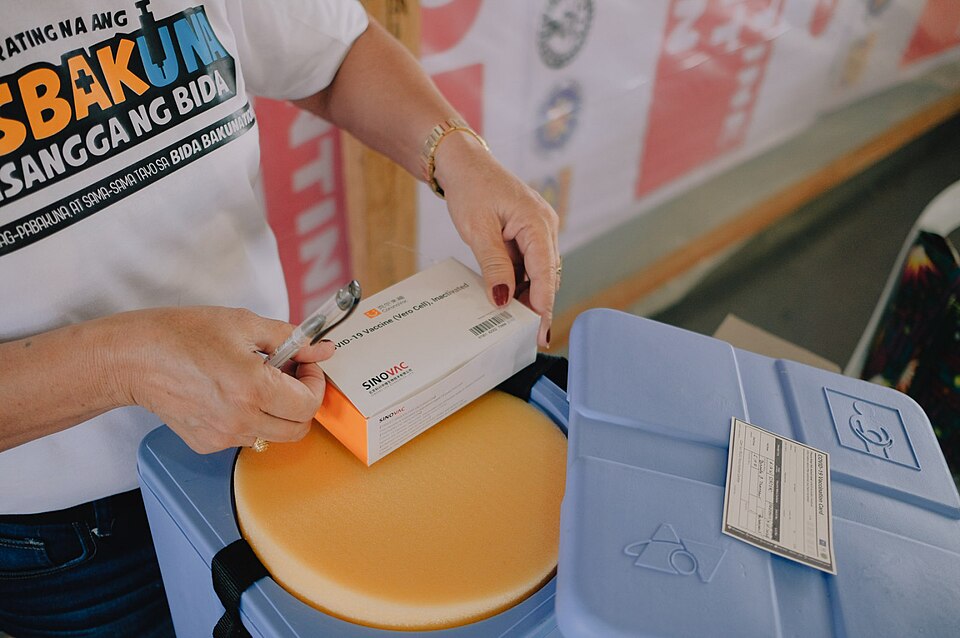
Correct — D, Whole virus vaccine. Sinovac is the Beijing-based company Sinovac Biotech, and its Covid-19 product CoronaVac is made the oldest way there is: whole SARS-CoV-2 virus is grown in cell culture (Vero cells), then killed with beta-propiolactone so that it can no longer replicate, and the dead but structurally intact virus is combined with an aluminium hydroxide adjuvant. Because the entire killed virion is injected, the immune system sees every surface antigen the virus carries, not just the spike protein — that is what 'whole virus vaccine' means. This is the same traditional inactivated platform used by India's own Covaxin (BBV152, Bharat Biotech) and by Sinopharm's BBIBP-CorV, which is why the three are usually grouped together in comparison tables. Two small precisions worth carrying: 'whole virus' is the broader family that covers both live-attenuated and inactivated vaccines, and CoronaVac belongs to the inactivated half; and the adjuvant is needed precisely because a killed virus is less immunogenic than a live one.
Why the others are wrong
- (a)Non-replicating viral vector — This platform uses a harmless carrier virus, engineered so it cannot multiply in the recipient, to deliver the gene for the coronavirus spike protein. The Covid vaccines built this way are Oxford–AstraZeneca (marketed in India as Covishield), Russia's Sputnik V and the Janssen single-dose vaccine — not CoronaVac. Sinovac delivers no genetic instruction at all; it delivers the killed virus itself.
- (b)mRNA vaccine — The mRNA platform injects lab-made messenger RNA in a lipid nanoparticle so that the recipient's own cells manufacture the spike protein. The two Covid vaccines of this kind are Pfizer–BioNTech's Comirnaty and Moderna's Spikevax. It was the newest of the Covid platforms and the one that required ultra-cold storage; CoronaVac, by contrast, is stable at ordinary refrigerator temperatures precisely because it is a conventional inactivated vaccine.
- (c)Protein sub-unit — A subunit vaccine contains only a selected piece of the pathogen — for Covid, the spike protein or its receptor-binding domain — manufactured separately and given with an adjuvant. Novavax (licensed in India as Covovax) and Biological E's Corbevax are the subunit examples. The whole point of the subunit approach is that no complete virus is present; CoronaVac contains the complete, killed virion.
Concept
Vaccines are classified by what is actually injected. Whole-organism vaccines use the entire pathogen, either weakened so it can no longer cause disease (live-attenuated: BCG, oral polio, measles) or killed outright (inactivated: injectable polio, hepatitis A, CoronaVac, Covaxin). Subunit vaccines use only a purified fragment such as a surface protein. Toxoid vaccines use an inactivated bacterial toxin. Viral-vector vaccines use an unrelated, non-replicating virus to carry a gene for the target antigen. Nucleic-acid vaccines — mRNA and DNA — deliver the genetic instruction directly and let the body build the antigen itself. The trade-offs run in a predictable direction: the older whole-virus platforms are cheap, need no exotic cold chain and provoke a broad response to many antigens, but they are slow to manufacture and usually need an adjuvant and booster doses, while the newer genetic platforms can be designed within weeks of a genome being published but demand far more sophisticated production and storage.
The question is a single-fact recall, so the reliable route is to memorise the Covid vaccines platform by platform rather than by country of origin. Group them once: inactivated whole-virus — CoronaVac (Sinovac), BBIBP-CorV (Sinopharm), Covaxin; non-replicating viral vector — Covishield/AstraZeneca, Sputnik V, Janssen; mRNA — Pfizer–BioNTech, Moderna; protein subunit — Novavax/Covovax, Corbevax; DNA — ZyCoV-D. The trap in 2022 was the assumption that a vaccine in the headlines during the pandemic must sit on one of the new platforms. In fact the Chinese and Indian mass-produced vaccines deliberately used the oldest and most manufacturable technology available, which is also why they could be shipped at 2–8 °C to countries with ordinary cold chains.
Key facts
- CoronaVac, made by Sinovac Biotech, is a whole inactivated-virus Covid-19 vaccine: SARS-CoV-2 grown in Vero cell culture and killed with beta-propiolactone.
- It is adjuvanted with aluminium hydroxide, because a killed virus on its own provokes a weaker immune response than a live one.
- The same inactivated whole-virion platform is used by India's Covaxin (BBV152, Bharat Biotech) and by Sinopharm's BBIBP-CorV.
- The distractors are all real Covid platforms used by other vaccines: non-replicating viral vector — Covishield/AstraZeneca, Sputnik V, Janssen; mRNA — Pfizer–BioNTech and Moderna; protein subunit — Novavax/Covovax and Corbevax.
- 'Whole virus vaccine' is the umbrella term covering both live-attenuated vaccines (BCG, oral polio, measles) and inactivated ones; CoronaVac belongs to the inactivated group.
- Inactivated vaccines are typically stable at ordinary refrigeration (2–8 °C), whereas the mRNA vaccines required much colder storage — a decisive practical difference during the pandemic.
Study next
Common traps
- Assuming that a vaccine developed during the Covid-19 pandemic must use a new platform — the Chinese and Indian mass-market vaccines deliberately used the oldest one.
- Reading 'whole virus' as necessarily meaning live-attenuated; CoronaVac is whole but inactivated, so it cannot replicate.
- Mixing up the two Chinese vaccines — Sinovac's CoronaVac and Sinopharm's BBIBP-CorV are different products, though both are inactivated whole-virus vaccines.
UPPSC asks it as a bare one-liner — 'X vaccine is a …' or 'which of these is an mRNA vaccine' — and has now used this format in consecutive years; UPSC prefers a multi-statement item that pairs several vaccines with their platforms and asks how many pairs are correct.
Related PYQs
In the context of vaccines manufactured to prevent COVID-19 pandemic, consider the following statements: 1. The Serum Institute of India produced COVID-19 vaccine named Covishield using mRNA platform. 2. Sputnik V vaccine is manufactured using vector based platform. 3. COVAXIN is an inactivated pathogen based vaccine. Which of the statements given above are correct?
- (a) 1 and 2 only
- (b) 2 and 3 only
- (c) 1 and 3 only
- (d) 1, 2 and 3
Answer(b) 2 and 3 only
The identical concept — matching a named Covid vaccine to its manufacturing platform — asked in the very same year, and its statement 3 (Covaxin is inactivated-pathogen based) names the platform CoronaVac also uses.
Which of the following is mRNA vaccine used against Covid-19 infection?
- (a) Sinovac
- (b) Moderna
- (c) Sputnik
- (d) Novavax
Answer(b) Moderna
UPPSC asked the same platform-matching idea from the opposite end a year later, with Sinovac itself sitting as the distractor at option (a) — a student who knows CoronaVac is an inactivated whole-virus vaccine answers both questions.
Practice
- practice — not a real PYQ
Which one of the following pairs of Covid-19 vaccine and platform is correctly matched?
- (a)Covishield — messenger RNA
- (b)Covaxin — inactivated whole virion
- (c)Sputnik V — protein subunit
- (d)Corbevax — non-replicating viral vector
Answer(b) Covaxin — inactivated whole virion. Covishield is a viral-vector vaccine, Sputnik V a viral-vector vaccine and Corbevax a protein-subunit vaccine. - practice — not a real PYQ
Inactivated whole-virus vaccines such as CoronaVac are generally given with an adjuvant such as aluminium hydroxide because
- (a)the adjuvant kills any virus particles that survive the inactivation step
- (b)a killed virus cannot replicate and so stimulates a weaker immune response, which the adjuvant enhances
- (c)the adjuvant allows the vaccine to be stored below minus seventy degrees Celsius
- (d)the adjuvant supplies the genetic instruction for the spike protein
Answer(b) a killed virus cannot replicate and so stimulates a weaker immune response, which the adjuvant enhances — the reason inactivated vaccines usually need adjuvants and booster doses.