
Which of the following coasts is the largest tidal energy producing area in India ?
- (a)Mannar Coast
- (b)Kerala Coast
- (c)North Circars Coast
- (d)Khambhat Coast
Answer
Why
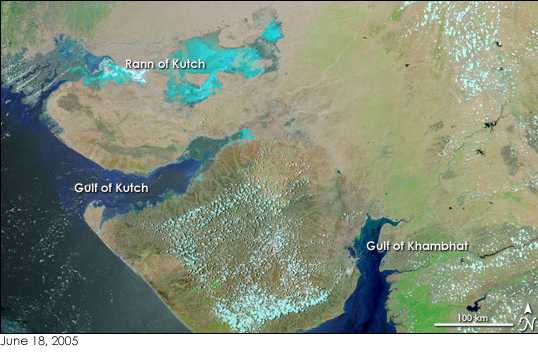
Correct — D, Khambhat Coast. The Gulf of Khambhat, on the Gujarat coast, holds by far the largest tidal energy resource in India. The Ministry of New and Renewable Energy's assessment puts the country's tidal potential at roughly 8,000 MW, of which about 7,000 MW lies in the Gulf of Khambhat alone, about 1,200 MW in the Gulf of Kutch and under 100 MW in the Gangetic delta and the Sundarbans. The reason is geometry: Khambhat is a funnel-shaped gulf that narrows and shallows northward, so the incoming tide is squeezed and amplified, giving a tidal range of about 11 to 12 metres between high and low water — the largest anywhere on the Indian coast, against roughly 8 metres in the Gulf of Kutch and 6 to 7 metres in the Sundarbans. NOW THE HONEST PART, and a student should carry it away from this card: the stem says 'producing', and India produces no tidal power at all. There is not a single tidal power plant in operation anywhere in the country. Two were sanctioned and then dropped on cost — a 3.75 MW project at Durgaduani creek in the Sundarbans, taken up in 2007, and a 50 MW project in the Gulf of Kutch, taken up in 2011. The commission's key marks (d), and (d) is the right answer to the question the examiner meant to ask: which coast has the largest tidal energy POTENTIAL. Read as written, about production, the question has no correct answer, because the quantity produced everywhere in India is zero.
Why the others are wrong
- (a)Mannar Coast — The Gulf of Mannar, between the Tamil Nadu coast and Sri Lanka, is a shallow, broad, open embayment without the funnelling geometry that amplifies a tide, and its tidal range is small. What it is genuinely famous for is ecology, not energy: it is India's first Marine Biosphere Reserve, with coral reefs, seagrass beds, dugongs and the historic pearl banks. Candidates pick it because the name is familiar from the environment syllabus, not because of anything to do with tides.
- (b)Kerala Coast — The Kerala coast is a smooth, largely straight shoreline on the Arabian Sea, fringed by lagoons and backwaters. It has no gulf or estuary that constricts the tide, and its tidal range is of the order of a metre — nowhere near the 11 to 12 metres of the Gulf of Khambhat. Kerala's renewable-energy interest lies elsewhere; tidal power is not a resource it possesses in any significant measure.
- (c)North Circars Coast — The North Circars is the northern Andhra stretch of the east coast, a smooth deltaic shoreline built out by the Godavari and the Krishna. It is an emergent, gently shelving coast with a modest tidal range and, again, no funnel-shaped gulf. Its energy significance is entirely different — the Krishna–Godavari basin offshore is a hydrocarbon province, which is gas, not tides.
Concept
Tidal energy is extracted in two broad ways: by damming an estuary with a barrage so that water impounded at high tide is released through turbines at low tide, or by placing turbines directly in a fast tidal stream. Both depend on the same two variables — the tidal range and the speed of the tidal current — and both need a coastline shaped to amplify them. A funnel-shaped, progressively narrowing and shallowing gulf does exactly that, which is why the world's tidal power sites are gulfs and estuaries such as the Bay of Fundy, the Severn and La Rance rather than open coasts. In India that geometry occurs on the Gujarat coast, in the Gulfs of Khambhat and Kutch, and in a weaker form in the tidal creeks of the Sundarbans; the peninsular east and west coasts are comparatively straight and have small tidal ranges. Tidal energy is a non-conventional, renewable source, but unlike solar and wind it is also almost perfectly predictable, because tides are governed by astronomy rather than by weather.
Two things are worth taking from this question. The first is the reasoning route: do not try to recall a fact about tidal energy at all, but ask which of the four coasts is a narrowing gulf. Mannar is an open bay, Kerala is a straight coast and the North Circars is a deltaic coast; only Khambhat is a funnel. Coastal geometry answers the question without any energy data. The second is a caution about the language of Indian renewable-energy statistics. Ministry documents routinely publish 'potential' figures — 8,000 MW of tidal, tens of gigawatts of small hydro, hundreds of gigawatts of wind — and examiners frequently convert 'potential' into 'production' without noticing that the two are completely different quantities. India's installed tidal capacity is nil. A candidate who reads such a question as a potential question will mark the intended answer and will also, correctly, not believe that India generates tidal electricity.
Key facts
- India's tidal energy potential is assessed at roughly 8,000 MW, of which about 7,000 MW is in the Gulf of Khambhat, about 1,200 MW in the Gulf of Kutch and under 100 MW in the Gangetic delta and Sundarbans; higher purely theoretical estimates of around 12 GW also circulate.
- The Gulf of Khambhat has a tidal range of about 11 to 12 metres — the largest on the Indian coast — against about 8 metres in the Gulf of Kutch and 6 to 7 metres in the Sundarbans.
- India has NO operating tidal power plant. A 3.75 MW project at Durgaduani creek in the Sundarbans (2007) and a 50 MW project in the Gulf of Kutch (2011) were both dropped because of cost.
- Tidal power depends on tidal range and current speed, and therefore on funnel-shaped gulfs and estuaries; the Gulf of Mannar, the Kerala coast and the North Circars coast all lack that geometry.
- Tidal energy is a renewable, non-conventional source and is highly predictable, because tides depend on the positions of the Moon and Sun rather than on weather.
Study next
Common traps
- Reading 'producing' literally and expecting a working plant. India has no operating tidal power station; the question is really about potential, and the key marks Khambhat on that basis.
- Choosing a coast because it is famous for something else. The Gulf of Mannar is famous as a marine biosphere reserve and the North Circars for offshore gas — neither has a large tidal resource.
- Confusing the two Gujarat gulfs. Both have large tidal ranges, but Khambhat's is bigger — about 11 to 12 metres against about 8 metres — and it holds the great bulk of the national potential.
UPPSC tests energy mainly through classification — which sources are conventional and which are not, which is renewable and which is not — and through place-specific geography. UPSC has repeatedly tested tides themselves: why they occur, what spring and neap tides are, and how tidal ports such as Kandla and Diamond Harbour work. Prepare tidal energy at the intersection of the two: the physics of the tide, the coastal geometry that concentrates it, and the Indian sites where that geometry occurs.
Related PYQs
Consider the following statements: I. Tides are of great help in navigation and fishing. II. High tide enables big ships to enter or leave the harbour safely. III. Tide prevents siltation in the harbours. IV. Kandla and Diamond Harbour are tidal ports. Which of these statements are correct?
- (a) I and IV
- (b) II, III and IV
- (c) I, II and III
- (d) I, II, III and IV
Answer(d) I, II, III and IV
The economic use of the same phenomenon, and it names Kandla — a port on the Gulf of Kutch, the other Gujarat gulf with a large tidal range. Wherever the tide is big enough to run a tidal port it is also big enough to be an energy resource, so this question and the 2022 one rest on the same coastal geometry.
Tides occur in the oceans and seas due to which among the following? 1. Gravitational force of the Sun 2. Gravitational force of the Moon 3. Centrifugal force of the Earth
- (a) 1 only
- (b) 2 and 3 only
- (c) 1 and 3 only
- (d) 1, 2 and 3
Answer(d) 1, 2 and 3
The physics underneath the resource. Because tides are produced by the Moon, the Sun and the Earth's rotation rather than by weather, tidal power is the one renewable whose output can be predicted years ahead — the point that makes it worth assessing coast by coast in the first place.
Non-conventional energy sources are those energy sources, that are -
- (a) Produced from electricity
- (b) Renewable
- (c) Produced from heat
- (d) Non-renewable
Answer(b) Renewable
The category to which tidal energy belongs, tested directly by the same commission the following year. UPPSC's energy questions turn overwhelmingly on classification — conventional against non-conventional, renewable against non-renewable — with the site-specific resource questions like this 2022 item layered on top.
A non-renewable source of energy is
- (a) Solar energy
- (b) Petroleum
- (c) Wind energy
- (d) Biogas
Answer(b) Petroleum
The same classification asked in reverse a year earlier. Together the two confirm that UPPSC expects every energy source to be filed under renewable or non-renewable before anything else is learnt about it — tidal energy belonging squarely in the renewable, non-conventional column.
Practice
- practice — not a real PYQ
The Gulf of Khambhat has the largest tidal energy potential in India mainly because
- (a)it lies closest to the equator, where the Moon's pull is strongest
- (b)it is a funnel-shaped gulf that narrows and shallows inward, amplifying the tidal range
- (c)several large rivers discharge into it and increase the volume of water
- (d)it experiences the highest ocean surface temperatures on the Indian coast
Answer(b) it is a funnel-shaped gulf that narrows and shallows inward, amplifying the tidal range — the constriction raises the tidal range to about 11 to 12 metres, the largest on the Indian coast. River discharge and sea temperature have nothing to do with tidal energy, and tidal range is not governed by latitude in this way. - practice — not a real PYQ
Which one of the following statements about tidal energy is correct ?
- (a)It is a non-renewable source of energy
- (b)It is renewable but its timing cannot be predicted in advance
- (c)It is renewable and its timing can be predicted accurately, since tides depend on the positions of the Moon and the Sun
- (d)It can be harnessed equally well on any stretch of coastline
Answer(c) It is renewable and its timing can be predicted accurately, since tides depend on the positions of the Moon and the Sun — this predictability is tidal energy's main advantage over solar and wind. It cannot, however, be harnessed anywhere: it needs a large tidal range or a strong tidal current, which in practice means a funnel-shaped gulf or estuary.