
Match List – I with List – II and select the correct answer from the code given below the lists. List – I (Building) A. Sultan garhi B. Red Palace C. Jamat Khana Masjid D. Dhai Din Ka Jhopra List – II (Builders) 1. Alauddin Khilji 2. Qutbuddin Aibak 3. Iltutmish 4. Balban Code :
- (a)A-3, B-4, C-2, D-1
- (b)A-4, B-3, C-2, D-1
- (c)A-3, B-4, C-1, D-2
- (d)A-4, B-3, C-1, D-2
Correct — C, A-3, B-4, C-1, D-2. Taking the four buildings in turn: SULTAN GHARI in Delhi was raised by ILTUTMISH in 1231 as the tomb of his eldest son, Prince Nasiruddin Mahmud, and is reckoned the first monumental Islamic tomb built in India (A-3). The RED PALACE, the Lal Mahal of Delhi, is attributed to BALBAN — the standard Delhi topographies, such as Hearn's The Seven Cities of Delhi, refer to it simply as 'the Red Palace of Balban' (B-4). The JAMAT KHANA MASJID at the dargah of Shaikh Nizamuddin Auliya in Delhi belongs to the reign of ALAUDDIN KHALJI: its central hall and dome were completed in 1312–13, built by his son Khizr Khan, who was a follower of the saint — so the pairing is right at the level of reign and dynastic patronage, with the son as the immediate builder (C-1). And the DHAI DIN KA JHOPRA at Ajmer was commissioned by QUTBUDDIN AIBAK in 1192 and completed by 1199, to a design by Abu Bakr of Herat; Iltutmish later added its celebrated screen of engrailed arches in 1213, but the building itself is Aibak's (D-2). One honest caveat: of the four attributions, the Red Palace is the thinnest in the surviving record — there is no modern monograph on it, and the Balban attribution rests on the older topographical literature rather than on an inscription.
- (a)A-3, B-4, C-2, D-1 — The near-miss. It gets Sultan Ghari–Iltutmish and Red Palace–Balban right, then swaps the last two: it gives the Jamat Khana Masjid to Qutbuddin Aibak, who died in 1210 — a full century before that mosque was built — and the Dhai Din ka Jhopra to Alauddin Khalji, whose reign (1296–1316) began roughly a century after the Ajmer mosque was finished. Both errors are chronologically impossible.
- (b)A-4, B-3, C-2, D-1 — Wrong at all four positions. It combines the inversion of (d) at the top — Sultan Ghari given to Balban and the Red Palace to Iltutmish — with the inversion of (a) at the bottom. Sultan Ghari is dated 1231, within Iltutmish's reign and decades before Balban took the throne in 1266, so the first pair alone rules this out.
- (d)A-4, B-3, C-1, D-2 — The mirror of (a): it gets the last two pairs right and inverts the first two, handing Sultan Ghari to Balban and the Red Palace to Iltutmish. Sultan Ghari carries a date of 1231 and was built for Iltutmish's own son, so it cannot belong to a sultan who ruled thirty-five years later.
These four buildings map the first century and a quarter of Indo-Islamic architecture in India, and each marks a step. Qutbuddin Aibak's generation (1190s) built fast and from spoil: at Ajmer, the Dhai Din ka Jhopra rose on the site of a Sanskrit college using material from dismantled temples, and its arches were corbelled — courses of stone stepped inward — because the true radiating arch was not yet in the masons' repertoire. Iltutmish's reign added two things: the screen of engrailed arches he set across the Ajmer prayer hall in 1213, and the idea of the monumental tomb, which Sultan Ghari introduced to India in 1231. By the Khalji period the true arch and true dome were fully naturalised, and the Jamat Khana Masjid at Nizamuddin shows the mature idiom — built as a mosque from the ground up rather than assembled from re-used parts.
The efficient way through this list is chronology rather than art history, because the four builders fall in a clean sequence: Qutbuddin Aibak (1206–10), Iltutmish (1211–36), Balban (1266–87), Alauddin Khalji (1296–1316). Two buildings then anchor themselves. The Dhai Din ka Jhopra at Ajmer is the earliest structure in the list, from the 1190s, so it must go to the earliest builder, Aibak. The Jamat Khana Masjid at Nizamuddin's dargah is the latest, so it must go to the latest builder, Khalji. Fixing those two eliminates (a) and (b) at a stroke and reduces the question to a single decision between (c) and (d) — whether Sultan Ghari is Iltutmish's or Balban's. The word 'Ghari' itself, and the fact that it is a tomb for a prince who predeceased his father, point to Iltutmish.
- Sultan Ghari, Delhi — built by Iltutmish in 1231 (some sources 1233) as the tomb of his eldest son Prince Nasiruddin Mahmud; regarded as the first Islamic monumental tomb in India.
- Dhai Din ka Jhopra (Adhai Din Ka Jhonpra), Ajmer — commissioned by Qutbuddin Aibak in 1192 and completed in 1199, designed by Abu Bakr of Herat; Iltutmish added the screen wall of corbelled engrailed arches in 1213, a first in India.
- Jamat Khana Masjid, Nizamuddin, Delhi — built in the reign of Alauddin Khalji, its central dome and hall completed between 1312 and 1313 by his son Khizr Khan, a disciple of Shaikh Nizamuddin Auliya.
- Red Palace (Lal Mahal), Delhi — conventionally attributed to Balban (r. 1266–87) in the standard Delhi topographies; the attribution is traditional rather than epigraphically documented. Balban's own tomb stands in the Mehrauli Archaeological Park.
- Reign order for the four builders: Qutbuddin Aibak 1206–10, Iltutmish 1211–36, Balban 1266–87, Alauddin Khalji 1296–1316.
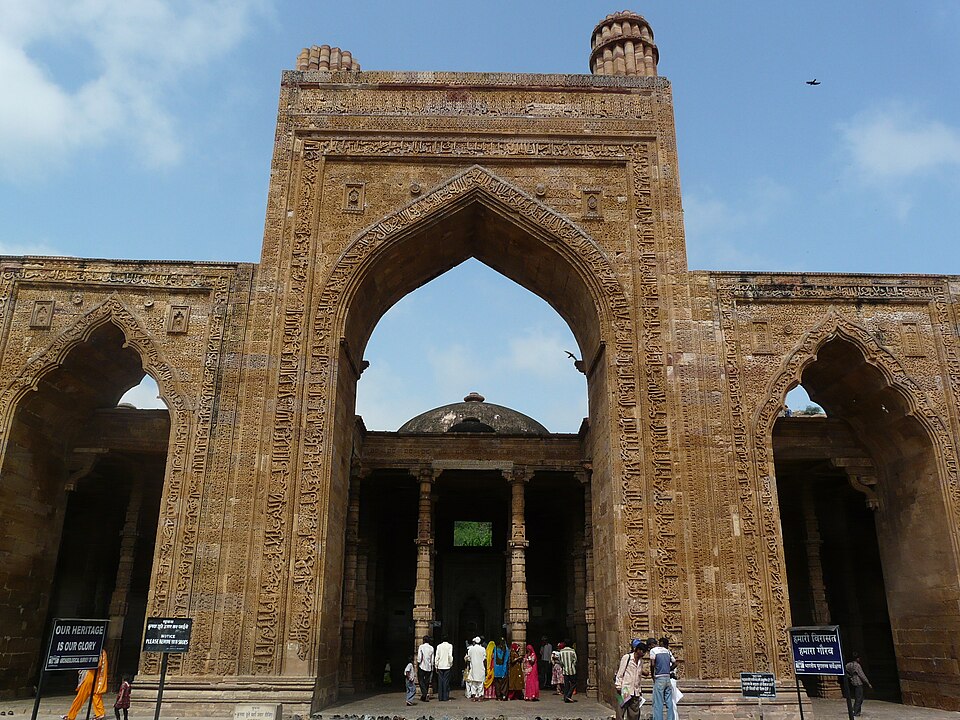
- Reading 'Dhai Din ka Jhopra' as a Delhi monument. It is at AJMER in Rajasthan, and the name — 'the two-and-a-half-day shed' — is a later legend about how quickly it was supposedly raised, not a description of the building.
- Crediting Iltutmish with the Dhai Din ka Jhopra because he built its most photographed feature. The arched screen of 1213 is his; the mosque of 1192–99 is Aibak's, and match-lists ask for the builder of the building.
- Assuming a mosque at a Sufi dargah was built by the saint's own generation. Shaikh Nizamuddin Auliya died in 1325, but the Jamat Khana Masjid at his dargah is a royal Khalji foundation, not a work of the khanqah.
UPPSC likes Indo-Islamic monuments as match-lists and chronology items — building-to-builder here in 2022, monuments-in-chronological-order in 2019, Alauddin Khalji's conquests in order in 2025 — so dates of reigns do most of the work. UPSC has generally preferred to test the same period through statements about a ruler's policies or through a single sharp factual question about a sultan, rather than through building-to-builder matching.
How did Sultan Qutb-ud-din Aibak die?
- (a) He was treacherously stabbed to death by one of his ambitious nobles
- (b) He was killed in a battle with Taj-u-din Yildiz, the ruler of Ghazni who entered into a contest with him over the capture of Punjab
- (c) He sustained injuries while besieging the fortress of Kalinjar in Bundelkhand and succumbed to death later
- (d) He died after a fall from his horse while playing Chaugan
Answer(d) He died after a fall from his horse while playing Chaugan
The date behind this question's cleanest elimination. Aibak's death in 1210 is what makes it impossible for him to have built the Jamat Khana Masjid of 1312–13 — the error that options (a) and (b) both commit.
Consider the following statements: 1. It was during the reign of Iltutmish that Chengiz Khan reached the Indus in pursuit of the fugitive Khwarezm prince. 2. It was during the reign of Muhammad bin Tughluq that Taimur occupied Multan and crossed the Indus. 3. It was during the reign of Deva Raya II of Vijayanagara Empire that Vasco da Gama reached the coast of Kerala. Which of the statements given above is/are correct?
- (a) 1 only
- (b) 1 and 2
- (c) 3 only
- (d) 2 and 3
Answer(a) 1 only
The same underlying demand — placing an event correctly inside a sultan's reign — and it anchors Iltutmish's dates, which is what separates option (c) from option (d) here. UPSC tests the skill through statements; UPPSC through a match-list.
Arrange the following monuments in a chronological order and select the correct answer from the codes given below : I. Rabia Daurani's Tomb, Aurangabad II. Shershah Suri's Tomb, Sasaram III. Humayun's Tomb, Delhi IV. Atala Mosque, Jaunpur Codes :
- (a) I, II, IV, III
- (b) IV, II, III, I
- (c) II, I, III, IV
- (d) III, IV, II, I
Answer(b) IV, II, III, I
The same body of knowledge one step later in time, and the same method: date an Indo-Islamic monument to its patron and the ordering follows. UPPSC alternates between 'arrange these monuments' and 'match building to builder' but expects the same dated mental list.
Arrange the following conquests of Alauddin Khalji in correct chronological order and select the correct answer from the code given below. 1. Ranthambore 2. Jaisalmer 3. Warangal 4. Chittor Code :
- (a) 1, 2, 3, 4
- (b) 2, 1, 3, 4
- (c) 2, 1, 4, 3
- (d) 1, 2, 4, 3
Answer(c) 2, 1, 4, 3
The same ruler, tested for the internal chronology of his reign. Between the two questions the commission expects a candidate to know not only that Alauddin Khalji ruled 1296–1316 but where inside those twenty years his campaigns and his buildings fall.
- practice — not a real PYQ
Which of the following is regarded as the first monumental Islamic tomb built in India ?
- (a)Tomb of Balban, Mehrauli
- (b)Sultan Ghari, Delhi
- (c)Tomb of Iltutmish, Qutb complex
- (d)Alai Darwaza, Delhi
Answer(b) Sultan Ghari, Delhi — built by Iltutmish in 1231 for his eldest son Prince Nasiruddin Mahmud, it precedes both Iltutmish's own tomb and Balban's. The Alai Darwaza (1311) is a gateway, not a tomb.
- practice — not a real PYQ
The screen wall of engrailed arches in front of the prayer hall of the Adhai Din Ka Jhonpra at Ajmer was added by :
- (a)Qutbuddin Aibak
- (b)Iltutmish
- (c)Balban
- (d)Alauddin Khalji
Answer(b) Iltutmish — he added the screen in 1213, some fourteen years after Qutbuddin Aibak completed the mosque itself. The same pattern repeats at Delhi, where Aibak began the Qutb Minar and Iltutmish completed it.