
Which one of the following is NOT an example of bio-mass energy source ?
- (a)Nuclear energy
- (b)Wood
- (c)Coal
- (d)Gobar (Dung)
Answer
Why
Correct — A, Nuclear energy. Biomass means organic matter of biological origin burnt or digested for its stored chemical energy — energy that traces back to photosynthesis. Nuclear energy has nothing to do with any of that: it is released when heavy nuclei such as uranium-235 or plutonium-239 are split in a reactor, converting a tiny fraction of nuclear binding mass into heat. No plant, no animal and no photosynthesis is involved anywhere in the chain, so nuclear energy is the one option that stands entirely outside the biomass family. Wood (b) and gobar (d) are the textbook examples of biomass and are clearly wrong choices here. Be aware, though, that this item has a second defensible answer: under the standard classification used in science and energy-policy texts, coal (c) is a fossil fuel, not biomass — the two categories are listed separately, alongside petroleum and natural gas. The commission's key marks (a), and (a) is the stronger answer because coal at least began as plant material while nuclear fuel never did; but a candidate who chose (c) had a real case. Marks follow the official key, so (a) it is.
Why the others are wrong
- (b)Wood — Wood is the oldest and most widely used biomass fuel on earth. Its energy is carbon fixed by a tree through photosynthesis over years or decades, and burning it releases that energy back. It is squarely inside the category the question asks you to step outside of.
- (c)Coal — Not the keyed answer, but the honest position is that this is the paper's weak point rather than the candidate's. Coal did begin as plant matter — peat-forming swamp vegetation compressed and heated over tens to hundreds of millions of years — which is presumably why the commission treats it as belonging with the biomass family. Standard classifications, however, place coal with petroleum and natural gas as a fossil fuel and keep biomass separate, precisely because coal's carbon left the living cycle in the geological past and is not renewable on any human timescale. So (c) is defensible on the science; (a) is what the key marks, and (a) remains the cleaner answer because nuclear energy has no organic origin at all.
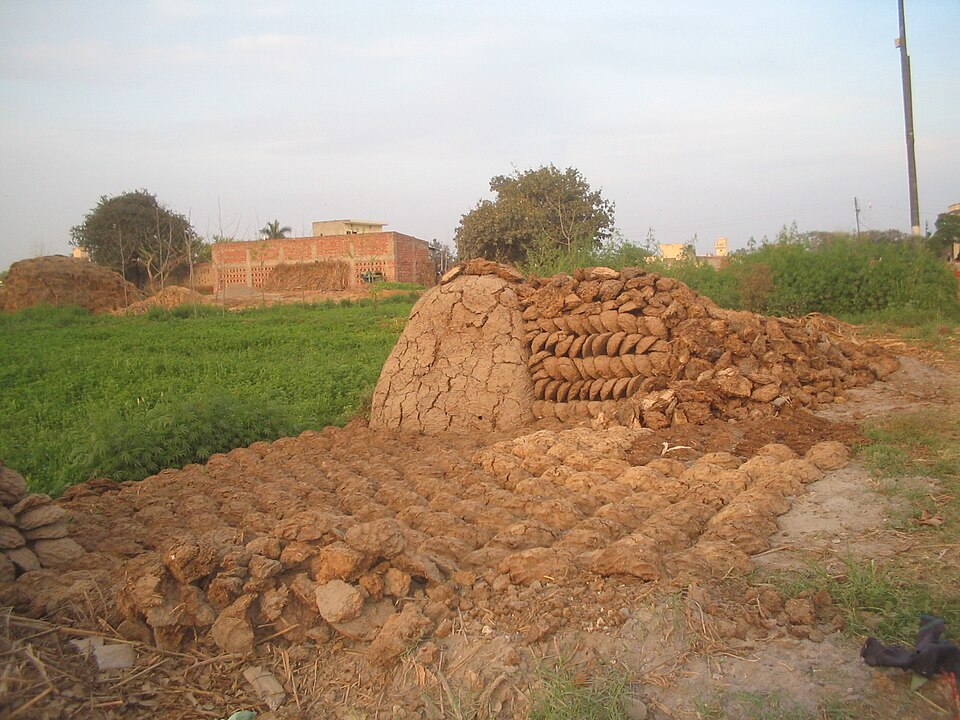
- (d)Gobar (Dung) — Cattle dung is biomass twice over — it is animal waste made of partly digested plant matter. Dried into cakes it is burnt directly in rural households, and fed into a digester it yields biogas. Either way the energy came from grass and fodder, that is, from photosynthesis.
Concept
Energy sources are sorted first by whether they renew on a human timescale and then by origin. Biomass is renewable organic matter of recent biological origin: firewood, crop residue, bagasse, dung, and the biogas or ethanol made from them. Fossil fuels — coal, petroleum, natural gas — are also of organic origin, but the organisms died hundreds of millions of years ago and the deposits are not replaced as we burn them, which is why they sit in a category of their own. Nuclear energy belongs to neither: it comes from the nucleus of heavy atoms, not from chemical bonds built by living things, and its fuel is a mined mineral.
The way to attack a 'which is NOT' question is to find the option that fails on a different axis from the others, not just on degree. Wood, dung and coal are all carbon fuels that burn; nuclear energy does not burn at all and does not release chemical energy. That gap is far wider than the gap between coal and the other two, and it is what makes (a) the intended answer even though a careful student can also argue coal out of the biomass box. Note the direction of the trap: a candidate who knows the fossil-fuel classification well is more likely to pick (c) than one who does not.
Key facts
- Biomass energy sources: firewood, crop residues, bagasse, dung cakes, biogas and biofuels — all trace back to recent photosynthesis
- Nuclear energy is released by fission of heavy nuclei such as uranium-235; it involves no combustion and no biological origin
- Coal, petroleum and natural gas are classified as fossil fuels — of ancient organic origin, but non-renewable on a human timescale
- Dung has two energy uses in India: burnt directly as dried cakes, and digested anaerobically in biogas plants
- In India, biomass has historically supplied a large share of rural household cooking energy, which is why LPG and biogas programmes target it
Study next
Common traps
- Treating coal as biomass because it formed from plants; standard classification calls it a fossil fuel, and that ambiguity is exactly what makes this item contestable
- Calling nuclear energy renewable because it emits little carbon dioxide — low-carbon and renewable are different tests, and uranium is a finite mined mineral
- Forgetting that dung counts twice: as a directly burnt fuel and as feedstock for biogas
UPPSC asks energy classification as one-line recall almost every year — 'which is non-renewable', 'non-conventional sources are those that are…', 'which is NOT biomass'. UPSC asks it functionally instead: which residues can feed a biomass gasifier, which crops the biofuel policy permits, what producer gas contains. Learn the categories and the feedstock lists together.
Related PYQs
Biomass gasification is considered to be one of the sustainable solutions to the power crisis in India. In this context, which of the following statements is/are correct? 1. Coconut shells, groundnut shells and rice husk can be used in biomass gasification. 2. The combustible gases generated from biomass gasification consist of hydrogen and carbon-dioxide only. 3. The combustible gases generated from biomass gasification can be used for direct heat generation but not in internal combustion engines. Select the correct answer using the codes given below :
- (a) 1 only
- (b) 2 and 3 only
- (c) 1 and 3 only
- (d) 1, 2 and 3
Answer(a) 1 only
The same category tested by its contents rather than its boundary. Statement 1 lists what biomass actually is in practice — coconut shells, groundnut shells, rice husk — the agricultural-residue side of the family that wood and dung belong to in this UPPSC question.
According to India's National Policy on Biofuels, which of the following can be used as raw material for the production of biofuels? 1. Cassava 2. Damaged wheat grains 3. Groundnut seeds 4. Horse gram 5. Rotten potatoes 6. Sugar beet Select the correct answer using the code given below:
- (a) 1, 2, 5 and 6
- (b) 1, 3, 4 and 6
- (c) 2, 3, 4 and 5
- (d) 1, 2, 3, 4, 5 and 6
Answer(a) 1, 2, 5 and 6
Biomass at policy level. The permitted feedstocks are all recent organic matter — starch- and sugar-rich crops and damaged grain — which is the defining test this question applies to wood, dung and coal.
A non-renewable source of energy is
- (a) Solar energy
- (b) Petroleum
- (c) Wind energy
- (d) Biogas
Answer(b) Petroleum
The neighbouring classification, and the one that exposes this question's soft spot. Petroleum is grouped with coal as a fossil fuel and marked non-renewable, while biogas — made from dung — is listed as renewable, which is precisely why treating coal as biomass sits awkwardly.
Non-conventional energy sources are those energy sources, that are -
- (a) Produced from electricity
- (b) Renewable
- (c) Produced from heat
- (d) Non-renewable
Answer(b) Renewable
The definition behind the whole family of questions. Once non-conventional is fixed as renewable, biomass, solar and wind fall on one side and coal, petroleum and nuclear on the other.
Practice
- practice — not a real PYQ
Which one of the following is NOT a fossil fuel?
- (a)Lignite
- (b)Natural gas
- (c)Biogas
- (d)Petroleum
Answer(c) Biogas — it is produced by anaerobic digestion of fresh organic waste such as dung, so it is biomass energy; lignite, natural gas and petroleum are all fossil fuels. - practice — not a real PYQ
The energy released in a nuclear power reactor comes principally from
- (a)combustion of enriched carbon fuel
- (b)fission of heavy nuclei such as uranium-235
- (c)fusion of hydrogen nuclei into helium
- (d)chemical oxidation of uranium ore
Answer(b) fission of heavy nuclei such as uranium-235 — commercial reactors run on fission; fusion powers the Sun but is not yet a commercial power source on Earth.