
Which one of the following type of medicines is used for treating indigestion?
- (a)Analgesic
- (b)Antiseptic
- (c)Antibiotic
- (d)Antacid
Answer
Why
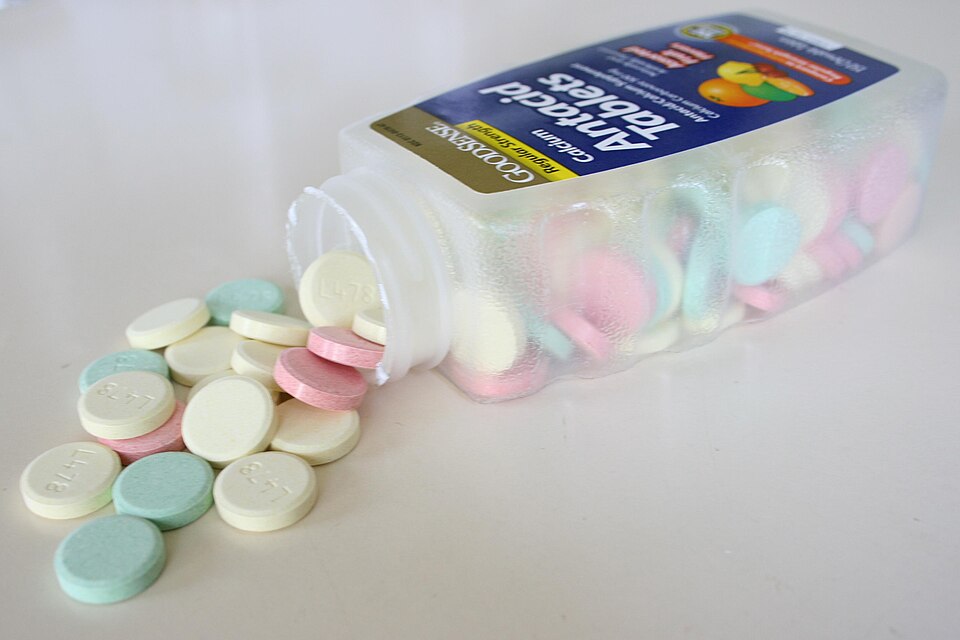
Correct — D, an antacid. Indigestion (dyspepsia) is commonly caused by excess hydrochloric acid in the stomach, and it is relieved by an antacid — a mild base such as magnesium hydroxide (milk of magnesia), aluminium hydroxide or sodium bicarbonate — which neutralises the excess acid and settles the discomfort. It is a simple acid-base neutralisation.
Why the others are wrong
- (a)Analgesic — An analgesic is a painkiller (for example paracetamol or aspirin) that relieves pain; it does not neutralise stomach acid.
- (b)Antiseptic — An antiseptic (for example tincture of iodine or Dettol) kills or checks microbes on living tissue such as skin and wounds; it is not taken for acidity.
- (c)Antibiotic — An antibiotic (for example penicillin) kills or stops bacteria and treats bacterial infections; acidity is not a bacterial infection, so an antibiotic is not the remedy.
Concept
The stomach secretes hydrochloric acid to aid digestion; excess acid causes acidity or heartburn. Antacids are mild, often insoluble bases that neutralise this excess acid without harming the stomach — common ones are milk of magnesia (magnesium hydroxide) and sodium bicarbonate. This is a textbook use of acid-base neutralisation in daily life.
The options are a family of similar-sounding 'anti-' medicines with distinct jobs. Match the ailment to the mechanism — acidity is too much acid, so the cure is something basic (an antacid), not a painkiller, a germ-killer or a bacteria-killer.
Key facts
- Acidity is caused by excess hydrochloric acid in the stomach.
- An antacid is a mild base that neutralises excess stomach acid (for example magnesium hydroxide, aluminium hydroxide or sodium bicarbonate).
- Milk of magnesia is a suspension of magnesium hydroxide used as an antacid.
- Analgesics relieve pain, antiseptics kill microbes on skin and wounds, and antibiotics treat bacterial infections.
Study next
Common traps
- Confusing an antacid (for acidity) with an antibiotic (for bacterial infection) or an antiseptic (for skin and wounds).
- Thinking a painkiller (analgesic) treats acidity.
Asked as matching the ailment (acidity) to the correct class of medicine, or naming a common antacid.
Related PYQs
Which one among the following is known as Milk of Magnesia?
- (a) Magnesium bicarbonate
- (b) Magnesium carbonate
- (c) Magnesium sulphate
- (d) Magnesium hydroxide
Answer(d) Magnesium hydroxide
Milk of magnesia (magnesium hydroxide) is one of the commonest antacids — the mild base that neutralises stomach acid in exactly the situation this question describes.
Practice
- practice — not a real PYQ
Milk of magnesia, used to treat acidity, is chemically
- (a)magnesium sulphate
- (b)magnesium hydroxide
- (c)magnesium carbonate
- (d)magnesium chloride
Answer(b) magnesium hydroxide, a mild base that neutralises stomach acid. - practice — not a real PYQ
A substance applied to wounds to kill microbes on living tissue is called a/an
- (a)antacid
- (b)analgesic
- (c)antiseptic
- (d)antibiotic
Answer(c) antiseptic (for example tincture of iodine or Dettol).