
For a material under static conditions, which one among the following statements is correct?
- (a)An insulator can be charged
- (b)A perfect conductor can be charged
- (c)Both perfect conductor and insulator can be charged
- (d)Both perfect conductor and insulator cannot be charged
Answer
Why
Correct — A, an insulator can be charged. On the framing the paper appears to intend, an insulator (glass, ebonite, plastic) can be given a static charge by friction and holds it because the charge cannot flow through the material, so it stays put under static conditions. This item is genuinely contested, though: an isolated perfect conductor can also carry a net static charge (it simply spreads over the outer surface), which makes option C — 'both can be charged' — the more complete statement. Our pick follows the likely intended key (A), which leans on the weaker idea that charge given to a conductor 'flows away'; why C is defensible is set out below.
Why the others are wrong
- (b)A perfect conductor can be charged — Read on its own this is actually true for an isolated conductor — the charge resides on its outer surface — but the paper treats a lone conductor as unable to 'hold' charge because charge is free to move within it and drains to earth if any path exists, so the key does not select B alone.
- (c)Both perfect conductor and insulator can be charged — This is the physically most complete statement — an isolated conductor and an insulator can each carry static charge — which is exactly why the item is disputed; it is not wrong on the physics, but the intended key selects A rather than C.
- (d)Both perfect conductor and insulator cannot be charged — False outright — both can be charged; friction charges insulators and conduction or induction charges conductors, so 'neither can be charged' is the one clearly incorrect option.
Concept
Static electricity is charge that stays at rest on a material rather than flowing as a current. In an insulator (dielectric) the electrons are bound, so charge deposited by rubbing stays localised where it was placed. In a conductor the outer electrons are free to move, so any net charge quickly spreads over the surface and, if the body is earthed or touched, drains away — but an isolated (insulated) conductor still keeps its charge on its outer surface. This double truth is what makes the question awkward.
The trap is the loose classroom shorthand 'conductors do not hold charge, insulators do.' That shorthand is really about earthing — a conductor connected to the ground loses its charge, while an insulator keeps it. Taken literally under 'static conditions' for an isolated body, a perfect conductor can be charged too, so a careful reader is torn between A and C. Author to the likely key (A) but know that C is the fuller statement.
Key facts
- An insulator charged by friction keeps the charge fixed at the spot where it was deposited (it cannot flow).
- A charged conductor spreads the charge over its outer surface; if earthed it loses the charge, if isolated it retains it.
- Charging methods are friction (works well on insulators), conduction (contact) and induction (works on conductors).
- The SI unit of charge is the coulomb (C); the smallest free charge is that of the electron/proton, about 1.6 x 10^-19 C.
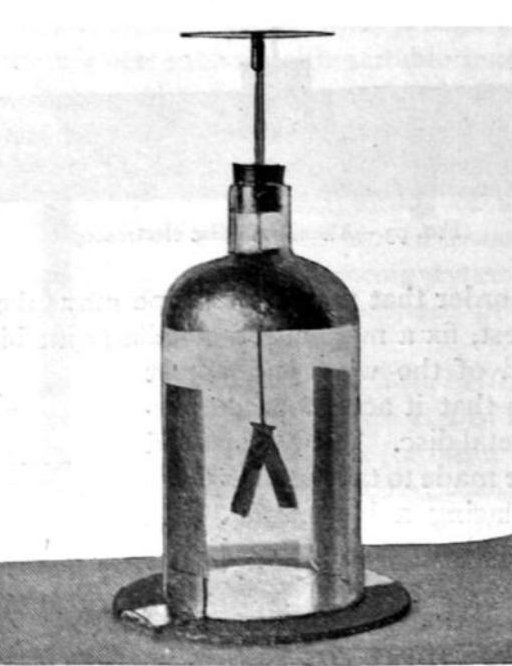
Study next
Common traps
- The shorthand 'conductors cannot be charged' is only true for an earthed conductor — an isolated conductor holds charge on its surface.
- Because both an insulator and an isolated perfect conductor can carry static charge, A and C are both defensible — this is a poorly framed item.
Asked as which materials 'can be charged' under static conditions, or by contrasting how insulators and conductors hold charge.
Related PYQs
No directly related past PYQ was found.
Practice
- practice — not a real PYQ
By which method is an insulator such as a glass rod most easily given a static charge?
- (a)Friction
- (b)Earthing
- (c)Conduction to the earth
- (d)Electromagnetic induction
Answer(a) Friction — rubbing transfers electrons and the charge stays fixed on the insulator. - practice — not a real PYQ
A charged metal sphere is connected to the earth by a wire. What happens to its charge?
- (a)It doubles
- (b)It stays the same
- (c)It flows to the earth and the sphere is discharged
- (d)It changes sign
Answer(c) It flows to the earth and the sphere is discharged — earthing removes charge from a conductor.