
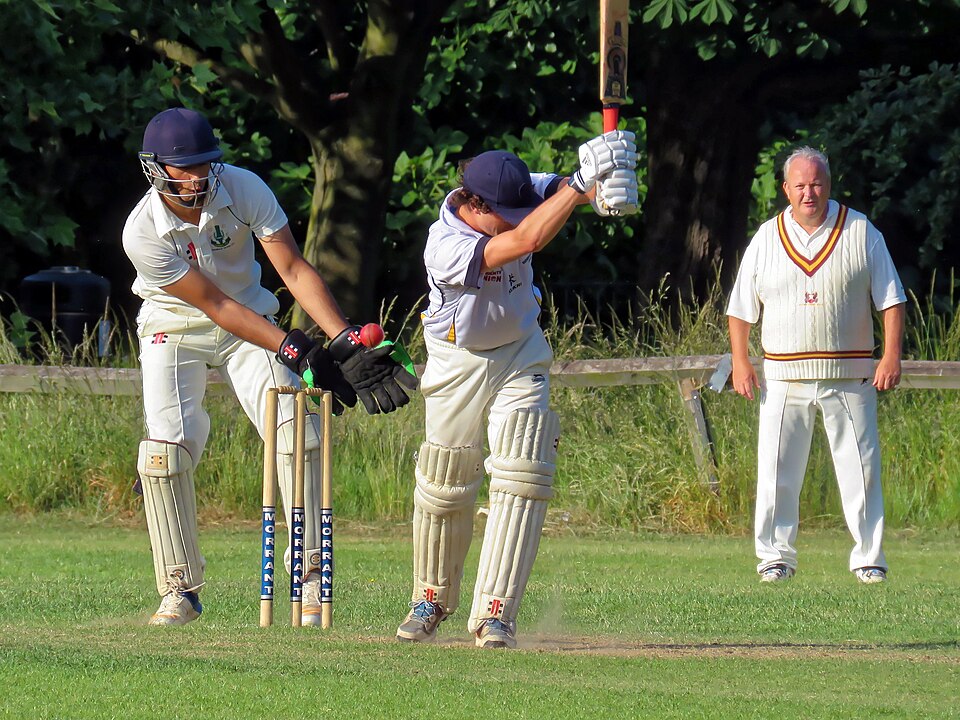
Why a fielder in the ground gradually pulls his hands backward while catching a fast moving cricket ball?
- (a)To reduce the acceleration of the ball
- (b)To increase the acceleration of the ball
- (c)To increase the velocity of the ball
- (d)None of above
Answer
Why
Correct — A, to reduce the acceleration of the ball. By drawing his hands back, the fielder lengthens the time over which the fast ball is brought to rest. The ball's change in momentum is fixed, so spreading it over a longer time reduces the rate of change of momentum — and therefore the force, and the deceleration, that the ball experiences and exerts on his hands. That is why the catch stings far less.
Why the others are wrong
- (b)To increase the acceleration of the ball — Increasing the ball's acceleration would mean stopping it more abruptly, which needs a larger force and would sting or injure the hands — the exact opposite of what the fielder wants.
- (c)To increase the velocity of the ball — Pulling the hands back does not speed the ball up; the fielder is bringing the ball to rest, reducing its velocity to zero, not increasing it.
- (d)None of above — Wrong because option (a) correctly explains the action, so 'none of the above' cannot apply.
Concept
The impulse-momentum theorem states that force multiplied by the time of contact equals the change in momentum (F times t equals the change in momentum). For a fixed momentum change, a longer contact time means a smaller average force and a smaller deceleration.
This is the same physics as bending the knees when landing a jump, cars having crumple zones and airbags, and choosing to fall onto a mattress rather than concrete — each lengthens the stopping time to cut the peak force. Here 'acceleration' means the deceleration involved in bringing the ball to rest.
Key facts
- Impulse equals force multiplied by time, and equals the change in momentum.
- The ball's momentum change is fixed; increasing the contact time lowers the average force.
- A longer stopping time gives a smaller deceleration and less force on the hands.
- The same principle protects us through crumple zones, airbags, helmets and bending the knees on landing.
Study next
Common traps
- Reading 'reduce acceleration' as 'reduce the ball's approach speed' — it means reducing the deceleration during the catch.
- Thinking the momentum change is reduced; it is the same, and only the time, and hence the force, changes.
Asked as the fielder-catching example, or as bending the knees on landing, airbags and crumple zones — all of which lengthen the stopping time to reduce the force.
Related PYQs
No directly related past PYQ was found.
Practice
- practice — not a real PYQ
A person jumping from a height bends the knees on landing in order to
- (a)look graceful
- (b)increase the time of impact and reduce the force on the legs
- (c)increase the force on the legs
- (d)gain more speed
Answer(b) increase the time of impact and reduce the force on the legs — the same impulse principle as the fielder. - practice — not a real PYQ
Airbags in cars reduce injury during a collision mainly by
- (a)increasing the passenger's momentum
- (b)increasing the time over which the passenger stops, reducing the force
- (c)reducing the mass of the passenger
- (d)increasing the car's speed
Answer(b) increasing the stopping time, which lowers the peak force on the passenger.