
In a Telescope, compared to the eyepiece lens the objective lens has
- (a)larger focal length and larger aperture
- (b)larger focal length and smaller aperture
- (c)smaller focal length and larger aperture
- (d)smaller focal length and smaller aperture
Answer
Why
Correct — A, larger focal length and larger aperture. In an astronomical refracting telescope the objective lens is built with a long focal length AND a wide aperture, while the eyepiece is a short-focus, small lens. The long objective focal length gives high angular magnification (M = f_objective / f_eyepiece), and the wide aperture gathers more light and improves resolution so that faint, distant objects can be seen clearly.
Why the others are wrong
- (b)larger focal length and smaller aperture — Right about the focal length but wrong about the aperture. A small objective would gather too little light; the objective must be the WIDER lens so it can collect enough light from faint, distant objects.
- (c)smaller focal length and larger aperture — Reverses the focal-length rule. A short objective focal length would REDUCE the magnifying power, since magnification is f_objective / f_eyepiece.
- (d)smaller focal length and smaller aperture — Wrong on both counts — this actually describes the eyepiece (short focal length, small size), not the objective.
Concept
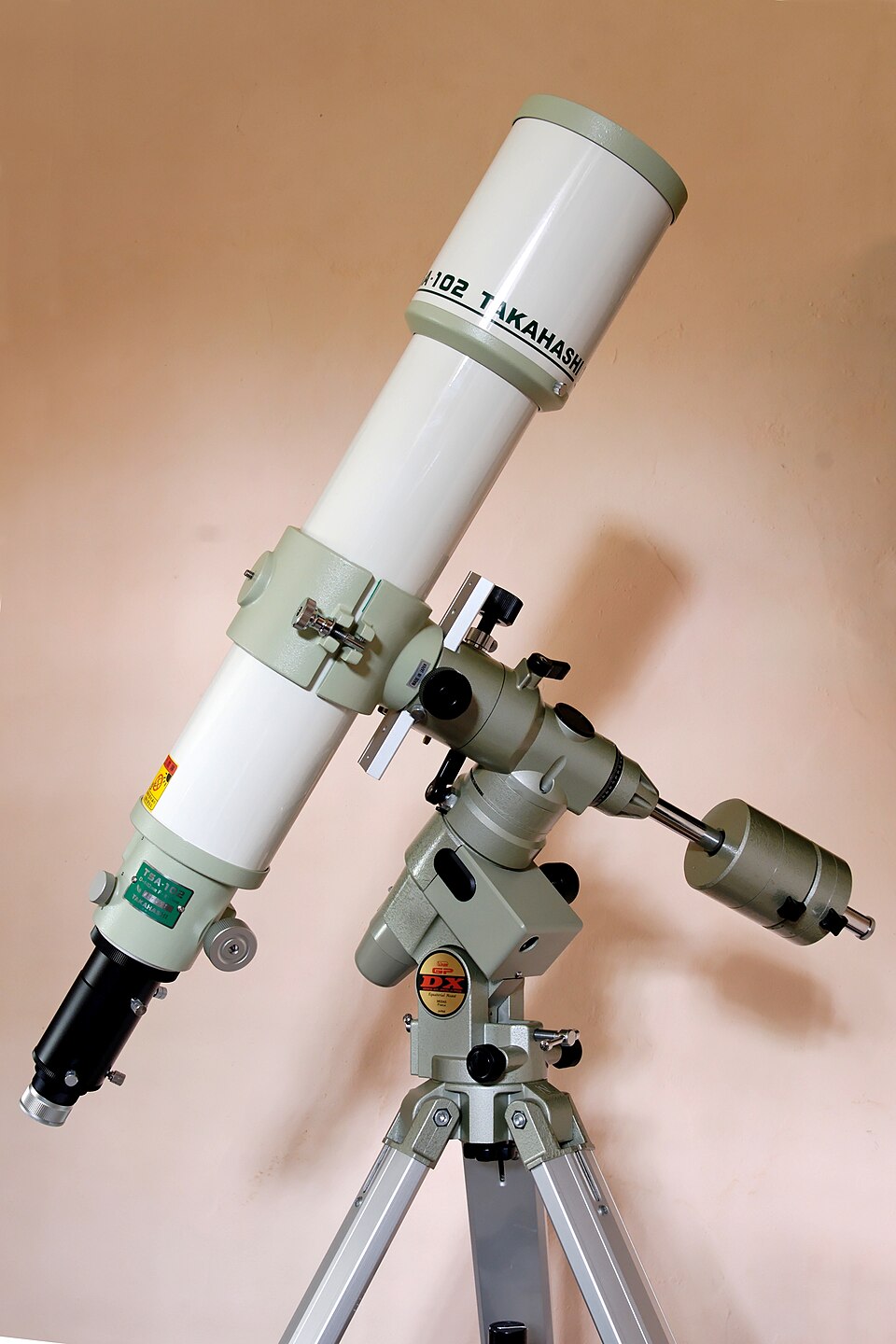
A refracting telescope uses two converging lenses. The objective (facing the object) has a large focal length and a large aperture; the eyepiece (near the eye) has a small focal length. The objective forms a real, inverted image of the distant object at its focus, and the eyepiece magnifies that image. In normal adjustment the magnifying power is M = f_objective / f_eyepiece.
Two independent jobs fix the objective's design. To MAGNIFY, you want a long objective focal length and a short eyepiece focal length, because their ratio is the magnification. To see FAINT objects clearly, you want a big aperture to collect more light and resolve fine detail. Both requirements push the objective to be the larger, longer lens — which is why real telescope objectives are physically big.
Key facts
- Telescope magnifying power in normal adjustment: M = f_objective / f_eyepiece.
- The objective has a long focal length AND a large aperture; the eyepiece has a short focal length.
- A larger aperture gathers more light (brighter image) and improves resolving power.
- Contrast the compound microscope, where BOTH lenses are short-focus and the objective focal length is SMALLER than the eyepiece's.
Study next
Common traps
- Confusing the telescope (objective = long focal length) with the microscope (objective = short focal length).
- Thinking a big objective is only about magnification — its main extra job is light-gathering.
Optical instruments are asked as 'compare objective vs eyepiece' or 'which lens has larger focal length' — remember M = f_objective / f_eyepiece for the telescope.
Related PYQs
No directly related past PYQ was found.
Practice
- practice — not a real PYQ
The magnifying power of an astronomical telescope in normal adjustment is given by
- (a)f_e / f_o
- (b)f_o / f_e
- (c)f_o x f_e
- (d)f_o + f_e
Answer(b) f_o / f_e — the ratio of the objective focal length to the eyepiece focal length. - practice — not a real PYQ
In a compound microscope, compared with a telescope, the focal length of the objective is
- (a)very large
- (b)equal to that of the eyepiece
- (c)small (shorter than the eyepiece)
- (d)infinite
Answer(c) small — a microscope objective is short-focus, unlike a telescope objective.