
Consider the following statements with reference to Feldspar mineral : 1. Half of the earth's crust is composed of feldspar 2. It has light cream to salmon pink colour 3. Magnesium is a common element in all types of feldspar Which of the statements given above is/are correct?
- (a)1 only
- (b)1 and 2 only
- (c)2 and 3 only
- (d)1, 2 and 3
Answer
Why
Correct — B, statements 1 and 2 only. Feldspar is the most abundant mineral group, making up roughly half of the Earth's crust, so statement 1 is true. Common feldspar ranges in colour from light cream to salmon-pink, so statement 2 is true. Statement 3 is false, because feldspars are aluminosilicates of potassium, sodium and calcium — magnesium is not one of their common elements. So only 1 and 2 are correct.
Why the others are wrong
- (a)1 only — This drops statement 2, but the light cream to salmon-pink colour is a standard, correct description of common feldspar, so statement 2 must be counted as correct too.
- (c)2 and 3 only — This includes the false statement 3 (magnesium as a common feldspar element) and leaves out the true statement 1 (feldspar forming about half the crust).
- (d)1, 2 and 3 — This wrongly treats statement 3 as correct. Magnesium is characteristic of minerals such as olivine and pyroxene, not feldspar, so statement 3 fails and all three cannot be right.
Concept
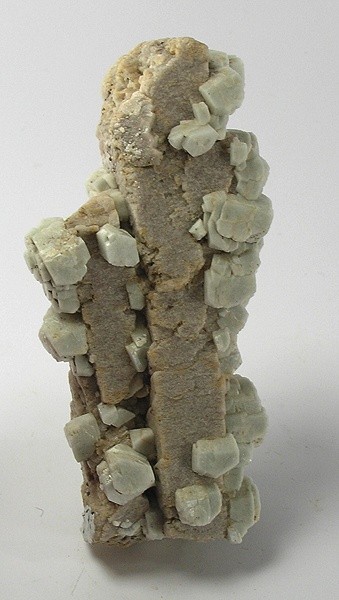
Feldspar is the most abundant group of rock-forming minerals, making up roughly half of the Earth's crust. Feldspars are framework aluminosilicates in which silicon and oxygen are common to all, joined with potassium, sodium or calcium. The potassium-rich alkali feldspars, orthoclase and microcline, typically show the light cream to salmon-pink colour used to recognise them.
This item is built from the standard description of feldspar — about half the crust, a cream to salmon-pink colour, and silicon and oxygen combined with sodium, potassium and calcium. The one trap is statement 3, which slips in magnesium; magnesium belongs to the ferromagnesian minerals such as olivine and pyroxene, not to feldspar, so that statement is false.
Key facts
- Feldspar is the most abundant mineral group, forming about half of the Earth's crust.
- Feldspars are aluminosilicates of potassium, sodium and calcium; silicon and oxygen are common to every type.
- Common feldspar is light cream to salmon-pink and is used in ceramics and glass making.
- Magnesium is not a feldspar element; it typifies ferromagnesian minerals such as olivine and pyroxene.
Study next
Common traps
- Do not attribute magnesium to feldspar; magnesium characterises olivine and pyroxene, not feldspar.
- Feldspar and quartz are both abundant silicates but distinct minerals; do not blur their properties.
Asked through statement-correctness or match items on the abundance, colour and chemical make-up of common rock-forming minerals.
Related PYQs
No directly related past PYQ was found.
Practice
- practice — not a real PYQ
Which one of the following is the most abundant mineral group in the Earth's crust?
- (a)Quartz
- (b)Feldspar
- (c)Mica
- (d)Calcite
Answer(b) Feldspar — it makes up roughly half of the Earth's crust. - practice — not a real PYQ
Feldspar is chiefly an aluminosilicate of which of the following elements?
- (a)Potassium, sodium and calcium
- (b)Magnesium and iron
- (c)Sodium and magnesium
- (d)Calcium and iron
Answer(a) Potassium, sodium and calcium — these cations, with silicon and oxygen, make up the feldspars.