
Which one of the following statements is NOT correct?
- (a)Diamond is hard due to extended covalent bonding in it
- (b)Fullerene is composed of five and six membered rings
- (c)Diamond is a good conductor of electricity
- (d)Graphite is used as a lubricant
Answer
Why
Correct — C, the claim that diamond is a good conductor of electricity. Diamond is in fact an electrical insulator. Each carbon atom is joined to four others in a rigid three-dimensional network, so all four of its outer electrons are locked into covalent bonds and none are free to move and carry current. The allotrope that conducts is graphite, whose layered structure leaves one delocalised electron per carbon. So statement c is the one that is NOT correct.
Why the others are wrong
- (a)Diamond is hard due to extended covalent bonding in it — This statement is correct, so it is not the answer. Diamond's rigid, extended three-dimensional network of strong covalent bonds is exactly why it is the hardest natural material.
- (b)Fullerene is composed of five and six membered rings — This statement is correct. Buckminsterfullerene, C60, is a closed cage built from twelve five-membered (pentagonal) and twenty six-membered (hexagonal) carbon rings, so it is not the odd one out.
- (d)Graphite is used as a lubricant — This statement is correct. In graphite the flat layers of carbon are held only weakly and slide over one another, which lets graphite act as a solid lubricant, so it is not the false statement.
Concept
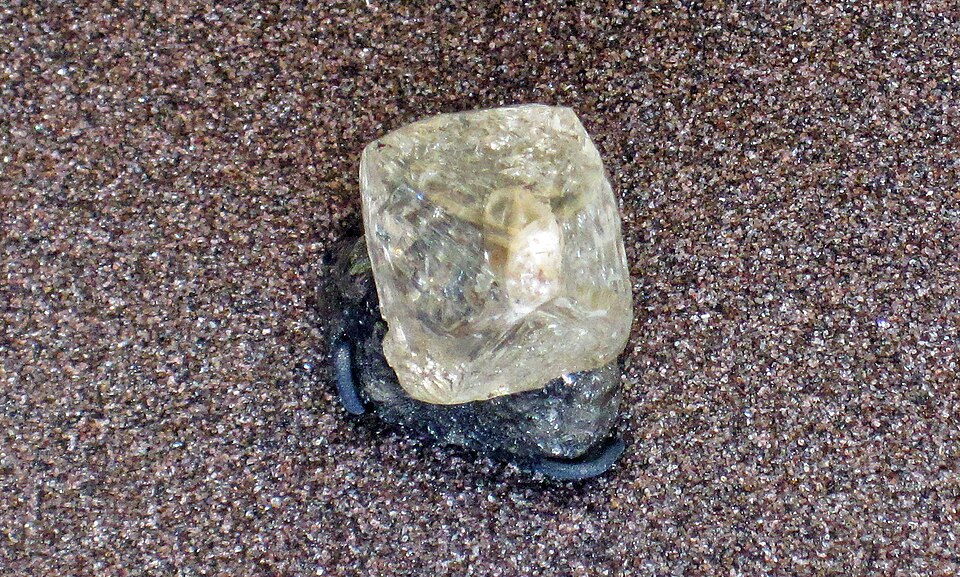
Diamond, graphite and fullerene are allotropes of carbon — the same element arranged in different structures, which is why they have strikingly different properties. Diamond is a giant covalent network, graphite is a layered sheet structure, and fullerenes such as C60 are cage-shaped molecules.
The question exploits the fact that diamond and graphite, though made of the same atoms, behave oppositely on electrical conductivity. Diamond ties up every electron in bonds and cannot conduct; graphite keeps one loose electron per atom and conducts well. The tempting mistake is to assume a hard, brilliant crystal like diamond must also be a good conductor.
Key facts
- Diamond and graphite are allotropes of carbon — the same element in different structures.
- In diamond each carbon is bonded to four others in a rigid three-dimensional lattice, making it extremely hard and an electrical insulator.
- In graphite carbon forms flat layers with one free electron per atom, so it conducts electricity, and the loosely held layers slide, letting it lubricate.
- Fullerenes such as C60 are cage molecules made of pentagonal and hexagonal carbon rings.
Study next
Common traps
- A hard, sparkling crystal like diamond does not conduct electricity — it is an insulator.
- It is graphite, not diamond, that conducts electricity and acts as a lubricant.
Asked to spot the incorrect statement about carbon allotropes, or to match an allotrope such as diamond, graphite or fullerene with one of its properties.
Related PYQs
Consider the following statements: I. Glass can be etched or scratched by diamond. II. Glass can be etched or scratched by hydrofluoric acid. III. Glass can be etched or scratched by aqua regia. IV. Glass can be etched or scratched by concentrated sulphuric acid. Which of these statements are correct?
- (a) I and IV
- (b) II and III
- (c) I and II
- (d) II and IV
Answer(c) I and II — diamond, being harder than glass, scratches it, and hydrofluoric acid etches silica glass.
Statement I rests on diamond's extreme hardness, the same extended-covalent-network property that Q110 tests in option a.
Practice
- practice — not a real PYQ
Which allotrope of carbon is a good conductor of electricity?
- (a)Diamond
- (b)Graphite
- (c)Both diamond and graphite
- (d)Neither diamond nor graphite
Answer(b) Graphite — its layered structure leaves one free electron per carbon atom, so it conducts. - practice — not a real PYQ
The extreme hardness of diamond is due to
- (a)weak forces between carbon layers
- (b)a rigid three-dimensional network of covalent bonds
- (c)free electrons moving through the crystal
- (d)ionic bonding between carbon atoms
Answer(b) a rigid three-dimensional network of covalent bonds — every carbon is bonded to four others.