
Which one of the following is NOT a heterogeneous mixture?
- (a)Sulphur in carbon disulphide
- (b)Mixture of sugar and salt crystals
- (c)Sandy water
- (d)Sulphur in water
Answer
Why
Correct — A, sulphur in carbon disulphide. Sulphur dissolves freely in carbon disulphide to give a clear, uniform solution, so this mixture is homogeneous — the same throughout, with no visible boundary between the components. Every other option keeps its parts physically separate and identifiable, so the sulphur-in-carbon-disulphide solution is the only one that is NOT heterogeneous.
Why the others are wrong
- (b)Mixture of sugar and salt crystals — Two different solids sit side by side as separate crystals you could sort grain by grain, so the composition is not uniform — this is a heterogeneous mixture.
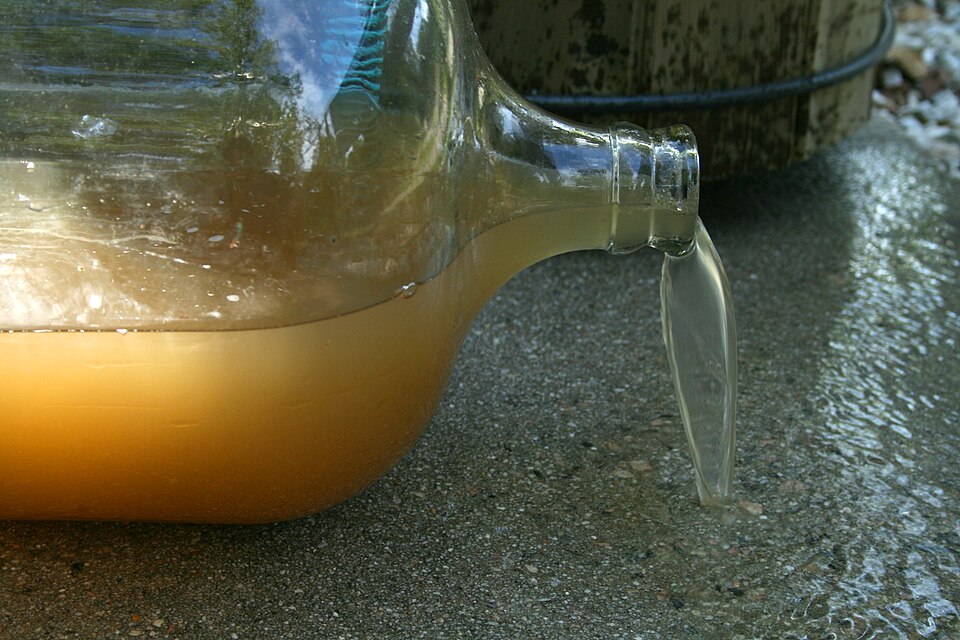
- (c)Sandy water — Sand is insoluble in water and settles or floats as a visible, separate phase, giving a non-uniform mixture — a textbook heterogeneous suspension.
- (d)Sulphur in water — Sulphur does not dissolve in water; it stays as undissolved particles forming a separate phase, so this mixture is heterogeneous.
Concept
A homogeneous mixture, or true solution, has a uniform composition throughout, with particles so small that no boundary between the components is visible — salt water is a familiar example. A heterogeneous mixture has a non-uniform composition whose separate parts can be seen or easily separated, such as sand in water. Which type forms often depends on solubility: a solute that dissolves in a given solvent yields a homogeneous solution, while an insoluble solute gives a heterogeneous mixture.
The stem asks which mixture is NOT heterogeneous, so the answer must be the homogeneous one. The deciding fact is solubility — sulphur is insoluble in water (heterogeneous) but very soluble in carbon disulphide (homogeneous). Spotting that sulphur behaves differently in the two solvents is the whole question.
Key facts
- A homogeneous mixture has uniform composition throughout; a heterogeneous mixture does not.
- Sulphur is readily soluble in carbon disulphide but practically insoluble in water.
- Whether a mixture is homogeneous or heterogeneous depends on whether the solute dissolves in that particular solvent.
- Two different solids mixed together, such as sugar and salt crystals, form a heterogeneous mixture.
Study next
Common traps
- 'NOT heterogeneous' means 'find the homogeneous one' — misreading the negative flips the answer.
- The same solute can give a homogeneous or a heterogeneous mixture depending on the solvent — sulphur in carbon disulphide versus sulphur in water.
Mixtures are asked as 'which is homogeneous or heterogeneous' or 'which is a true solution' — decide each case from the solute's solubility in that solvent.
Related PYQs
No directly related past PYQ was found.
Practice
- practice — not a real PYQ
Which one of the following is a homogeneous mixture?
- (a)Sand and iron filings
- (b)Oil and water
- (c)Sugar dissolved in water
- (d)Chalk powder in water
Answer(c) Sugar dissolved in water — it forms a uniform solution with no visible separate phase. - practice — not a real PYQ
Sulphur is most soluble in which one of the following?
- (a)Water
- (b)Carbon disulphide
- (c)Dilute hydrochloric acid
- (d)Common salt solution
Answer(b) Carbon disulphide — sulphur dissolves freely in it to give a homogeneous solution.