
When a light ray passes through from air to water with a non-zero angle the ray will be
- (a)bending towards the normal
- (b)bending away from the normal
- (c)propagating in straight line
- (d)reflected towards the opposite direction
Answer
Why
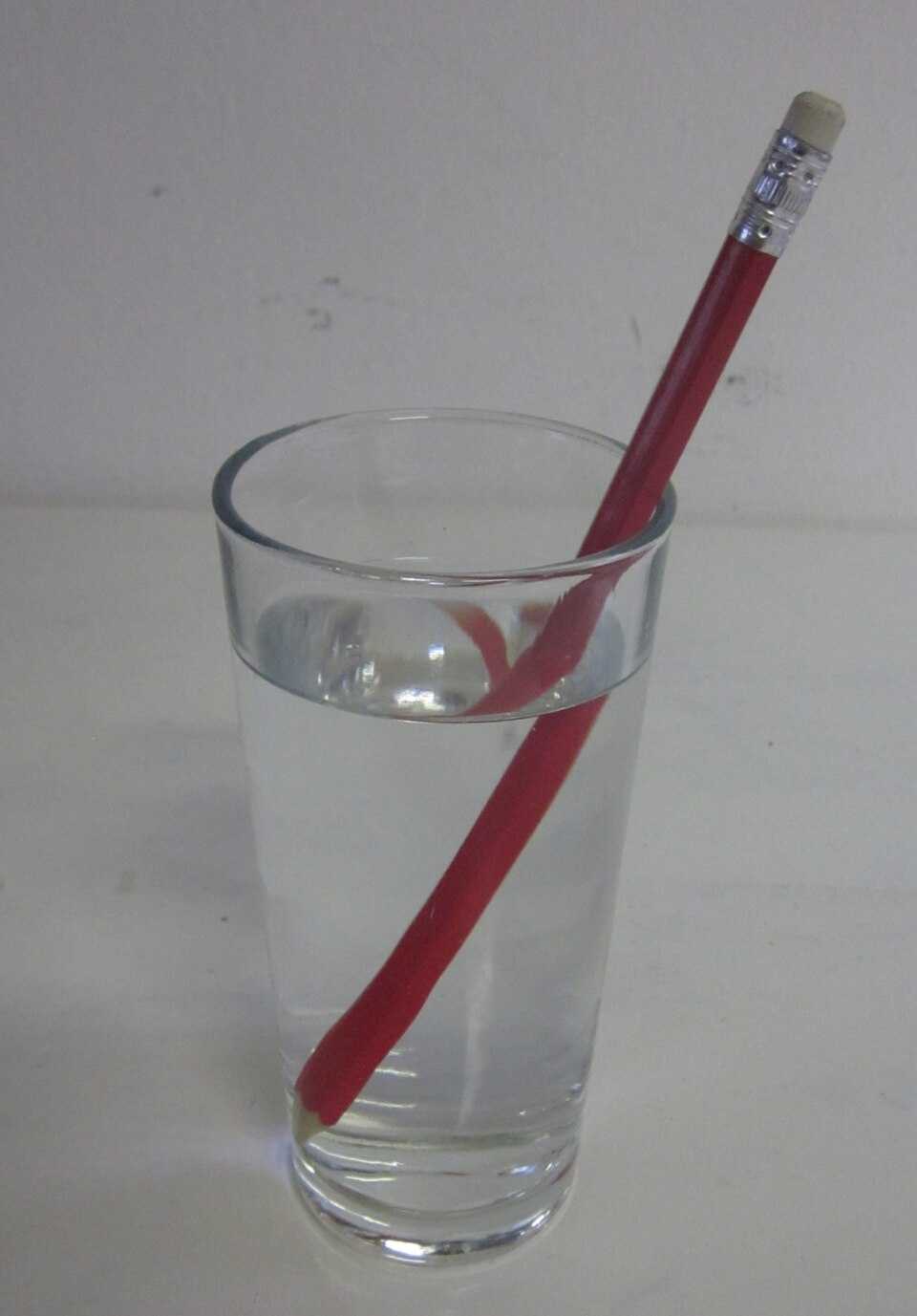
Correct — A, bending towards the normal. Air is optically rarer and water optically denser (n ≈ 1.33). When light crosses into a denser medium at a non-zero angle of incidence it slows down, and by Snell's law the angle of refraction is smaller than the angle of incidence — so the ray bends towards the normal. This is why a straw looks bent and a swimming pool looks shallower than it is.
Why the others are wrong
- (b)bending away from the normal — Light bends away from the normal only when it goes from a denser to a rarer medium (water to air), the reverse of this situation.
- (c)propagating in straight line — The ray continues undeviated only at normal incidence (angle 0°); here the incidence is non-zero, so it must refract.
- (d)reflected towards the opposite direction — Some light is reflected, but the ray that enters the water is refracted (transmitted), not simply reflected back; the question asks about the ray passing through.
Concept
Refraction is the bending of light as it passes between media of different optical densities, because its speed changes. Snell's law, n₁ sin i = n₂ sin r, governs the amount of bending. Going into a denser medium (rarer → denser) the ray bends towards the normal; going into a rarer medium it bends away from the normal. At normal incidence there is no bending.
The key words are 'air to water' (rarer to denser) and 'non-zero angle'. Denser-medium entry means bending towards the normal; the non-zero angle rules out the straight-line option. The reflection option is a trap because reflection and refraction happen together, but only the transmitted ray is asked about.
Key facts
- Light bends towards the normal when it enters an optically denser medium (air → water, water n ≈ 1.33).
- It bends away from the normal when it enters a rarer medium (water → air).
- Snell's law: n₁ sin i = n₂ sin r governs the angles of incidence and refraction.
- At normal incidence (i = 0°) the ray passes straight through without bending.
Study next
Common traps
- Reversing the rule — light bends towards the normal into a denser medium, not away.
- Choosing 'straight line' by forgetting that the angle of incidence is non-zero.
Asked by naming two media and an angle and asking which way the ray bends, or through everyday examples like a bent straw or a shallow-looking pool.
Related PYQs
Total internal reflection can take place when light travels from
- (a) diamond to glass
- (b) water to glass
- (c) air to water
- (d) air to glass
Answer(a) diamond to glass
Same concept — how light behaves when crossing between optically denser and rarer media. That UPSC item needs a denser-to-rarer path (diamond to glass) for total internal reflection; this NDA one is the rarer-to-denser case (air to water), where light bends towards the normal.
Which of the following statements with regard to the phenomenon of the primary rainbow formation by water droplets is/are correct? 1. It involves refraction and one internal reflection of sunlight. 2. It involves refraction of sunlight only. 3. It is formed as the inner bow. 4. It may involve more than one internal reflection as well as refraction of sunlight. Select the answer using the code given below:
- (a) 1 only
- (b) 1 and 3
- (c) 3 and 4
- (d) 2 and 3
Answer(b) 1 and 3
Same concept — refraction of light entering and leaving water droplets. That NDA item builds a rainbow from refraction plus internal reflection; this one tests the basic direction of bending as light enters water.
Practice
- practice — not a real PYQ
A ray of light travelling from water into air at a non-zero angle will
- (a)bend towards the normal
- (b)bend away from the normal
- (c)go straight without bending
- (d)be totally absorbed
Answer(b) bend away from the normal — moving from a denser to a rarer medium, light speeds up and bends away. - practice — not a real PYQ
A pond appears shallower than its real depth because of
- (a)Reflection of light
- (b)Refraction of light
- (c)Dispersion of light
- (d)Scattering of light
Answer(b) Refraction of light — light from the bottom bends away from the normal on leaving the water, raising the apparent position.