
In which one among the following the vegetative propagation takes place through Eye Buds?
- (a)Potato
- (b)Ginger
- (c)Onion
- (d)Sugarcane
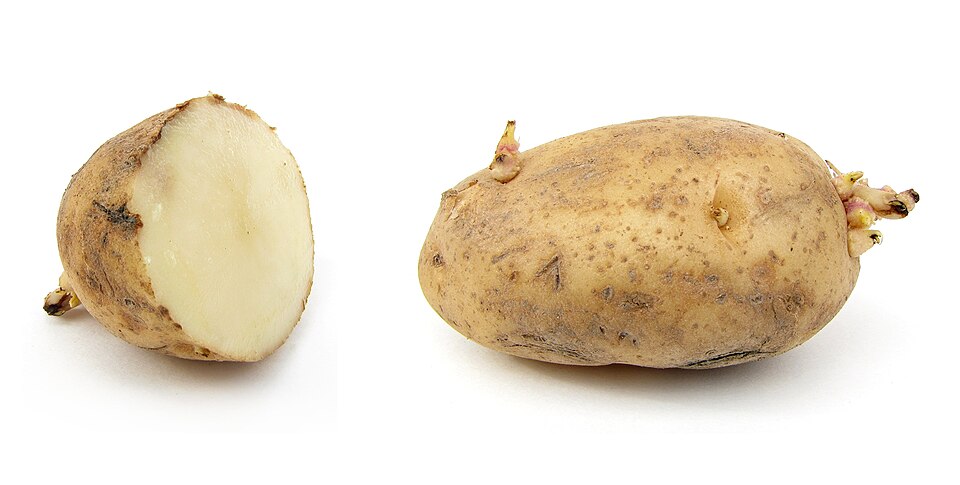
Correct — A, Potato. A potato is an underground stem tuber whose surface carries small pits called 'eyes' — each eye is an axillary bud. When a piece of tuber bearing an eye is planted, the bud sprouts into a new plant, so the potato is the classic example of vegetative propagation through eye buds.
- (b)Ginger — Ginger is a rhizome (an underground stem) that propagates from buds on its nodes, but these are not called 'eyes' — the 'eye bud' term is specific to the potato, not ginger.
- (c)Onion — The onion is a bulb — a condensed stem with fleshy scale leaves — and it propagates via the bulb (and its daughter bulbs), not through eye buds.
- (d)Sugarcane — Sugarcane is propagated from stem cuttings called 'setts', each carrying nodal buds. The buds sprout, but sugarcane is described by 'setts/nodal buds', whereas 'eye buds' is the standard descriptor for the potato — so potato is the intended answer.
Vegetative (asexual) propagation grows a new plant from a vegetative part — root, stem or leaf — without seeds. The potato is a stem tuber: its 'eyes' are axillary buds sitting in shallow pits on the tuber surface, and each can grow into a full plant, making the tuber a natural propagation unit.
The phrase 'eye buds' is a strong pointer to the potato. Reason by the propagation part each crop uses: potato = eyes on a stem tuber; ginger = rhizome; onion = bulb; sugarcane = stem setts with nodal buds. Only the potato's buds are traditionally called 'eyes'.
- A potato is a stem tuber; its 'eyes' are axillary buds used for propagation.
- Ginger propagates by rhizome (an underground stem), onion by bulb.
- Sugarcane is propagated from stem cuttings ('setts') bearing nodal buds.
- Vegetative propagation produces genetically identical clones of the parent plant.
- Picking ginger or onion because they are also underground — their buds are not called 'eyes'.
- Confusing the potato (stem tuber) with sweet potato (a root).
Asked as 'which crop propagates by eyes / which is a modified stem' — link the plant part (tuber/rhizome/bulb/sett) to the crop.
Which one of the following is a modified stem?
- (a) Carrot
- (b) Sweet potato
- (c) Coconut
- (d) Potato
Answer(d) Potato
Same concept — the potato is a stem tuber bearing 'eyes' (axillary buds), which is exactly why it propagates through eye buds. UPSC tests it as 'which is a modified stem'; the answer is the potato.
- practice — not a real PYQ
The 'eyes' of a potato that give rise to new plants are actually
- (a)roots
- (b)axillary buds
- (c)seeds
- (d)flowers
Answer(b) axillary buds — each eye is a bud that can sprout into a new plant.
- practice — not a real PYQ
Ginger is propagated vegetatively through its
- (a)bulb
- (b)rhizome
- (c)eye buds
- (d)leaf
Answer(b) rhizome — ginger is an underground stem (rhizome).