
Consider the following statements regarding River Brahmaputra: 1. It rises in Tibet, near Lake Mansarovar 2. It takes a "U" turn near Namcha Barwa and enters India through a gorge Which of the statements given above is/are correct?
- (a)1 only
- (b)2 only
- (c)Both 1 and 2
- (d)Neither 1 nor 2
Answer
Why
Correct — C, Both 1 and 2. Statement 1 is correct: the Brahmaputra rises in Tibet from the Chemayungdung glacier near Lake Mansarovar (Mount Kailash region), where it is called the Yarlung Tsangpo. Statement 2 is correct: at Namcha Barwa the river swings sharply — the 'Great Bend' or 'U'-turn — and then cuts through a deep gorge to enter India (as the Siang/Dihang in Arunachal Pradesh). Since both are right, the answer is Both 1 and 2.
Why the others are wrong
- (a)1 only — Statement 2 is also correct — the U-turn at Namcha Barwa and entry through a gorge is a defining feature of the Brahmaputra, so '1 only' is incomplete.
- (b)2 only — Statement 1 is also correct — the river's Tibetan source lies near Lake Mansarovar, so '2 only' is incomplete.
- (d)Neither 1 nor 2 — Both statements are factually correct, so 'neither' is wrong.
Concept
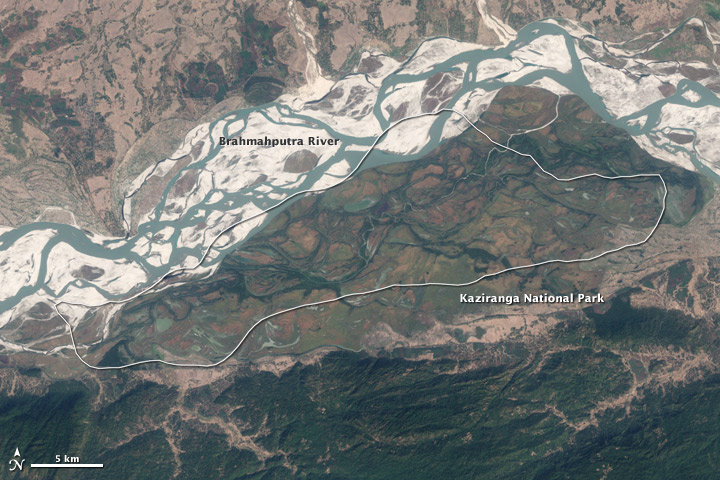
The Brahmaputra is a trans-Himalayan (antecedent) river: it existed before the Himalaya fully rose and cut its course as the mountains uplifted. It runs eastward across Tibet as the Tsangpo, loops around Namcha Barwa in the Great Bend, drops through a gorge into Arunachal Pradesh (Siang/Dihang), becomes the braided Brahmaputra in the Assam valley, and finally joins the Ganga in Bangladesh (as the Jamuna) before the combined flow reaches the Bay of Bengal via the Meghna.
Both statements are textbook facts. The only trap is assuming the Great Bend is not 'near Namcha Barwa' or that the Tibetan source is elsewhere — but Namcha Barwa (7,782 m) is precisely the peak the river wraps around, and its source is the Kailash-Mansarovar area.
Key facts
- Source: Chemayungdung glacier, Tibet, near Lake Mansarovar; Tibetan name Yarlung Tsangpo.
- Namcha Barwa (7,782 m) forms the eastern syntaxis where the river takes its 'U'-turn (Great Bend).
- Enters India as the Siang/Dihang in Arunachal Pradesh; becomes the Brahmaputra in Assam.
- In Bangladesh it is the Jamuna, joins the Ganga (Padma), then the Meghna to the Bay of Bengal.
Study next
Common traps
- Confusing the Brahmaputra's source with that of the Indus or Sutlej (all rise near Kailash-Mansarovar).
- Forgetting the river's changing names along its course.
Exams test the source, the Namcha Barwa bend, the name-changes, or the tributaries of the Brahmaputra.
Related PYQs
The Brahmaputra, Irrawady and Mekong rivers originate in Tibet and flow through narrow and parallel mountain ranges in their upper reaches. Of these rivers, Brahmaputra makes a "U" turn in its course to flow into India. This "U" turn is due to
- (a) uplift of folded Himalayan series
- (b) syntaxis bending of geologically young Himalayas
- (c) geo-tectonic disturbance in the tertiary folded mountain chains
- (d) Both (a) and (b) above
Answer(b) syntaxis bending of geologically young Himalayas
Same 'U'-turn concept: UPSC asks WHY the Brahmaputra loops before entering India — the syntaxial bending of the young Himalaya at Namcha Barwa — which is exactly the Great Bend that statement 2 of this NDA item describes.
Practice
- practice — not a real PYQ
By what name is the Brahmaputra known while flowing through Tibet?
- (a)Dihang
- (b)Yarlung Tsangpo
- (c)Jamuna
- (d)Meghna
Answer(b) Yarlung Tsangpo — its Tibetan name before the Great Bend. - practice — not a real PYQ
The Brahmaputra enters India through which State?
- (a)Assam
- (b)Sikkim
- (c)Arunachal Pradesh
- (d)Nagaland
Answer(c) Arunachal Pradesh — as the Siang/Dihang, before entering the Assam valley.