
Which one of the following is found in appreciable amount in Laterite soil in India?
- (a)Calcium
- (b)Phosphate
- (c)Potash
- (d)Nitrogen
Correct — C, Potash. Laterite forms under intense tropical leaching that strips out nitrogen, phosphate and lime (calcium); iron and aluminium oxides are left behind (giving the brick-red colour), and among the four nutrients offered potash is the one the exam treats as still present in appreciable amount. Note honestly that laterite is a poor soil overall — even potash is limited and standard geography calls the soil deficient in it — so this item is textbook-dependent, but relative to the other three heavily-leached options, (c) is the intended answer.
- (a)Calcium — Leaching removes lime/calcium bases, leaving laterite acidic and calcium-deficient — so calcium is not present in appreciable amount.
- (b)Phosphate — Laterite is characteristically poor in phosphate (phosphoric acid), which is lost with the leached bases.
- (d)Nitrogen — The low humus and organic-matter content of laterite means very little nitrogen; it is one of the nutrients the soil is most deficient in.
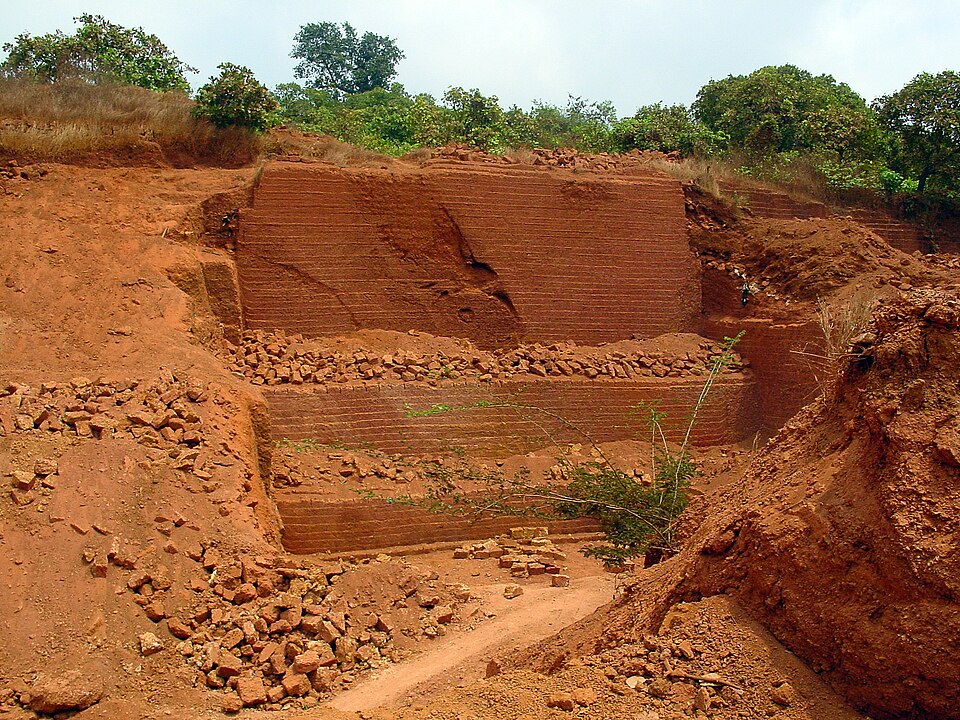
Laterite soil forms in areas of high temperature and heavy monsoon rainfall (alternating wet-dry seasons) where intense leaching washes away silica and soluble bases, leaving a residue rich in iron and aluminium oxides — hence its brick-red colour and its use as building blocks (Latin later = brick). It is generally infertile: low in humus, nitrogen, phosphate and lime.
All four options are nutrients depleted by leaching, so the item turns on which is LEAST depleted. Calcium/lime, phosphate and nitrogen are the classic deficiencies of laterite; potash is the one commonly listed as retained with the iron and aluminium oxides, which is why the exam marks (c).
- Laterite is rich in iron and aluminium oxides (brick-red), poor in humus, nitrogen, phosphate and lime.
- Found in high-rainfall peninsular belts: Western Ghats, Eastern Ghats, Kerala, Karnataka, Maharashtra, Odisha, Assam hills.
- With manuring it supports plantation crops — cashew, tapioca, tea, coffee, rubber.
- Hardened laterite is cut into bricks for construction — the origin of the name.
- Assuming laterite is fertile because it is thick and red — it is actually nutrient-poor.
- Confusing laterite (poor in lime/potash) with black regur soil (rich in lime and potash).
GAT/UPSC match a soil to its nutrient status or to the crops/regions it supports — learn each soil's 'rich in / poor in' profile.
Which of the following statements regarding laterite soils of India are correct? 1. They are generally red in colour. 2. They are rich in nitrogen and potash. 3. They are well-developed in Rajasthan and UP. 4. Tapioca and cashew nuts grow well on these soils. Select the correct answer using the codes given below.
- (a) 1, 2 and 3
- (b) 2, 3 and 4
- (c) 1 and 4
- (d) 2 and 3 only
Answer(c) 1 and 4
Directly on laterite soil — and worth noting for honesty: UPSC's own key marks statement 2 ('rich in nitrogen and potash') as WRONG, treating laterite as poor in both. That is why this NDA 'potash in appreciable amount' item is textbook-dependent; the two questions together show how contested the nutrient profile of laterite is.
- practice — not a real PYQ
Which soil of India is formed by intense leaching and is rich in iron and aluminium oxides but poor in humus?
- (a)Black soil
- (b)Alluvial soil
- (c)Laterite soil
- (d)Arid soil
Answer(c) Laterite soil — leaching leaves iron/aluminium oxides and removes bases and humus.
- practice — not a real PYQ
Which of the following crops grows well on laterite soils?
- (a)Wheat
- (b)Cashew nut
- (c)Cotton
- (d)Gram
Answer(b) Cashew nut — cashew and tapioca thrive on laterite soils of the Western Ghats/coast.