
Which one of the following is correct?
- (a)Pyroxene is commonly found in meteorites
- (b)Amphiboles form about 20% of the Earth’s crust
- (c)Quartz is soluble in water
- (d)The word ‘sedimentary’ is derived from the Latin word kelimentum
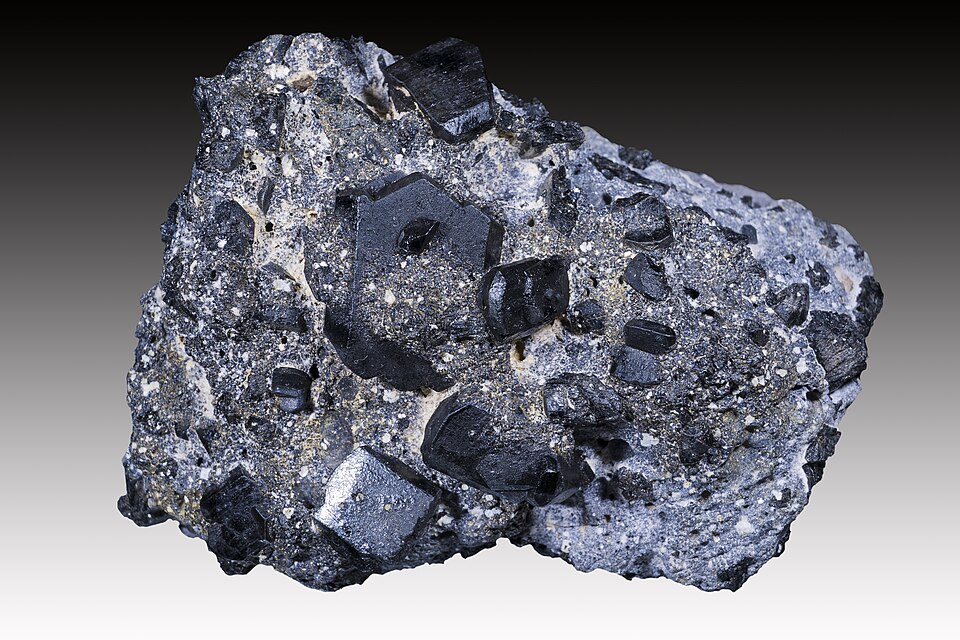
Correct — A, 'Pyroxene is commonly found in meteorites.' Pyroxenes are important rock-forming inosilicate minerals — major constituents of basalt, gabbro and the Earth's upper mantle — and they are common in stony meteorites (chondrites and achondrites); the Martian meteorite ALH 84001, for instance, is a pyroxenite. The other three statements are false.
- (b)Amphiboles form about 20% of the Earth’s crust — False — the crust is dominated by feldspars (roughly half of it) with quartz next; amphiboles are only a minor component (a few per cent), far below 20%.
- (c)Quartz is soluble in water — False — crystalline quartz (SiO2) is essentially insoluble in water under ordinary conditions; that chemical resistance is exactly why quartz survives weathering and accumulates as sand.
- (d)The word ‘sedimentary’ is derived from the Latin word kelimentum — False — 'sedimentary' comes from the Latin sedimentum / sedere, meaning 'to settle'. 'Kelimentum' is not a Latin word.
Silicate minerals make up most of the Earth's crust and mantle. Feldspars are the most abundant crustal minerals; pyroxenes and amphiboles are ferromagnesian silicates common in basic igneous rocks; quartz is a chemically resistant framework silicate. Pyroxenes are also abundant in extraterrestrial rock, making them common in meteorites.
This is a single-correct-statement item, so eliminate the clearly false ones: quartz's insolubility and the crustal dominance of feldspar are standard facts, and the invented Latin word 'kelimentum' is a giveaway. That leaves the true statement about pyroxene in meteorites.
- Pyroxenes are single-chain inosilicates common in basalt, gabbro, the upper mantle and in meteorites.
- Feldspars are the most abundant minerals of the crust (~50%); quartz ~12%; amphiboles are minor.
- Quartz (SiO2) is hard, chemically stable and insoluble in water — hence it dominates beach and river sand.
- 'Sedimentary' derives from Latin sedimentum (sedere, 'to settle').
- Believing amphiboles are hugely abundant — feldspars dominate the crust, not amphiboles.
- Assuming quartz dissolves in water — it is one of the most insoluble common minerals.
'Which one of the following is correct/incorrect' testing basic mineralogy and crustal-composition facts.
No directly related past PYQ was found.
- practice — not a real PYQ
The most abundant mineral group in the Earth's crust is:
- (a)Pyroxenes
- (b)Feldspars
- (c)Micas
- (d)Amphiboles
Answer(b) Feldspars — they make up roughly half of the Earth's crust.
- practice — not a real PYQ
Which mineral is highly resistant to chemical weathering and dominates most beach and river sand?
- (a)Feldspar
- (b)Olivine
- (c)Quartz
- (d)Calcite
Answer(c) Quartz — chemically stable and insoluble, it survives weathering to form sand.