
Which one of the following is an example of both an igneous as well as a metamorphic rock?
- (a)Gabbro
- (b)Geyserite
- (c)Gneissoid
- (d)Granite
Answer
Why
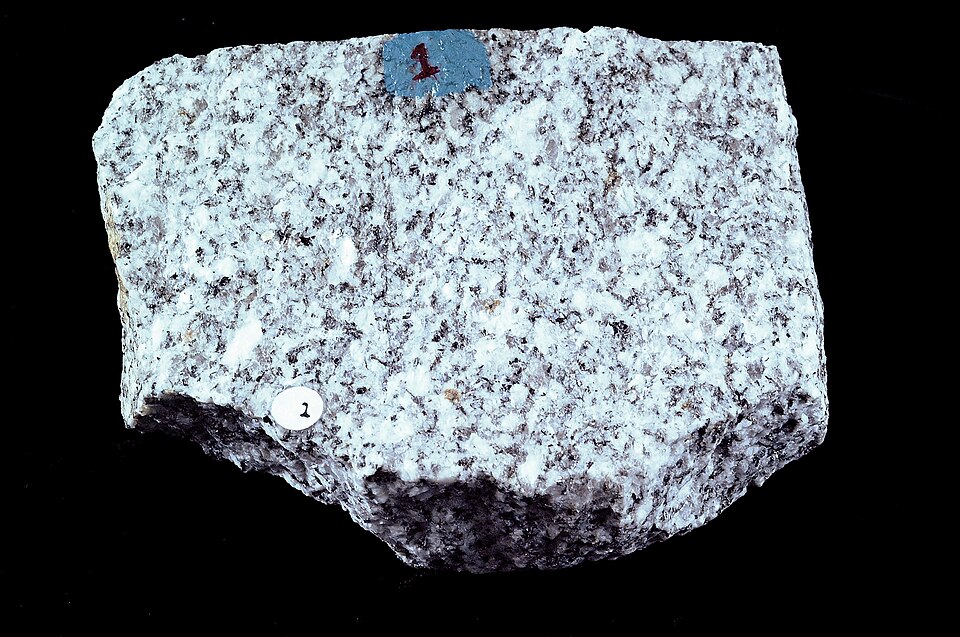
Correct — D, Granite. Granite is normally an intrusive (plutonic) igneous rock formed by slow cooling of magma rich in quartz and feldspar. But geologists also recognise granite of metamorphic origin: rocks buried deep and heated close to melting can be transformed into granite by granitization / anatexis (partial melting and recrystallisation). Because granite can arise by both routes, it is the standard textbook example of a rock that is both igneous and metamorphic. (Gneissose 'granite gneiss' is also arguably dual-origin, but 'granite' is the intended answer to this item.)
Why the others are wrong
- (a)Gabbro — Gabbro is a coarse-grained basic intrusive igneous rock (the plutonic equivalent of basalt) — purely igneous, with no metamorphic origin.
- (b)Geyserite — Geyserite is a siliceous sinter — opaline silica chemically deposited around geysers and hot springs — so it is a chemical sedimentary deposit, neither igneous nor metamorphic.
- (c)Gneissoid — Gneiss (gneissoid rock) is classed as a foliated, banded metamorphic rock; in the textbook two-way sense it is metamorphic, not a rock quoted as both igneous and metamorphic — so granite is the intended answer.
Concept
In the rock cycle, igneous rocks form by cooling of magma, metamorphic rocks by heat/pressure alteration of pre-existing rock, and sedimentary rocks by deposition and lithification. Granite straddles the first two: alongside ordinary magmatic granite, deep-seated 'granitization' can convert country rock into granite — a long-running debate known as the 'granite controversy'.
The eliminating logic: gabbro is unambiguously igneous, geyserite is a hot-spring sediment, and gneiss is metamorphic. Only granite is routinely cited as having a dual (magmatic + metamorphic) origin, which is why it is the answer — with gneissoid the tempting near-miss.
Key facts
- Granite — intrusive igneous rock of quartz, feldspar and mica; can also form by metamorphic granitization/anatexis.
- Gabbro — coarse-grained basic (mafic) intrusive igneous rock.
- Geyserite — siliceous sinter deposited around geysers/hot springs (chemical sedimentary).
- Gneiss — a foliated, banded metamorphic rock (often from granite or shale).
Study next
Common traps
- Choosing gneissoid because gneiss can derive from granite — but gneiss itself is classed metamorphic.
- Treating gabbro as dual-origin — it is a purely igneous rock.
Asked as 'which rock has a dual origin / is both igneous and metamorphic', or matching a rock to its mode of formation.
Related PYQs
No directly related past PYQ was found.
Practice
- practice — not a real PYQ
Gabbro is an example of which type of rock?
- (a)Sedimentary
- (b)Intrusive igneous
- (c)Metamorphic
- (d)Extrusive igneous
Answer(b) Intrusive igneous — gabbro is a coarse-grained basic plutonic rock. - practice — not a real PYQ
The process by which pre-existing rocks are converted into granite at great depth is called:
- (a)Weathering
- (b)Granitization
- (c)Lithification
- (d)Erosion
Answer(b) Granitization — deep-seated transformation of rock into granite (the metamorphic route to granite).