
Consider the two statements given below: Statement-1: Infrared waves are also called heat waves. Statement-2: Water molecules readily absorb infrared waves. Select the correct answer using the code given below:
- (a)Both the statements are individually true and Statement-2 is the correct explanation of Statement-1.
- (b)Both the statements are individually true, but Statement-2 is not the correct explanation of Statement-1.
- (c)Statement-1 is true, but Statement-2 is false.
- (d)Statement-2 is true, but Statement-1 is false.
Answer
Why
Correct — A, both statements are true and the second explains the first. Infrared radiation is indeed called heat radiation, and the reason is exactly the second statement: water molecules, present in most materials including our bodies, readily absorb infrared waves, and this absorption sets the molecules vibrating and warms the material. Because infrared is so efficiently absorbed and turned into thermal energy, it is felt as heat, which is why it earns the name heat waves. So the second statement is not merely a true fact standing alongside the first; it is the mechanism that makes the first true.
Why the others are wrong
- (b)Both the statements are individually true, but Statement-2 is not the correct explanation of Statement-1. — The two are not independent facts — the ready absorption of infrared by water molecules is precisely why infrared feels like heat, so the second statement is the correct explanation of the first, not a separate coincidence.
- (c)Statement-1 is true, but Statement-2 is false. — The second statement is true — water molecules do readily absorb infrared radiation; this absorption underlies molecular heating and the greenhouse effect.
- (d)Statement-2 is true, but Statement-1 is false. — The first statement is also true — infrared waves are routinely referred to as heat waves because of their strong heating effect.
Concept
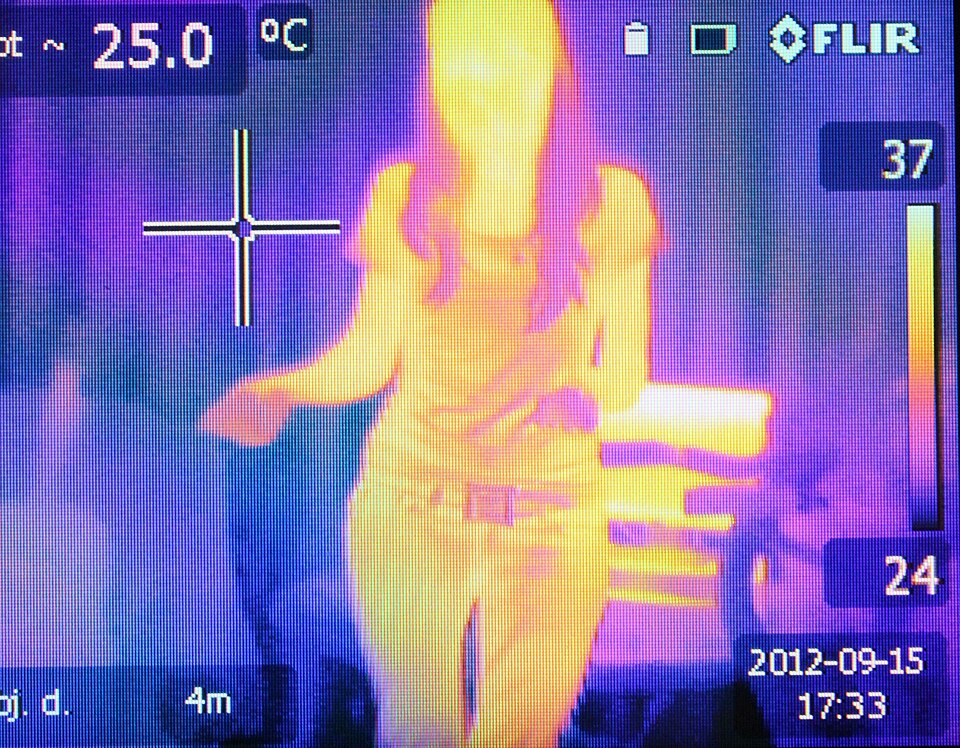
Infrared occupies the region of the electromagnetic spectrum just beyond visible red light, with wavelengths longer than visible light but shorter than microwaves. It is emitted by warm bodies and is strongly absorbed by molecules, especially water, raising their thermal energy.
The item is an assertion-reason style pairing. The key is recognising that the heat-wave label is a consequence of infrared's absorption by water and similar molecules, so the second statement supplies the cause behind the first.
Key facts
- Infrared lies between visible light and microwaves on the electromagnetic spectrum; all objects above absolute zero emit infrared.
- Water molecules and many organic molecules have vibrational modes that absorb infrared strongly, converting the radiation into heat.
- This same absorption by atmospheric water vapour and carbon dioxide is central to the greenhouse effect that warms the Earth.
- NCERT physics explicitly notes that infrared waves are often called heat waves because water molecules present in most materials readily absorb them.
Study next
Common traps
- Marking 'both true but not the explanation' when the reason genuinely is the mechanism behind the assertion.
- Confusing infrared with ultraviolet — ultraviolet is higher-energy and on the opposite side of visible light.
Set as an assertion-reason (statement-1 and statement-2) item — decide both truth values and whether the second is the cause of the first.
Related PYQs
Which one of the following types of waves are used in a night vision apparatus ?
- (a) Radio waves
- (b) Microwaves
- (c) Infra-red waves
- (d) None of the above
Answer(c) Infra-red waves — night-vision devices detect the infrared radiation emitted or reflected by objects and convert it into a visible image.
Both hinge on the properties of infrared radiation — the UPSC question tests that night-vision devices work by detecting infrared, complementing this item's point that infrared is the heat-carrying band readily absorbed by water molecules.
Practice
- practice — not a real PYQ
Which type of electromagnetic radiation is used in a TV remote control and is also known as heat radiation?
- (a)Ultraviolet
- (b)Infrared
- (c)X-rays
- (d)Microwaves
Answer(b) Infrared — remote controls emit infrared, the band commonly called heat radiation. - practice — not a real PYQ
In the electromagnetic spectrum, infrared radiation lies between:
- (a)visible light and ultraviolet
- (b)microwaves and radio waves
- (c)visible light and microwaves
- (d)X-rays and gamma rays
Answer(c) visible light and microwaves — infrared has wavelengths longer than red light but shorter than microwaves.