
A metallic bob X of mass m is released from position A. It collides elastically with another identical bob Y placed at rest at position B on a horizontal frictionless table. The angle AOB is 30 degrees. How high does the bob X rise immediately after the collision?
- (a)To the same height as that of position A on the other side in the same trajectory
- (b)To half the height as that of position A on the other side along the same trajectory
- (c)The same height at position A
- (d)It stops at position B
Answer
Why
Correct — D, bob X stops at position B. When two bodies of equal mass undergo a one-dimensional elastic collision and the target is initially at rest, they simply exchange velocities: the incoming body comes to rest and the struck body moves off with the incoming body's speed. Conservation of momentum (mu = m*v_X + m*v_Y) together with conservation of kinetic energy forces v_X = 0 and v_Y = u for equal masses. So the moment X strikes the identical stationary bob Y, X transfers all of its velocity to Y and is left at rest at B; with zero speed it cannot climb, so it does not rise at all, while Y swings up instead.
Why the others are wrong
- (a)To the same height as that of position A on the other side in the same trajectory — This would require X to rebound with its original speed, which happens only if it struck a fixed wall or a much heavier body — not an identical free bob, which instead carries the velocity away.
- (b)To half the height as that of position A on the other side along the same trajectory — There is no sharing that leaves X with half the speed; an equal-mass elastic collision transfers the whole velocity to Y, so X keeps none of it.
- (c)The same height at position A — X would return to A's height only if it bounced straight back at full speed; here it stops, so it neither rebounds nor rises.
Concept
In a perfectly elastic collision both linear momentum and kinetic energy are conserved. For the special case of equal masses with one body at rest, these two conservation laws have a clean consequence: the two bodies swap velocities.
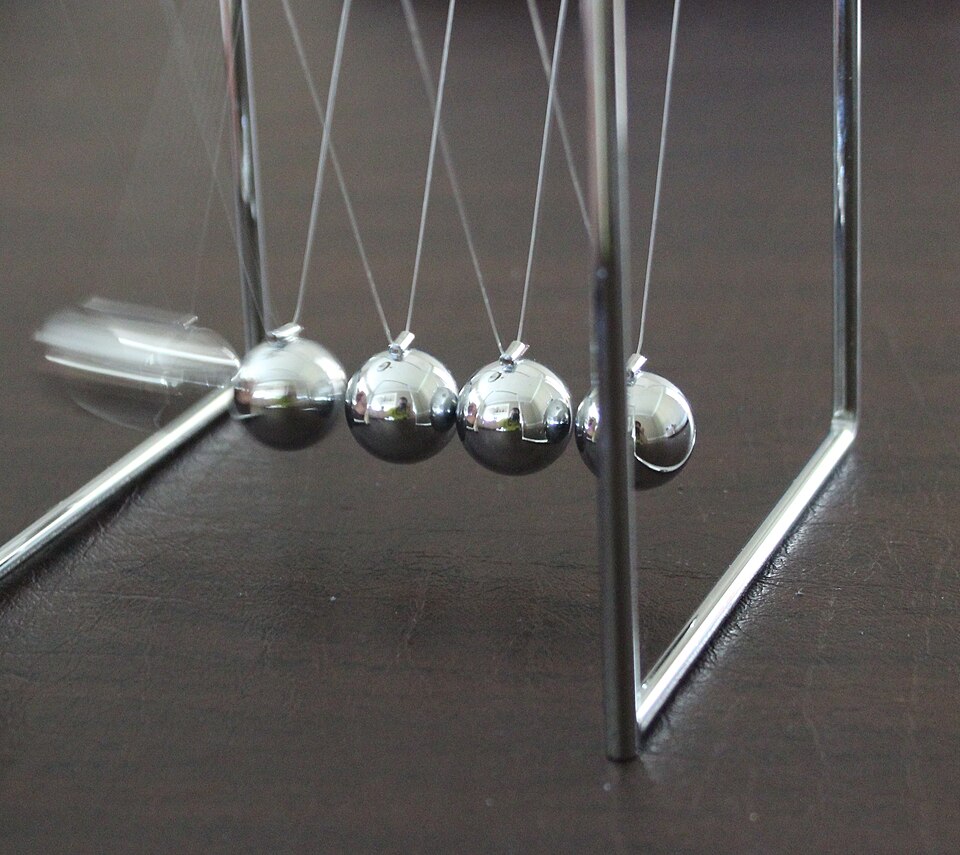
This is the physics of a Newton's cradle. The trap is expecting X to bounce back, as it would off a wall, or to share the motion; instead, with an identical partner it hands over all of its speed and halts.
Key facts
- In an elastic collision, kinetic energy is conserved in addition to momentum; in an inelastic one, kinetic energy is not conserved.
- For equal masses in a one-dimensional elastic collision with the target at rest, the bodies exchange velocities — the incident body stops and the target moves off with the incident speed.
- This velocity exchange is what makes a Newton's cradle work: one ball swings in and one ball swings out.
- The table is frictionless, so no energy is lost to friction and the idealised elastic result applies.
Study next
Common traps
- Assuming the incoming bob rebounds to its original height — that is the fixed-wall or much-heavier-target case, not an identical free bob.
- Forgetting that elastic collisions conserve kinetic energy as well as momentum.
Posed as a Newton's-cradle scenario — recall that equal masses in an elastic collision exchange velocities, so the striker stops.
Related PYQs
Assertion (A): A man standing on a completely frictionless surface can propel himself by whistling. Reason (R): If no external force acts on a system, its momentum cannot change.
- (a) Both A and R are true, and R is the correct explanation of A
- (b) Both A and R are true, but R is not a correct explanation of A
- (c) A is true, but R is false
- (d) A is false, but R is true
Answer(a) Both A and R are true, and R is the correct explanation of A — expelling air while whistling gives the man equal and opposite momentum because the total momentum of an isolated system is conserved.
Both turn on conservation of linear momentum in an isolated, frictionless system — the UPSC item states the principle that momentum cannot change without an external force, which is exactly the law (with kinetic-energy conservation) that fixes the equal-mass elastic-collision result here.
Practice
- practice — not a real PYQ
A moving ball collides head-on and elastically with an identical stationary ball. After the collision, the first ball:
- (a)continues with the same velocity
- (b)comes to rest
- (c)rebounds with the same speed
- (d)moves with half the velocity
Answer(b) comes to rest — equal masses exchange velocities in an elastic collision, so the first ball stops and the second moves off. - practice — not a real PYQ
Which quantity is conserved in an elastic collision but NOT in a perfectly inelastic collision?
- (a)linear momentum
- (b)kinetic energy
- (c)total energy
- (d)mass
Answer(b) kinetic energy — momentum and total energy are conserved in both, but kinetic energy is conserved only in an elastic collision.