
In the human digestive system, which one among the following is the role of the pancreas?
- (a)Secretion of surfactants to break up lipid droplets
- (b)Storage and regulated release of bile
- (c)Secretion of lipase, amylase and protease
- (d)Neutralizing stomach acids
Answer
Why
Correct — C, secretion of lipase, amylase and protease. The pancreas is chiefly an exocrine digestive gland: its acinar cells make pancreatic juice, which delivers fat-splitting lipase, starch-splitting pancreatic amylase, and protein-splitting proteases (trypsin, chymotrypsin) into the duodenum. Handling all three food groups — fats, carbohydrates and proteins — with one juice is the pancreas's defining role in digestion, which is exactly option (c).
Why the others are wrong
- (a)Secretion of surfactants to break up lipid droplets — Breaking large fat globules into small droplets (emulsification) is done by bile salts, which are made by the liver and delivered via bile — not by the pancreas. (Pulmonary surfactant, the other 'surfactant', is made in the lungs.)
- (b)Storage and regulated release of bile — Storing bile and releasing it on cue is the job of the gallbladder, with the bile itself produced by the liver. The pancreas neither makes nor stores bile.
- (d)Neutralizing stomach acids — Pancreatic juice does carry sodium bicarbonate that helps neutralise the acidic chyme arriving from the stomach, so this is a real but secondary pancreatic action. As a single 'role of the pancreas', however, it captures only the buffering side and misses the enzyme secretion that defines the organ, so (c) is the fuller and intended answer.
Concept
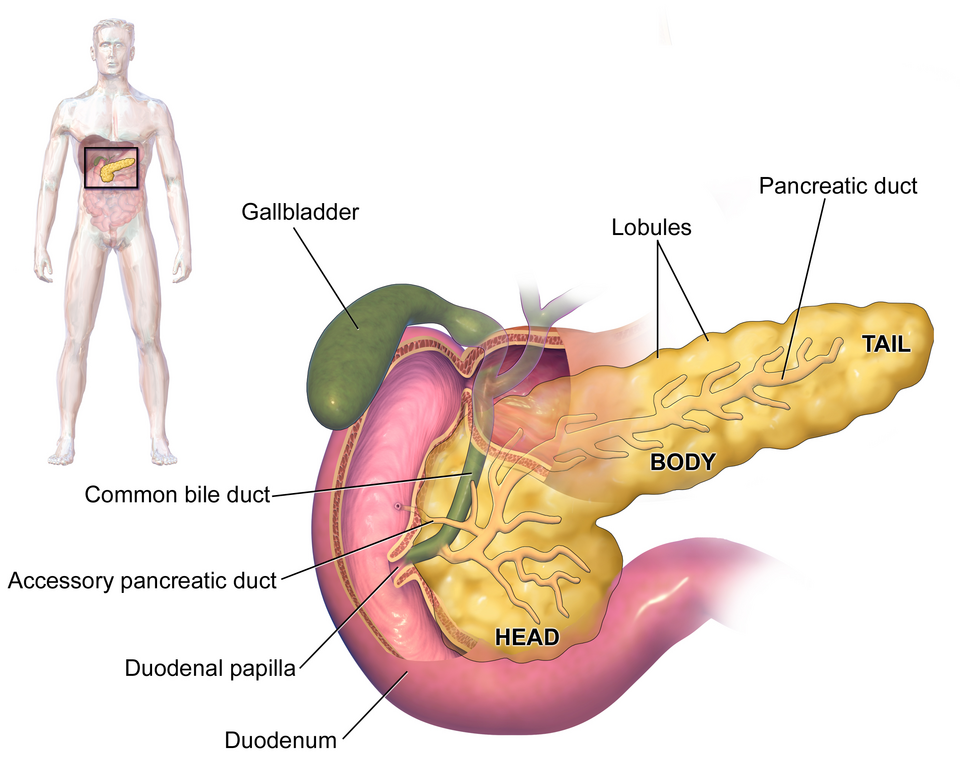
The pancreas is a dual gland lying behind the stomach. Its exocrine part (about 98% of the tissue) pours pancreatic juice into the duodenum through the pancreatic duct; that juice contains digestive enzymes plus bicarbonate. Its small endocrine part (the islets of Langerhans) releases the hormones insulin and glucagon straight into the blood to control blood sugar.
Every option here describes something that happens in fat or acid handling in the gut, so the question tests whether you can attach each action to the right organ. Emulsifying fat and storing bile belong to the liver and gallbladder; the pancreas's headline contribution is the enzyme cocktail that chemically digests fats, starch and protein. Pin the enzymes to the pancreas and (c) stands out.
Key facts
- Exocrine pancreas secretes lipase (fats), pancreatic amylase (starch) and proteases such as trypsin and chymotrypsin (proteins).
- Pancreatic juice is alkaline because it carries sodium bicarbonate, which neutralises acidic chyme in the duodenum.
- Bile is made by the liver and stored/released by the gallbladder — not by the pancreas.
- The endocrine pancreas (islets of Langerhans) secretes insulin and glucagon to regulate blood glucose.
Study next
Common traps
- Attributing fat emulsification or bile storage to the pancreas — these belong to the liver and gallbladder.
- Treating the pancreas's bicarbonate (acid-neutralising) role as its whole job and overlooking enzyme secretion.
Asked as 'which enzyme/secretion comes from the pancreas', or by matching digestive glands to their secretions.
Related PYQs
Which of the following is not a digestive enzyme in the human system?
- (a) Trypsin
- (b) Gastrin
- (c) Ptyalin
- (d) Pepsin
Answer(b) Gastrin
Same concept — digestive enzymes vs non-enzymes. Trypsin (a pancreatic protease), ptyalin and pepsin are enzymes, while gastrin is a hormone. It reinforces that the pancreas's role in this NDA question is enzyme secretion.
Practice
- practice — not a real PYQ
The hormone insulin is secreted by which part of the pancreas?
- (a)Acinar cells
- (b)Islets of Langerhans
- (c)Pancreatic duct
- (d)Bile canaliculi
Answer(b) Islets of Langerhans — the endocrine part of the pancreas that releases insulin and glucagon. - practice — not a real PYQ
Emulsification of fats in the small intestine is mainly carried out by:
- (a)Pancreatic lipase
- (b)Bile salts
- (c)Salivary amylase
- (d)Pepsin
Answer(b) Bile salts — bile from the liver breaks large fat globules into small droplets before lipase acts.