
Consider the following cell types: 1. Monocyte 2. Chondrocyte 3. Basophil 4. Lymphocyte How many of the above belong to animal cell types?
- (a)1
- (b)2
- (c)3
- (d)4
Answer
Why
Correct — D, 4. All four named cells are animal cells. Monocytes, basophils and lymphocytes are white blood cells (leukocytes) that circulate in animal blood, and a chondrocyte is the living cell that builds and maintains cartilage in animals. None of the four is a plant cell, a bacterium or a non-cellular structure, so every one of them belongs to animal cell types — the count is 4.
Why the others are wrong
- (a)1 — A count of 1 would mean only one of the four is an animal cell. In fact monocyte, chondrocyte, basophil and lymphocyte are all animal cells, so 1 is far too low.
- (b)2 — A count of 2 tempts you if you recognise only the two familiar blood cells (lymphocyte and monocyte) and discount basophil and chondrocyte. But those two are animal cells as well, so 2 undercounts.
- (c)3 — A count of 3 usually comes from wrongly excluding the unfamiliar chondrocyte. The chondrocyte is a genuine animal cell (the cell of cartilage), so all four qualify and the answer is 4, not 3.
Concept
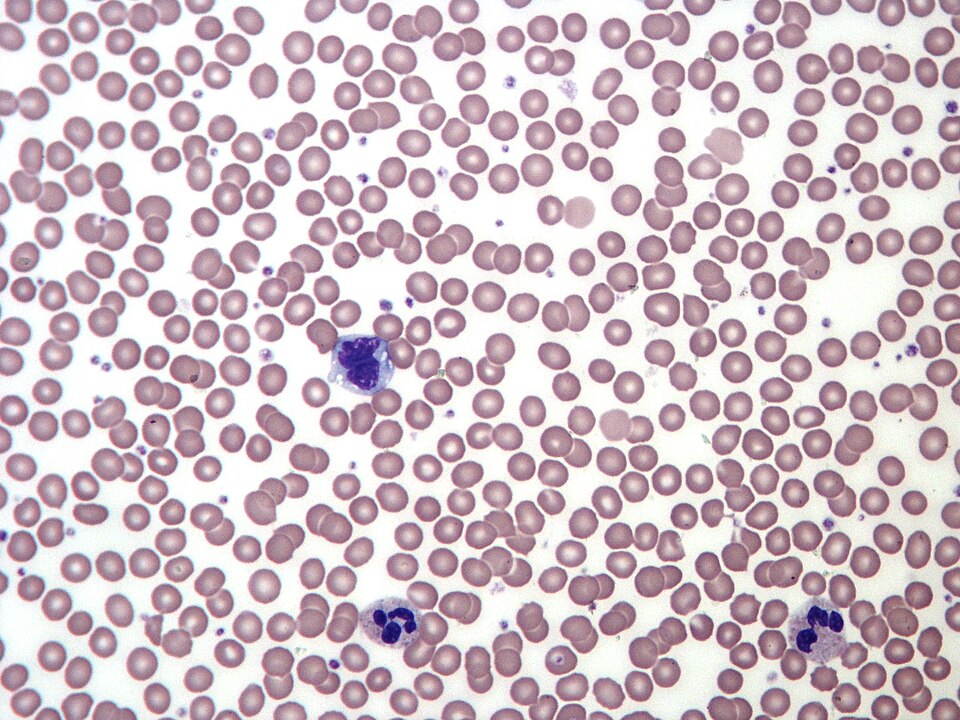
Animals are built from eukaryotic animal cells, which lack the cell wall and chloroplasts of plant cells. These cells specialise into families such as blood cells and connective-tissue cells. The white blood cells (leukocytes) include monocytes, lymphocytes and the granulocytes — neutrophils, eosinophils and basophils — while a chondrocyte is the resident cell of cartilage, a connective tissue.
The list deliberately mixes two blood cells you meet often (lymphocyte, monocyte) with a less familiar granulocyte (basophil) and a connective-tissue cell (chondrocyte). The trap is to dismiss an unfamiliar name as 'not really a cell' or to imagine one of them is a plant cell. Once you place each name — three leukocytes plus one cartilage cell — you see all four are ordinary animal cells and the count is 4.
Key facts
- Monocytes, lymphocytes and basophils are all white blood cells (leukocytes) found in animals.
- Basophils are the rarest granulocyte and release histamine and heparin in allergic and inflammatory responses.
- Chondrocytes are the living cells embedded in the matrix of cartilage, a type of connective tissue.
- Every animal cell is eukaryotic and lacks the rigid cell wall and chloroplasts that characterise plant cells.
Study next
Common traps
- Dismissing an unfamiliar cell name such as chondrocyte or basophil as 'not a real cell type'.
- Assuming one of the listed cells must be a plant cell — none of the four is.
Asked as 'how many of the following are animal/plant cells', or as matching a named cell to the tissue it belongs to.
Related PYQs
In which organ of the human body are the lymphocyte cells formed?
- (a) Liver
- (b) Long bone
- (c) Pancreas
- (d) Spleen
Answer(b) Long bone
Same concept — the lymphocyte, one of the animal (blood) cell types in this NDA question. UPSC asks where lymphocytes are formed; the answer is the bone marrow of long bones.
Practice
- practice — not a real PYQ
Which one of the following is NOT a white blood cell?
- (a)Monocyte
- (b)Basophil
- (c)Chondrocyte
- (d)Lymphocyte
Answer(c) Chondrocyte — it is the cell of cartilage; the other three are white blood cells. - practice — not a real PYQ
Chondrocytes are the characteristic cells of which tissue?
- (a)Blood
- (b)Cartilage
- (c)Nervous tissue
- (d)Muscle
Answer(b) Cartilage — chondrocytes lie embedded in the cartilage matrix.