
Consider the following characteristics of a grassland: 1. An extensive area of mid latitude grasslands are devoid of trees and shrubs. 2. The climate is characterised by hot summers, cold winters and relatively low rainfall occurring mainly in spring and summer. 3. In humid parts, grasses grow to a meter or more in height. On the basis of the above characteristics, select the correct grassland from the options given below:
- (a)Steppes
- (b)Prairies
- (c)Savanna
- (d)Pampas
Answer
Why
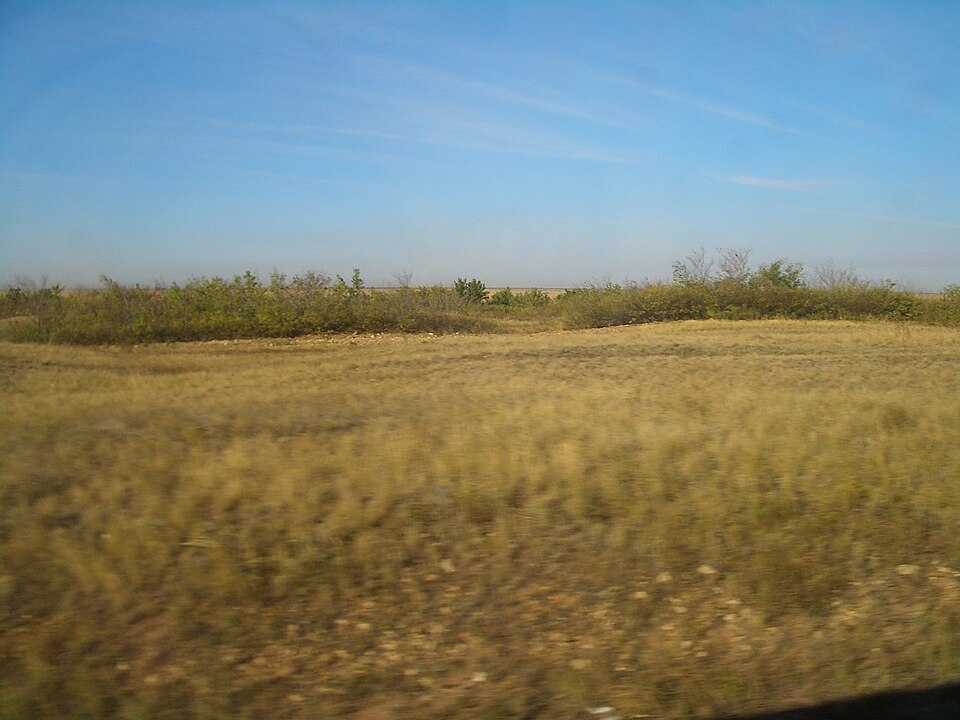
Correct — A, Steppes. The clues describe a mid-latitude (temperate) grassland: an extensive, treeless expanse, a continental climate of hot summers and cold winters with relatively low rainfall falling mainly in spring and summer, and grasses reaching a metre or more in the moister parts. This is the Eurasian Steppe — the temperate grassland of Central Asia and southern Russia and Ukraine. One honest caveat: the tall-grass clue in statement 3 also fits the North American tall-grass prairies, which belong to the same temperate-grassland family; the steppe reading is preferred here because the description stresses an extensive, treeless, relatively low-rainfall mid-latitude belt, which is the steppe's signature.
Why the others are wrong
- (b)Prairies — The North American temperate grassland shares the mid-latitude, treeless and tall-grass traits, but prairies (especially the tall-grass east) receive higher and more reliable rainfall, whereas the description stresses 'relatively low rainfall', which is the steppe trait.
- (c)Savanna — Savanna is a TROPICAL grassland with scattered trees and a hot climate with wet and dry seasons — not the mid-latitude, cold-winter, treeless grassland described here.
- (d)Pampas — The pampas is the temperate grassland of South America; it fits mid-latitude grassland but is humid and lacks the cold continental winters and low rainfall highlighted in the description.
Concept
Temperate (mid-latitude) grasslands occupy continental interiors with hot summers, cold winters and moderate-to-low rainfall — too little for forest but enough for grass. They go by regional names: Steppes in Eurasia, Prairies in North America, Pampas in South America, Veld in South Africa and Downs in Australia. Tropical grasslands, such as the Savanna, Llanos and Campos, are different — hot all year with scattered trees.
The decisive clues are 'mid latitude', 'devoid of trees', 'cold winters' and 'relatively low rainfall', all pointing to a temperate continental grassland and, among the four options, specifically the Eurasian Steppe. The tall-grass line is what makes prairies tempting, but the steppe is the standard match for a treeless, low-rainfall, cold-winter grassland.
Key facts
- Steppes are the temperate grasslands of Central Asia and south-eastern Europe — southern Russia, Ukraine, Kazakhstan and Mongolia.
- Their climate is continental — hot summers, very cold winters and scanty rainfall concentrated in spring and summer.
- Regional names for temperate grasslands are Steppe (Eurasia), Prairie (North America), Pampas (South America), Veld (South Africa) and Downs (Australia).
- Savanna, by contrast, is a tropical grassland with scattered trees and a wet-and-dry climate.
Study next
Common traps
- Confusing steppe (temperate, cold winters) with savanna (tropical, scattered trees).
- Picking prairies on the tall-grass clue alone — the low-rainfall, cold-winter description is the steppe signature.
- Forgetting that pampas and veld are also temperate grasslands, just on other continents.
Grassland questions give a climate and vegetation description and ask you to name the region — key on latitude (temperate versus tropical), rainfall and tree cover.
Related PYQs
“Climate is extreme, rainfall is scanty and the people used to be nomadic herders.” The above statement best describes which of the following regions?
- (a) African Savannah
- (b) Central Asian Steppe
- (c) North American Prairie
- (d) Siberian Tundra
Answer(b) Central Asian Steppe
Same concept — identifying a temperate grassland from its climate; the UPSC clue ('climate extreme, rainfall scanty, nomadic herders') resolves to the Central Asian Steppe, the very grassland this NDA question describes.
The vegetation of savannah consists of grassland with scattered small trees, but extensive areas have no trees. The forest development in such areas is generally kept in check by one or more or a combination of some conditions. Which of the following are such conditions? 1. Burrowing animals and termites 2. Fire 3. Grazing herbivores 4. Seasonal rainfall 5. Soil properties Select the correct answer using the code given below.
- (a) 1 and 2
- (b) 4 and 5
- (c) 2, 3 and 4
- (d) 1, 3 and 5
Answer(c) 2, 3 and 4
Related grassland ecology — why extensive grassland areas stay treeless (fire, grazing, seasonal rainfall), which is exactly the 'devoid of trees and shrubs' clue in statement 1 here.
Practice
- practice — not a real PYQ
The temperate grassland of North America is known as the
- (a)Steppe
- (b)Pampas
- (c)Prairie
- (d)Veld
Answer(c) Prairie — the North American temperate grassland; the steppe is Eurasian and the pampas South American. - practice — not a real PYQ
Which one of the following is a TROPICAL grassland with scattered trees?
- (a)Steppe
- (b)Prairie
- (c)Savanna
- (d)Pampas
Answer(c) Savanna — a tropical grassland with scattered trees and a wet-and-dry climate.