
Name the scientist who first used a glass prism to obtain the spectrum of sunlight
- (a)C. V. Raman
- (b)Lord Rayleigh
- (c)Isaac Newton
- (d)S. Chandrasekhar
Answer
Why
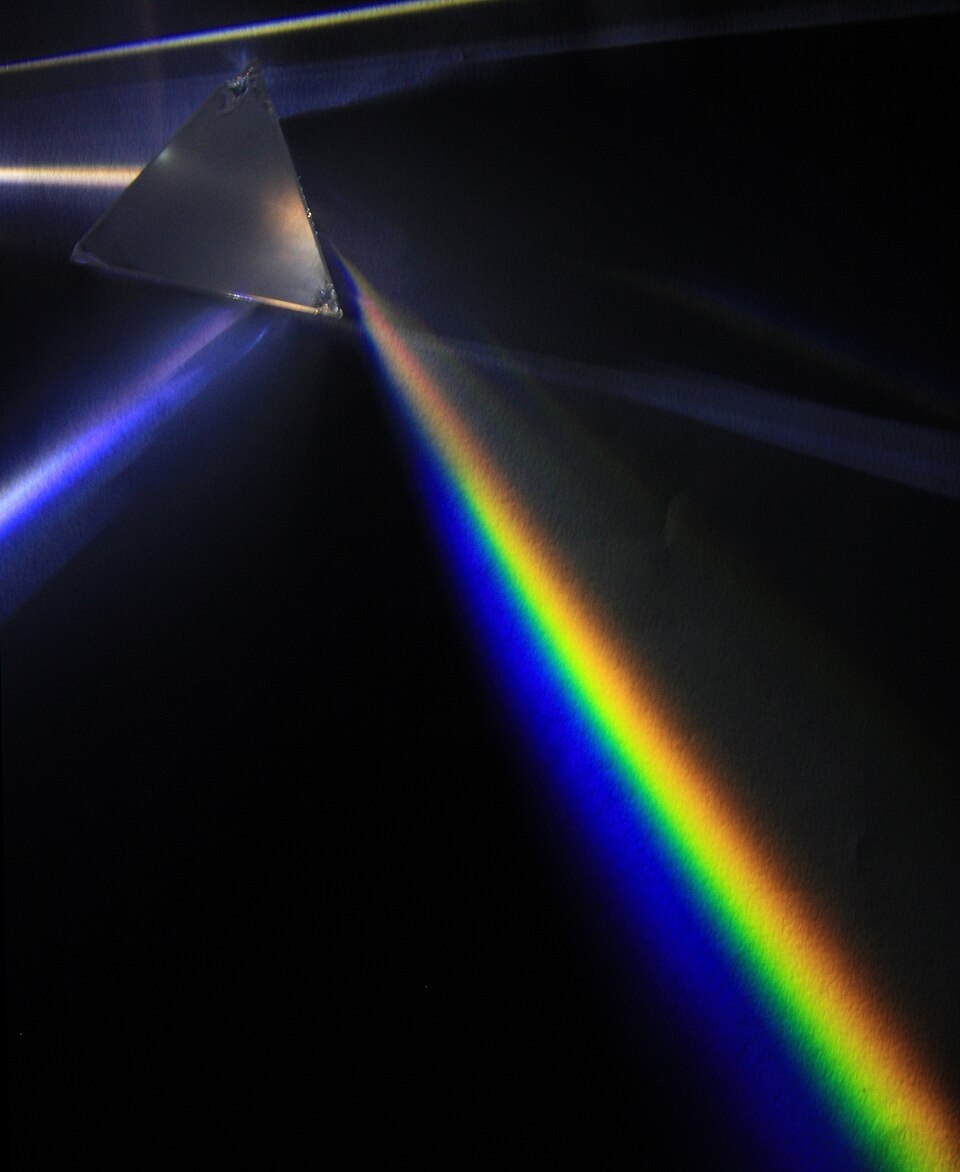
Correct — C, Isaac Newton. Isaac Newton, in his famous prism experiments around 1666, passed a beam of sunlight through a glass prism and split it into the band of colours (VIBGYOR), showing that white light is a mixture of colours. He was the first to demonstrate this dispersion of sunlight into a spectrum.
Why the others are wrong
- (a)C. V. Raman — C. V. Raman won the 1930 Nobel Prize for the Raman effect (scattering of light) — a 20th-century Indian physicist, not the discoverer of the solar spectrum.
- (b)Lord Rayleigh — Lord Rayleigh explained the scattering of light that makes the sky blue and co-discovered argon; he did not perform the original prism-spectrum experiment.
- (d)S. Chandrasekhar — S. Chandrasekhar was an astrophysicist known for the Chandrasekhar limit on white-dwarf stars, unrelated to the prism experiment.
Concept
Dispersion is the splitting of white light into its component colours because each colour (wavelength) is refracted by a slightly different amount in glass. Newton's prism experiment established that sunlight is composite and gave the ordered spectrum from red to violet.
Three of the names are 20th-century physicists; only Isaac Newton belongs to the 17th century and to the prism experiment. Match the classic 'white light through a prism' to Newton.
Key facts
- Isaac Newton split sunlight with a glass prism around 1666, producing the spectrum.
- The experiment showed white light is a mixture of seven colours (VIBGYOR).
- Dispersion occurs because different colours refract by different amounts.
- Violet bends the most and red the least on passing through the prism.
Study next
Common traps
- Picking an Indian physicist (Raman or Chandrasekhar) by association with 'light' or 'spectra'.
- Confusing scattering (Rayleigh/Raman) with dispersion (Newton's prism).
History-of-science questions pair a discovery with a scientist — link the prism/spectrum to Newton and scattering to Rayleigh/Raman.
Related PYQs
Rainbow is produced when sunlight falls on drops of rain. Which of the following physical phenomena are responsible for this? 1. Dispersion 2. Refraction 3. Internal reflection
- (a) 1 and 2 only
- (b) 2 and 3 only
- (c) 1 and 3 only
- (d) 1, 2 and 3
Answer(d) 1, 2 and 3
Same core physics — dispersion of white light into its colours. The UPSC item builds a rainbow from dispersion (plus refraction and internal reflection); Newton's prism is the classic laboratory demonstration of that same dispersion.
Which of the following statements with regard to the phenomenon of the primary rainbow formation by water droplets is/are correct? 1. It involves refraction and one internal reflection of sunlight. 2. It involves refraction of sunlight only. 3. It is formed as the inner bow. 4. It may involve more than one internal reflection as well as refraction of sunlight. Select the answer using the code given below:
- (a) 1 only
- (b) 1 and 3
- (c) 3 and 4
- (d) 2 and 3
Answer(b) 1 and 3
Same concept — refraction and dispersion of sunlight into a spectrum. A rainbow forms when water drops disperse sunlight, the natural counterpart of Newton's glass-prism experiment.
Practice
- practice — not a real PYQ
The splitting of white light into its constituent colours by a prism is called
- (a)reflection
- (b)dispersion
- (c)polarisation
- (d)interference
Answer(b) dispersion — as first shown by Newton's prism. - practice — not a real PYQ
In the spectrum of white light produced by a prism, which colour is deviated (bent) the most?
- (a)Red
- (b)Green
- (c)Yellow
- (d)Violet
Answer(d) Violet — it has the shortest wavelength and refracts the most.