
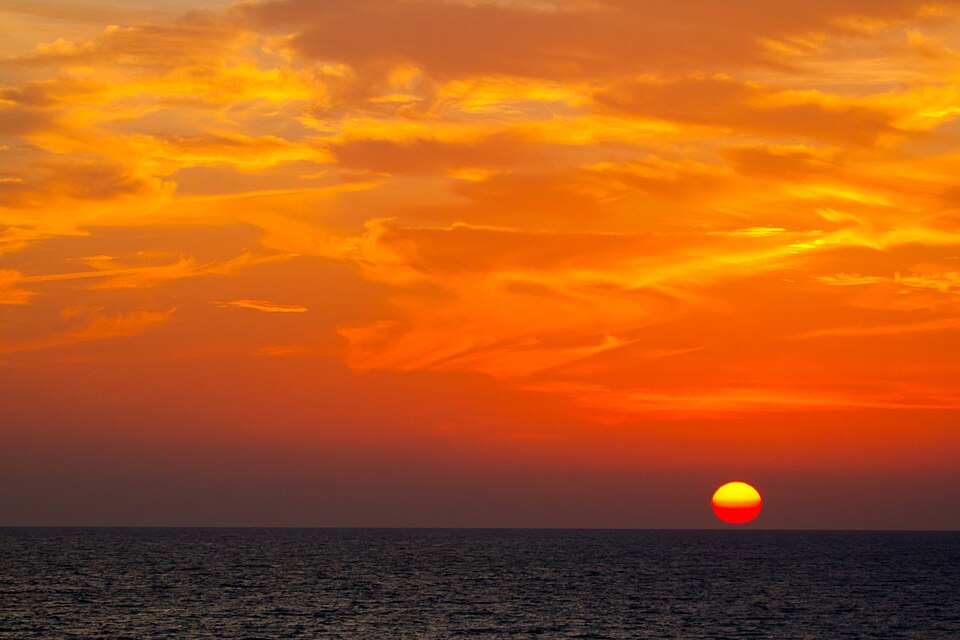
The Sun appears reddish during sunrise and sunset. The phenomenon in optics which is responsible for this appearance of the Sun is
- (a)Reflection
- (b)Total internal reflection
- (c)Scattering
- (d)Interference
Answer
Why
Correct — C, Scattering. At sunrise and sunset the sunlight travels a much longer, more slanting path through the atmosphere. Along this path the shorter-wavelength blue light is scattered away (Rayleigh scattering is strongest for short wavelengths), leaving mainly the longer-wavelength red and orange light to reach the eye, so the Sun looks reddish.
Why the others are wrong
- (a)Reflection — Reflection simply returns light from a surface; it does not selectively remove blue light from sunlight, so it cannot explain the reddening.
- (b)Total internal reflection — This occurs when light in a denser medium meets a boundary beyond the critical angle (as in optical fibres or a mirage); it is not what colours the Sun.
- (d)Interference — Interference produces coloured fringes from overlapping waves (for example in soap films); it does not cause the Sun's reddish colour near the horizon.
Concept
Rayleigh scattering by air molecules is inversely proportional to the fourth power of the wavelength, so blue light is scattered far more than red. Near the horizon sunlight crosses the greatest thickness of atmosphere, so most of the blue is scattered out of the direct beam and the remaining light that reaches us is red and orange.
The reddish Sun at the horizon and the blue daytime sky are two sides of the same scattering effect. Refraction is a tempting distractor because it bends light, but the colour change is due to selective scattering, not bending.
Key facts
- Rayleigh scattering is inversely proportional to the fourth power of wavelength, so blue is scattered much more than red.
- Near the horizon sunlight passes through the greatest thickness of atmosphere, scattering out most of the blue and leaving red and orange.
- The same scattering makes the daytime sky appear blue.
- The overhead midday Sun looks white or yellowish because the light path through the atmosphere is much shorter.
Study next
Common traps
- Choosing refraction — refraction bends light, but the reddening is caused by selective scattering.
- Confusing scattering with reflection or interference.
The reddish Sun at sunrise or sunset, the blue sky, and the darkness of space are all tested as applications of scattering.
Related PYQs
Consider the following statements: 1. Light of longer wavelength is scattered much more than light of shorter wavelength. 2. The speed of visible light in water is 0.95 times its speed in vacuum. 3. Radio waves are produced by rapidly oscillating electrical currents. 4. To detect over-speeding vehicles, police use the Doppler effect of reflected short radio waves. Which of these statements are correct?
- (a) 1 and 2
- (b) 1 and 3
- (c) 2 and 4
- (d) 3 and 4
Answer(d) 3 and 4
Statement 1 is the scattering concept, and it is false — shorter (blue) wavelengths are scattered more than longer ones, which is why the horizon Sun looks red.
What happens when the sunlight travels through the Earth's atmosphere?
- (a) The blue colour is scattered more compared to the red colour
- (b) The red colour is scattered more compared to the blue colour
- (c) Both the blue and the red colours are scattered equally
- (d) The blue colour is not scattered but the red colour is scattered the most
Answer(a) The blue colour is scattered more compared to the red colour
The same Rayleigh-scattering fact — blue is scattered more than red, which underlies both the blue sky and the reddish rising/setting Sun.
Practice
- practice — not a real PYQ
The sky appears blue because of
- (a)reflection of blue light by the sea
- (b)scattering of shorter-wavelength (blue) light by air molecules
- (c)absorption of red light by ozone
- (d)total internal reflection
Answer(b) scattering of shorter-wavelength (blue) light by air molecules. - practice — not a real PYQ
To an astronaut in space, the sky appears
- (a)blue
- (b)red
- (c)white
- (d)black
Answer(d) black — with almost no atmosphere there is no scattering of sunlight.