
Thyroid gland produces a hormone called "Thyroxine" which
- (a)controls blood glucose levels.
- (b)controls ovulation.
- (c)controls metabolic rate.
- (d)maintains pregnancy.
Answer
Why
Correct — C, controls metabolic rate. Thyroxine (T4) is an iodine-containing hormone secreted by the thyroid gland in the neck. Its central job is to set the body's basal metabolic rate - how fast cells burn fuel to release energy, produce heat and consume oxygen. Too much thyroxine (hyperthyroidism) speeds metabolism and causes weight loss; too little (hypothyroidism) slows it and causes weight gain and lethargy.
Why the others are wrong
- (a)controls blood glucose levels. — Blood-glucose regulation is done by insulin and glucagon from the PANCREAS, not by thyroxine from the thyroid.
- (b)controls ovulation. — Ovulation is controlled by the pituitary gonadotropins (LH and FSH) and the ovarian hormone oestrogen, not by thyroxine.
- (d)maintains pregnancy. — Pregnancy is maintained mainly by progesterone (from the corpus luteum and later the placenta), not by thyroxine.
Concept
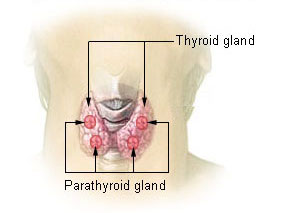
The thyroid gland secretes thyroxine (T4) and tri-iodothyronine (T3), iodine-containing hormones that regulate the body's basal metabolic rate, growth and heat production. Iodine is essential to make them, which is why iodine deficiency causes goitre.
Match each function to its correct gland. Blood sugar belongs to the pancreas, ovulation and pregnancy to the reproductive hormones - all can be eliminated. The thyroid's signature role is regulating metabolism, so thyroxine controls the metabolic rate.
Key facts
- Thyroxine (T4) and tri-iodothyronine (T3) are secreted by the thyroid gland and contain iodine.
- They regulate basal metabolic rate, growth and body-heat production.
- Iodine deficiency impairs thyroxine synthesis and causes goitre - hence the use of iodised salt.
- Hyperthyroidism speeds metabolism (weight loss); hypothyroidism slows it (weight gain, fatigue).
Study next
Common traps
- Matching the wrong gland to the function - glucose is the pancreas, metabolism is the thyroid.
- Forgetting that thyroxine needs iodine (the link to goitre).
Hormone questions ask 'which gland / hormone controls X' - learn one signature function per hormone (thyroxine = metabolism).
Related PYQs
Which one of the following hormones contains iodine?
- (a) Thyroxine
- (b) Testosterone
- (c) Insulin
- (d) Adrenaline
Answer(a) Thyroxine - the iodine-containing thyroid hormone.
UPSC 1995 on the same hormone - thyroxine, the iodine-bearing thyroid hormone tested here.
The menstrual cycle in females is controlled by hormones that are secreted by
- (a) Ovary and lacrimal gland
- (b) Ovary and sebaceous gland
- (c) Ovary and pituitary gland
- (d) Prostate and pituitary gland
Answer(c) Ovary and pituitary gland
Same endocrine concept - matching a hormone / body function to the gland that secretes it.
Practice
- practice — not a real PYQ
Deficiency of iodine in the diet leads to which one of the following?
- (a)Diabetes
- (b)Goitre
- (c)Rickets
- (d)Anaemia
Answer(b) Goitre - iodine is needed to synthesise thyroxine. - practice — not a real PYQ
The gland that controls the activity of the thyroid gland is the
- (a)Pancreas
- (b)Adrenal gland
- (c)Pituitary gland
- (d)Liver
Answer(c) Pituitary gland - its TSH stimulates the thyroid.