
Which one of the following is also known as Dry ice in its solid form?
- (a)SiO2
- (b)CO2
- (c)CaO
- (d)MgO
Answer
Why
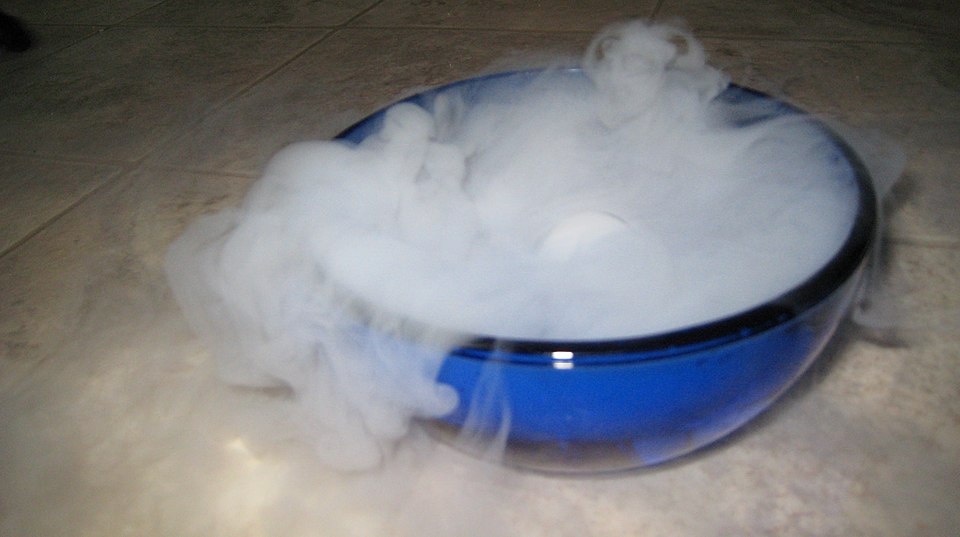
Correct — B, CO2 (carbon dioxide). Solid carbon dioxide is called dry ice because it looks like ordinary ice yet leaves no liquid behind. At normal atmospheric pressure it sublimes — passes straight from solid to gas at about -78.5 degrees C — so it keeps things cold and 'dry' with no melt water. That property is exactly why it is used to store frozen goods, create stage fog and flash-freeze foods.
Why the others are wrong
- (a)SiO2 — Silicon dioxide is quartz/silica sand, a hard mineral that melts near 1700 degrees C. It is a solid at room temperature for structural reasons, not a frozen gas, and has nothing to do with dry ice.
- (c)CaO — Calcium oxide is quicklime, a basic oxide that reacts vigorously with water to give slaked lime. It is not a frozen form of any gas and does not sublime.
- (d)MgO — Magnesium oxide is a white, very high-melting basic oxide used in refractories. Like CaO it is an ionic solid, not solidified carbon dioxide, so it is never called dry ice.
Concept
Dry ice is the solid state of carbon dioxide. Because CO2 has no stable liquid phase at ordinary atmospheric pressure, warming solid CO2 makes it sublime directly into gas instead of melting into a puddle. This is why it chills without wetting.
The four options are all solids, so the trap is to pick any familiar white solid. The distinguishing clue in the name is 'dry' — the substance must vanish without leaving liquid, which only sublimation gives. Of SiO2, CO2, CaO and MgO, only carbon dioxide sublimes at room conditions.
Key facts
- Dry ice is solid carbon dioxide (CO2).
- At 1 atm CO2 sublimes at about -78.5 degrees C, going solid straight to gas.
- It leaves no liquid, which is the origin of the word 'dry'.
- Sublimation is a direct solid-to-vapour change with no liquid stage.
Study next
Common traps
- Assuming every white solid that keeps things cold is 'ice' (water).
- Confusing sublimation with melting.
- Mixing up CO2 (dry ice) with the oxides CaO/MgO.
NDA/UPSC name a common substance ('dry ice', 'quicklime', 'washing soda') and ask for the formula, or vice versa — link the trivial name to the chemical.
Related PYQs
No directly related past PYQ was found.
Practice
- practice — not a real PYQ
The process by which dry ice changes directly from solid to gas is called
- (a)Melting
- (b)Sublimation
- (c)Condensation
- (d)Vaporisation
Answer(b) Sublimation — a solid changing directly to vapour without a liquid stage, as solid CO2 does. - practice — not a real PYQ
Dry ice is the solid form of which gas?
- (a)Nitrogen
- (b)Oxygen
- (c)Carbon dioxide
- (d)Ammonia
Answer(c) Carbon dioxide — solid CO2 is dry ice, which sublimes at about -78.5 degrees C.