
A student measures certain lengths using a meter scale having least count equal to 1 mm. Which one of the following measurements is more precise?
- (a)0·50 mm
- (b)29·07 cm
- (c)0·925 m
- (d)910 mm
Answer
Why
Correct - C, 0.925 m. The scale's least count - its smallest reliably readable division - is 1 mm, so a genuine reading should be quoted to the nearest millimetre and no finer. Converting the options, 0.925 m = 925 mm is stated to the nearest 1 mm, exactly matching the instrument's precision. Option (b) 29.07 cm implies precision to 0.1 mm and option (a) 0.50 mm to 0.01 mm - both finer than a millimetre scale can deliver - while option (d) 910 mm, with its trailing zero, reads as precise only to 10 mm. So 0.925 m is the reading that uses, and is consistent with, the full 1 mm precision of the scale.
Why the others are wrong
- (a)0·50 mm — 0.50 mm claims precision to 0.01 mm and even names a length below the 1 mm least count - a millimetre scale simply cannot read that fine.
- (b)29·07 cm — 29.07 cm equals 290.7 mm, which implies a reading to 0.1 mm - finer than the 1 mm least count, so it overstates the scale's precision.
- (d)910 mm — The trailing zero in 910 mm makes it read as precise only to the nearest 10 mm - coarser than the scale allows, so it is less precise than 0.925 m.
Concept
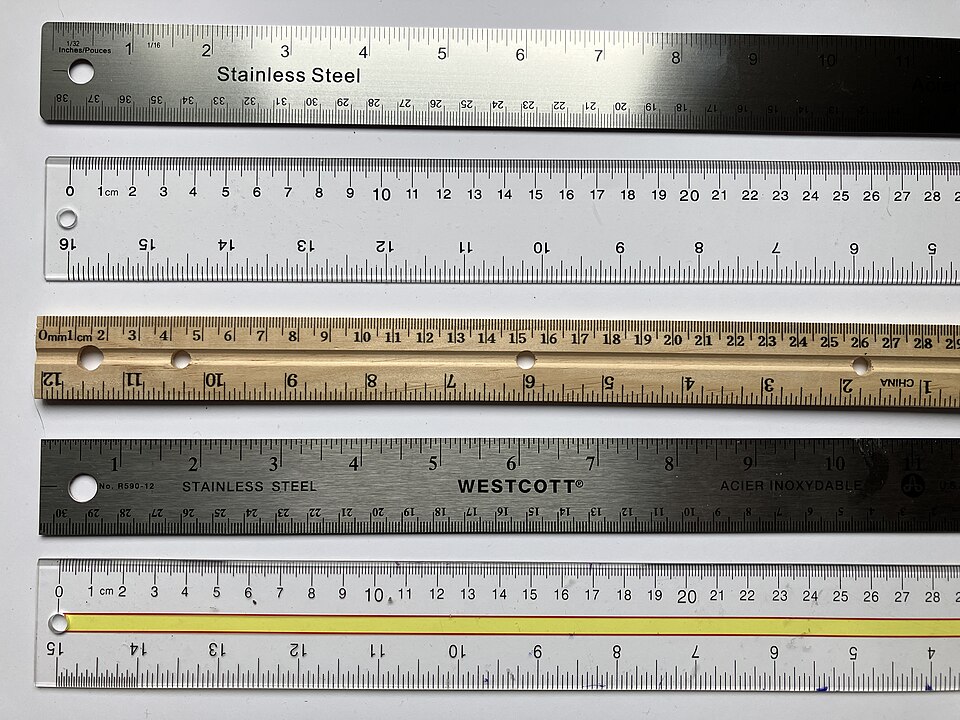
The least count of a measuring instrument is the smallest change it can resolve - 1 mm for an ordinary metre scale. A measurement should be recorded to that resolution and no finer, and the digit. A reading quoted more finely than the least count claims a precision the instrument does not have.
Convert every option to the same unit (millimetres) and compare its smallest place value with the 1 mm least count. The reading whose finest place value equals 1 mm - 0.925 m, or 925 mm - is the correctly precise one.
Key facts
- Least count is the smallest division an instrument can measure; for a metre scale it is 1 mm.
- A reading should be quoted only to the least-count place - here, to the nearest millimetre.
- 0.925 m equals 925 mm (stated to 1 mm); 29.07 cm implies 0.1 mm; 0.50 mm implies 0.01 mm.
- Quoting a value finer than the least count falsely overstates the precision of a measurement.
Study next
Common traps
- Reading a value written to more decimals as 'more precise' even when the instrument cannot resolve that fine.
- Ignoring the meaning of trailing zeros, which can signal a coarser precision.
Asked by giving several readings and an instrument's least count and asking which is correctly (or most) precise.
Related PYQs
No directly related past PYQ was found.
Practice
- practice — not a real PYQ
The least count of an ordinary metre scale is
- (a)1 cm
- (b)1 mm
- (c)0.1 mm
- (d)0.01 mm
Answer(b) 1 mm - the smallest division of a metre scale. - practice — not a real PYQ
A length is recorded as 2.50 cm. The number of significant figures in it is
- (a)2
- (b)3
- (c)4
- (d)1
Answer(b) 3 - the digits 2, 5 and 0 are all significant.