
Given below are the four cases in which certain heat transfer is taking place: 1. Ice is melting in a glass full of water 2. Water is boiling in an open container 3. A metal rod is heated in a furnace 4. A cup of coffee is allowed to cool on a table In which of the above cases, the Newton's Law of Cooling is applicable?
- (a)1 only
- (b)4 only
- (c)1 and 4 only
- (d)1, 2 and 3
Answer
Why
Correct — B, 4 only. Newton's law of cooling states that the rate at which a warm body loses heat is proportional to the temperature difference between the body and its surroundings, and it describes a body that is cooling down. Only the cup of coffee left on the table (case 4) is a hot object losing heat to cooler surroundings, so the law applies to it alone.
Why the others are wrong
- (a)1 only — Ice melting in a glass of water is a phase change happening at a constant temperature (0 degrees C). No body is cooling toward the surrounding temperature, so Newton's law of cooling does not describe it.
- (c)1 and 4 only — Case 4 is right, but case 1 (ice melting) is a constant-temperature phase change rather than a cooling body, so including it is wrong.
- (d)1, 2 and 3 — All three fail: melting ice (1) and boiling water (2) are constant-temperature phase changes, and a rod heated in a furnace (3) is gaining heat, not cooling.
Concept
Newton's law of cooling says the rate of heat loss of a body is directly proportional to the difference between the body's temperature and that of its surroundings, and it applies to a body that is cooling. It holds best when this temperature difference is small and the surroundings stay at a steady temperature.
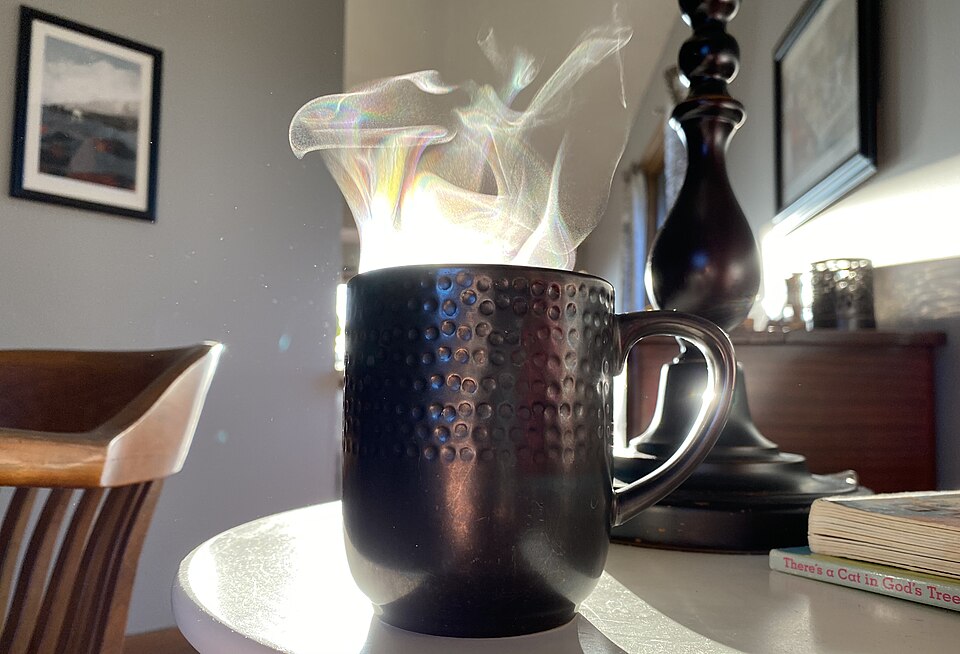
Screen each case for two conditions: is the body cooling, and is its temperature actually falling? Ice melting and water boiling both happen at a fixed temperature (latent heat is exchanged with no temperature change), and a rod in a furnace is being heated, not cooled. Only the coffee cup is a hot body losing heat and dropping in temperature toward the room.
Key facts
- Newton's law of cooling: rate of heat loss is proportional to (body temperature minus surroundings temperature).
- It applies to a body that is cooling, and works best for a small temperature difference.
- Melting ice and boiling water occur at constant temperature (latent heat / phase change), so the law does not apply.
- A rod heated in a furnace is gaining heat, not cooling, so it is outside the law's scope.
Study next
Common traps
- Including the phase-change cases (melting ice, boiling water), which happen at constant temperature.
- Confusing a body being heated (rod in furnace) with a body cooling down.
Asked as 'in which case does Newton's law of cooling apply?' or as a statement-check on when it is valid.
Related PYQs
No directly related past PYQ was found.
Practice
- practice — not a real PYQ
Newton's law of cooling is most accurate when the temperature difference between the body and its surroundings is:
- (a)very large
- (b)small
- (c)zero
- (d)negative
Answer(b) small — the law is a good approximation only for small temperature differences. - practice — not a real PYQ
According to Newton's law of cooling, the rate of cooling of a hot body is proportional to:
- (a)the body's own temperature
- (b)the temperature of the surroundings
- (c)the temperature difference between the body and its surroundings
- (d)the time elapsed
Answer(c) the temperature difference between the body and its surroundings.