 View answer copy →
Raghav JhunjhunwalaRank 4CSE 2025
Answered a very similar question
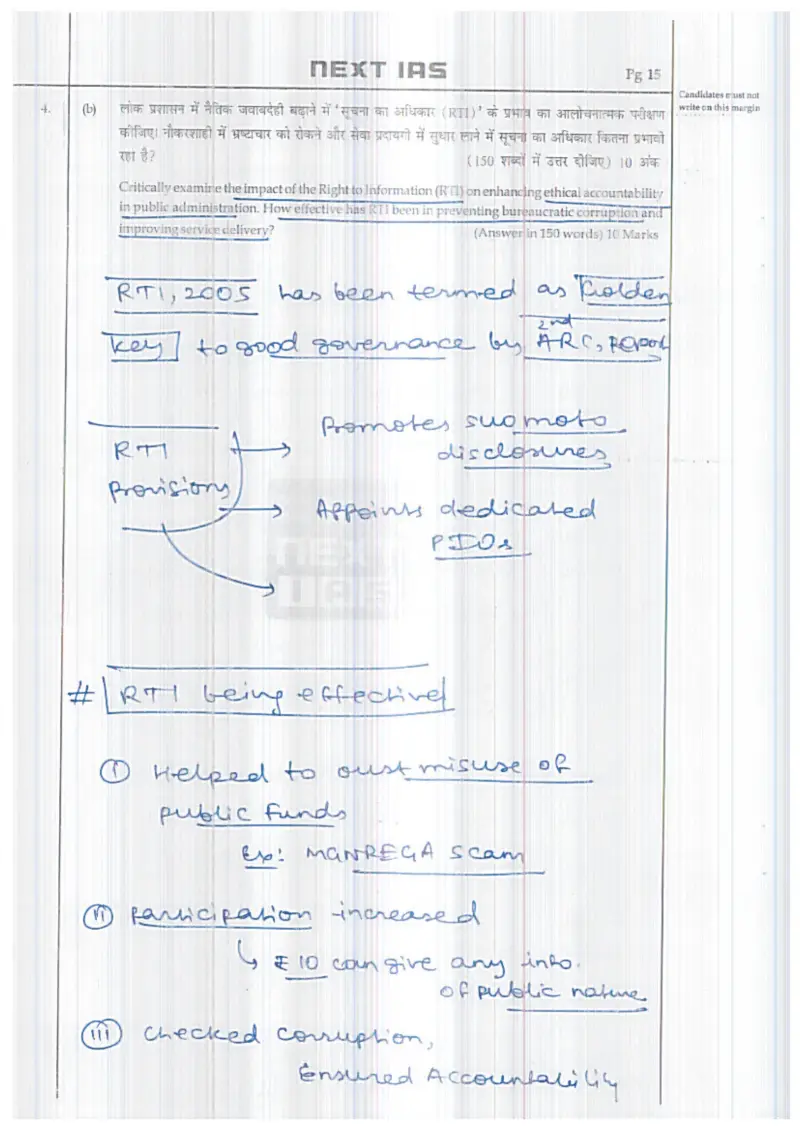
Their question: “RTI 2005 and ethical accountability / curbing bureaucratic corruption”
Backs the RTI-as-accountability argument with the 2nd ARC's 'RTI = golden key to good governance' line and current hooks (MGNREGA scam, 80% PMO requests withheld, 2019 amendment dilution), exactly the governance-literate content the 2018 'RTI redefines accountability' question wants.
Key learnings from their answer
- ›Theory answers are anchored in citable law and reports, not vague principle - Art. 47 (Right to Health), Art. 48A, MC Mehta v. UOI, Conduct Rules 1961, Companies Act 2013, and the 2nd ARC's 'RTI = golden key to good governance' - and on the RTI question (Q4b) he layers current hooks like the MGNREGA scam, '80% PMO requests withheld' and the 2019 amendment dilution -> Even in Ethics, back claims with specific articles, cases, conduct rules and ARC lines; it converts a moral essay into a governance-literate answer.
- ›Strong constitutional and administrative anchoring: Art. 47, Art. 48A, MC Mehta v. UOI, Conduct Rules 1961, Companies Act 2013, 2nd ARC.
What they cited: RTI 2005 + MGNREGA scam, '80% PMO requests withheld', 2019 amendment dilution; 'Data is the new oil, information is the new currency'