
 View answer copy →
Puru DubeyRank 86CSE 2025
Answered a very similar question
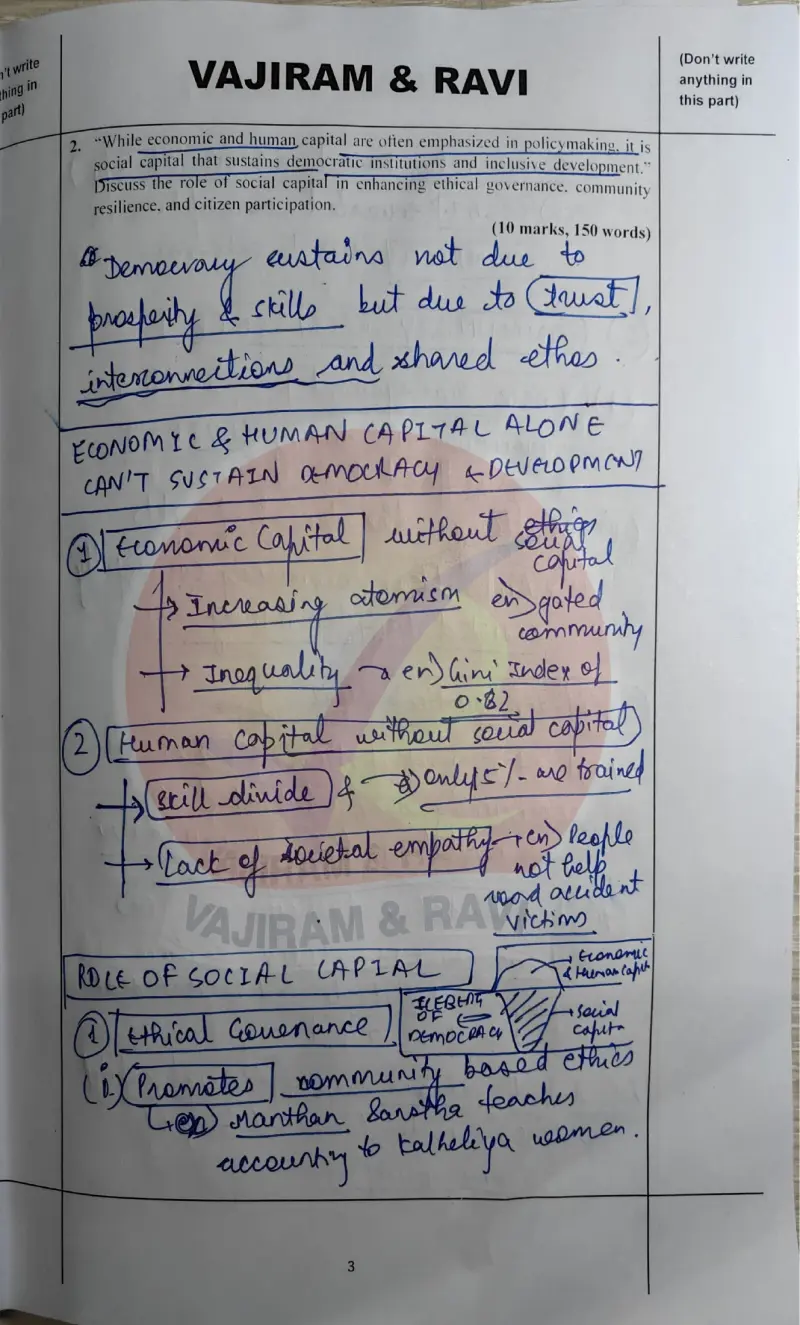
Their question: “Social capital in ethical governance, community resilience & citizen participation”
Defines social capital via Putnam and proves through named cases (SSAAT, COVID langars, Kozhikode drive) how it enhances good governance, precisely the 2023 Q9 demand.
Key learnings from their answer
- ›He closed the biotech/bioethics answer (Q1) by invoking Gandhi's 'science without humanity' from the seven social sins, and led the social-capital answer (Q2) with Putnam's 'social capital is the sum total moral fibre of any society' plus a Venn diagram (economic + human + social capital) -> bookend technical/governance answers with a thinker's line that names the underlying ethical principle, so a factual answer is framed by an ethical anchor at intro or conclusion.
- ›Almost every body point is welded to a specific, named, current instance rather than a generic claim: SSAAT exposing MGNREGA corruption (Q2), IMA vs UOI on the right to health plus Articles 25/26/30 (Q6), the Meghalaya social audit that surfaced pension gaps and absentee teachers (Q10), and the L&T CEO 70-hour-week remark alongside the EY young-employee suicide case (Q9) -> for each argument, attach one precise, recent, named example (a scheme, court case, official, or news event), concrete instances are what make an ethics point look informed rather than rehearsed.
What they cited: Gini index 0.82; only 5% of workforce trained; SSAAT exposing MGNREGA corruption; Sikh gurudwara langars in COVID-19; Parsi community in ECI 'Chunav ka Parv'; 'Malinya Muktham Nava Keralam' (Kozhikode 75% door-to-door collection) (Q2)
Quotes used: “Robert Putnam — 'social capital is the sum total moral fibre of any society' (Q2)”