
 View answer copy →
VikasRank 27CSE 2025
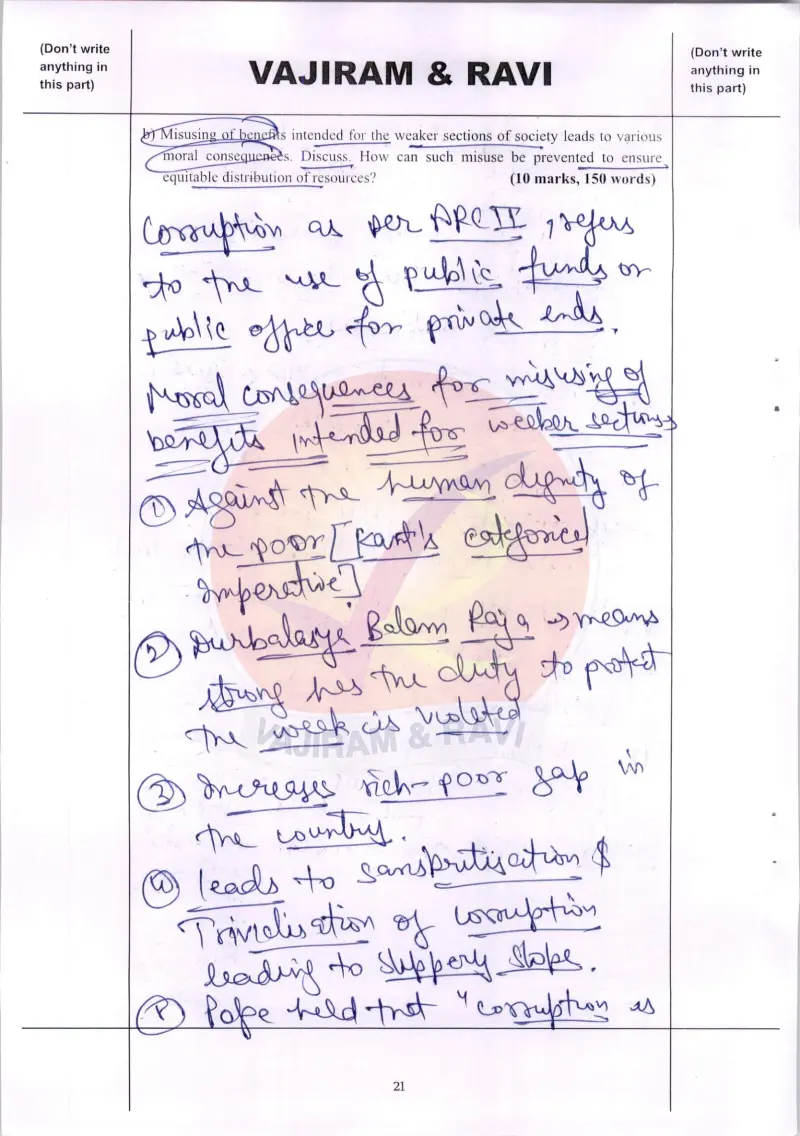
Answered a very similar question
Their question: “Misuse of welfare benefits for weaker sections — moral consequences & prevention”
2019_Q9 asks to examine under-utilisation and mis-utilisation of public funds and their implications, the topper's welfare-leakage answer (DBT, Aadhaar-enabled MGNREGA payments, social audit) gives both the diagnosis and the preventive measures.
Key learnings from their answer
- ›His administrative-ethics vocabulary is precise and loaded: in the climate answer alone he deploys CBDR, Polluter Pays, Just Transition, New Collective Quantified Goal, India's ~2.6 tonnes per-capita figure and the Brandt Line; the welfare-corruption answer cites the ARC-II definition, Kant's Categorical Imperative, DBT, Meghalaya's social-audit law and Nishkam Karma -> Build a per-topic terminology kit (the exact frameworks, one statistic, one Indian-thinker concept) so each answer reads like an informed practitioner's, not a layperson's, specificity of vocabulary is itself a scoring signal.
What they cited: Corruption/welfare: ARC-II definition, Kant's Categorical Imperative, Direct Benefit Transfer, MGNREGA Aadhaar-enabled payments, social audit & Meghalaya's social audit law, Article 21/POSH Act, Gita's Nishkam Karma, constitutional morality