
 View answer copy →
Shruti SharmaAIR 1CSE 2021scored 4.5/10
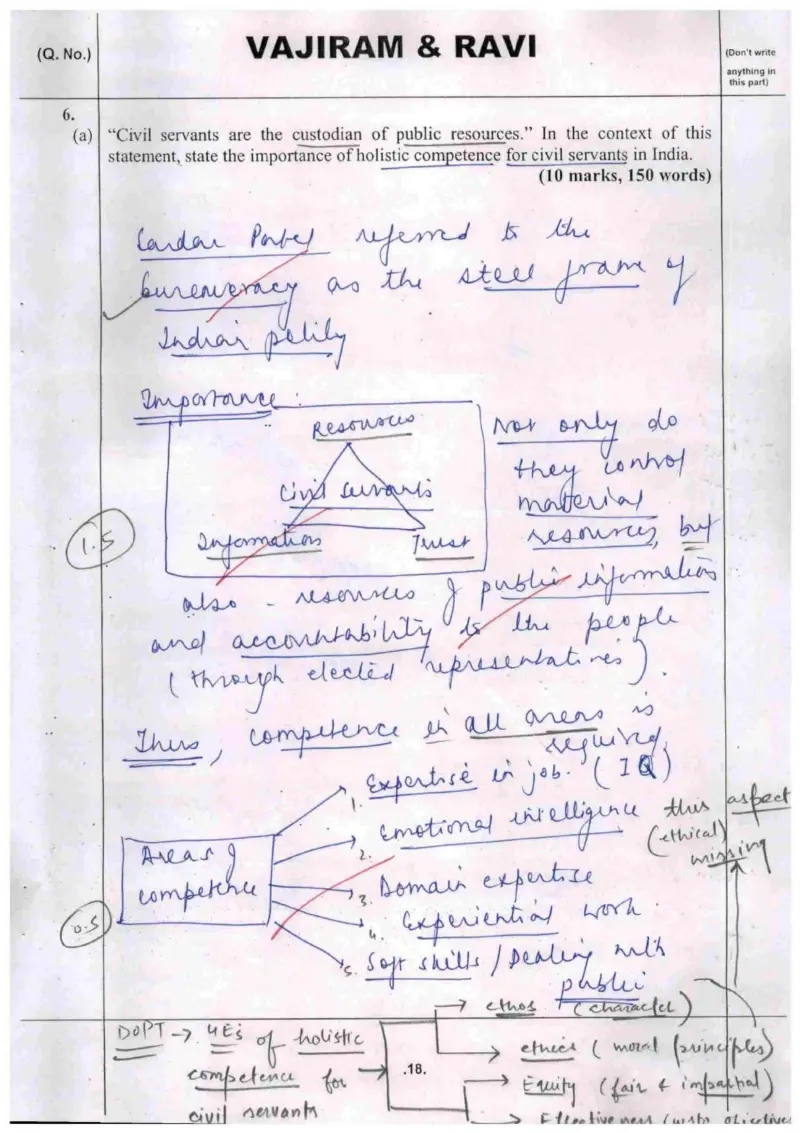
Answered a very similar question
Their question: “Civil servants as custodians of public resources — importance of holistic competence”
Her answer on civil servants as custodians of public resources needing holistic competence (steel-frame anchor, DoPT 4 E's, Mission Karmayogi) directly serves 2014 Q8 on the heavy ethical responsibility of those who handle public funds and how to build ethical competence.
Key learnings from their answer
- ›Every answer opens with a deliberate 'anchor' in a short underlined intro, a quote, a constitutional article, or a named personality (e.g. Sardar Patel's 'steel frame' for Q6(a), Article 15 for Q5(a), Marcus Aurelius for Q5(b)), and this consistency earned 'Very Good' on Language & Articulation. Lesson: build one repeatable opening template (quote/article/personality + underlined sub-headings like 'Importance', 'Society of justice') so every answer reads structured under time pressure.
- ›For environmental ethics Q2(a) she did not stop at one example, she stacked grassroots, named, verifiable cases: the 'pipal' tree worshipped since Harappan times, Telangana's Yadadri Tree Model, Padma Shri Tulasi Gowda, the Assam 'elephant doctor', and the Idu Mishmi tribe treating tigers as kin; the evaluator's note 'good articulation with examples' is the payoff. Lesson: in Ethics, convert every abstract value into a cluster of specific named real-world instances (people, schemes, tribes) rather than generic statements, that density is what drew the 'Very Good' on Conceptual Clarity & Content.
What they cited: Q6(a): Sardar Patel calling the bureaucracy the 'steel frame'; RTI Act (evidence-based policy); DoPT's 4 E's of holistic competence (Ethos, Ethics, Equity, Effectiveness); 2nd ARC recommendations; 360-degree performance management; Mission Karmayogi