View answer copy →
Aayushi BansalAIR 7CSE 2024
Answered a very similar question
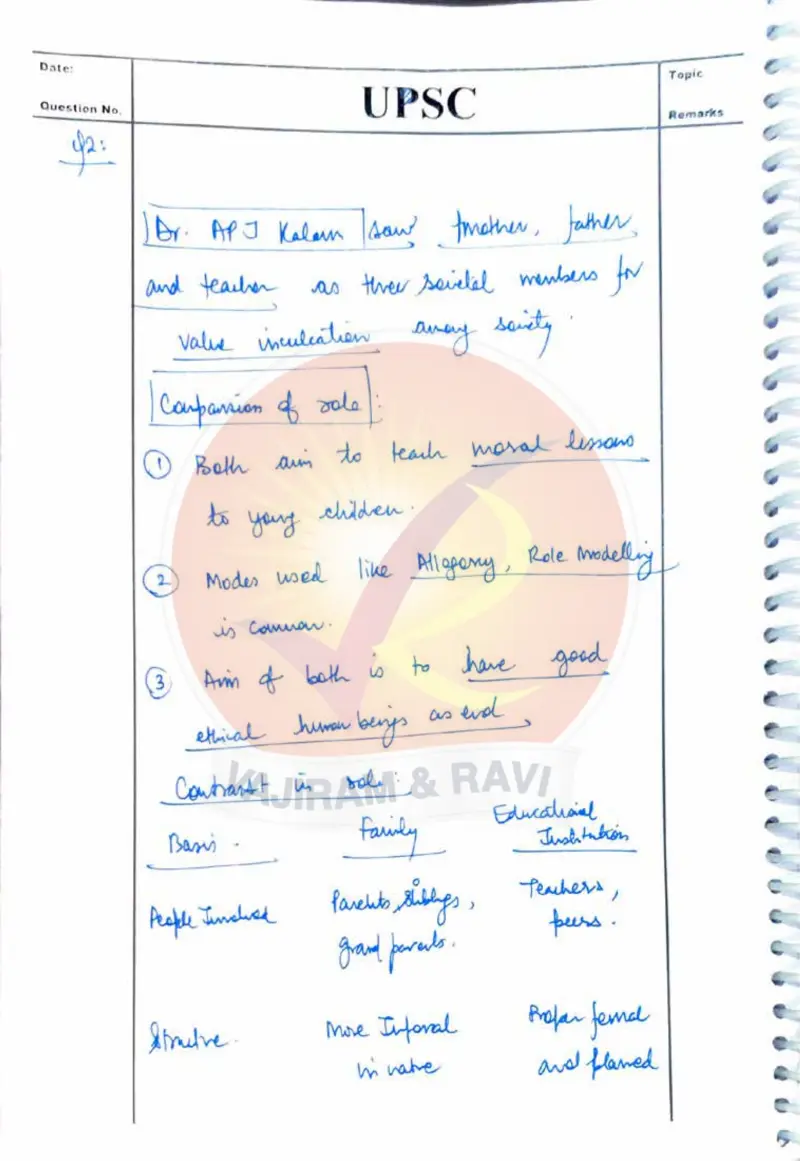
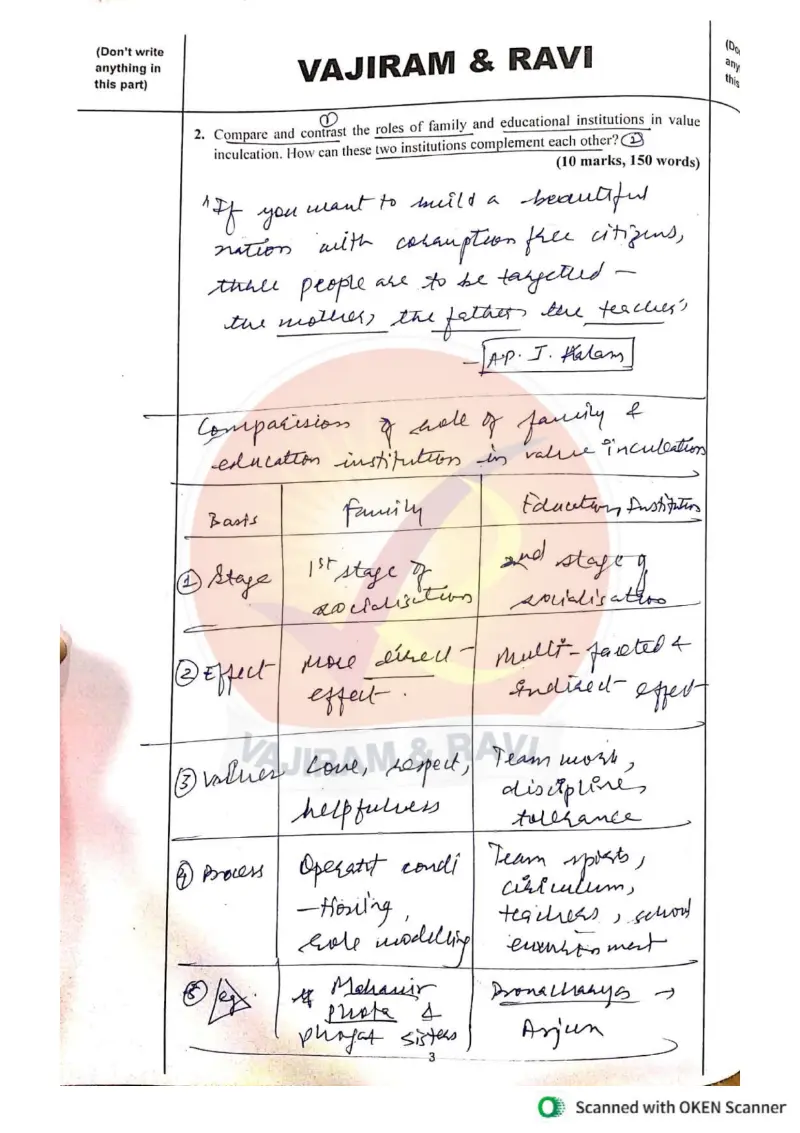
Their question: “Compare/contrast roles of family vs educational institutions in value inculcation; how they complement each other”
The Kalam PYQ turns on the roles of parents (family) and teacher (education) in building a corruption-free citizenry; Aayushi's family-vs-educational-institution answer, with Jijabai and Anne Sullivan, supplies exactly that content.
Key learnings from their answer
- ›She pairs almost every abstract ethics point with a precise, named example rather than a vague reference, e.g. Anne Sullivan mentoring Helen Keller and Jijabai teaching values to Shivaji for value-inculcation (Q2), Copernicus defending heliocentrism and Vidyasagar's widow-remarriage campaign for courage-under-controversy (Q6b/6c), and Baba Amte empathising with leprosy patients for empathy (Q7). Lesson: build a stocked, named example bank so each ethical claim lands on a concrete person/event instead of a generic platitude.
- ›She structures every compare/contrast question as a two-column table, Family vs Educational institution (Q2), Impartiality vs Neutrality (Q10), character in private vs public life (Q4). Lesson: when a question literally asks you to compare/contrast or distinguish, a two-column table is the fastest way to make the contrast unmissable to an examiner skimming the page.
What they cited: Jijabai teaching values to Shivaji; Aristotle tutoring Alexander; Gokhale as role-model teacher for Gandhi (Q2) · Anne Sullivan as mentor/teacher to Helen Keller (Q2) · Deshbhakti curriculum in Delhi schools (Q2)